The expansion of infrastructure is creating significant opportunities for major cities along new connectivity corridors, shifting capital away from Ho Chi Minh City’s core to areas with larger land reserves and more reasonable development costs. During this market stabilization phase, cities linked to the Ring Road – Expressway network are emerging as prominent investment hubs for the 2025–2035 cycle.
Accelerated Ring Road – Expressway Infrastructure Ushers in a New Urbanization Era
The robust development of inter-regional infrastructure is playing a pivotal role in reshaping Ho Chi Minh City’s urban spatial strategy. According to the Ho Chi Minh City Institute for Development Studies, planning models centered on Ring Road – Expressway networks have helped Asian metropolises like Seoul, Shanghai, and Bangkok alleviate pressure on their central areas while fostering efficient satellite urban networks. Ho Chi Minh City is following suit, with Ring Road 3 and Ring Road 4 accelerating their deployment.
Spanning over 76 km, Ring Road 3 connects Ho Chi Minh City, Dong Nai, Binh Duong, and Long An, serving as the new backbone of the regional transportation system. Once completed, it will significantly reduce travel times between the East, West, South, and North growth poles, easing congestion on overburdened radial routes. The Long An and Northwest Ho Chi Minh City sections are currently 87% complete, targeting full operation by March 2026.
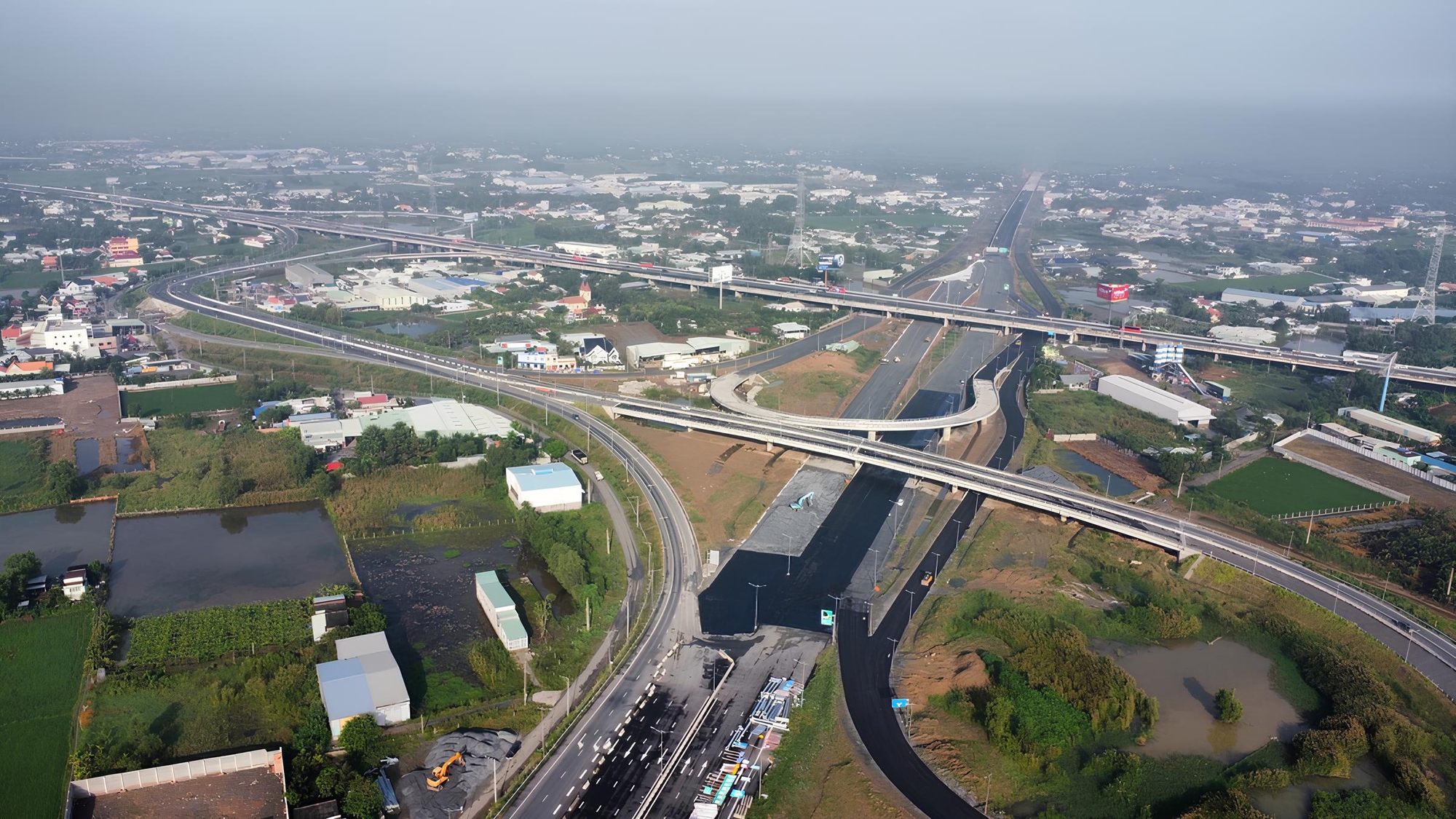
Ho Chi Minh City’s Ring Road 3 through Tay Ninh Province is 87% complete, with full operation expected by March 2026.
Meanwhile, Ring Road 4, stretching 207 km across five key provinces, connects the Cai Mep – Thi Vai international seaport complex, Can Gio Port, major industrial-logistics zones, and the Southern airport network. When synchronized with expressways like Ho Chi Minh City – Long Thanh – Dau Giay, Ho Chi Minh City – Trung Luong – My Thuan, the North-South Expressway, and future metro lines, the expanded Ho Chi Minh City region will establish a multi-layered transportation network, laying the groundwork for large-scale urban development.
This context opens a new investment cycle for the real estate market. Areas at the intersection of key infrastructure, particularly Duc Hoa and Tay Ninh (formerly Long An), are emerging as prime investment destinations due to their strong connectivity and abundant developable land.
Capital Shift: Megacities Flock to Ring Road – Expressway Corridors
The infrastructure boom is reshaping the strategies of major developers. Instead of expanding within Ho Chi Minh City’s constrained and costly core, real estate conglomerates are pivoting toward the Ring Road 3 – Ring Road 4 – Expressway corridors, leveraging their extensive land banks, reasonable costs, and potential for integrated megacities.
The Tay Ninh (Long An) and West Saigon areas are witnessing large-scale projects like Vinhomes Hau Nghia (linked to Ring Road 4), Nam Long Group’s WaterPoint (connecting Ring Road 3 and Trung Luong Expressway), Ecopark Long An (near Ring Road 3 and Trung Luong Expressway), and An Gia’s WestGate Binh Chanh at the Trung Luong Expressway – National Highway 1A intersection. These projects benefit directly from the migration of residents, professionals, and businesses seeking more spacious living environments, comprehensive amenities, and cost-effective solutions.
Among these, The Win City by Thang Loi Group is becoming a new focal point in West Saigon’s investment landscape. Strategically located at the “infrastructure triangle” of Ring Road 3, Ring Road 4, and the Ho Chi Minh City – Trung Luong Expressway, it is just a 5-minute drive from the Ring Road 3 – Tran Van Giau (Provincial Road 10) interchange. Upon infrastructure completion, residents can reach Binh Duong in 30 minutes, Long Thanh Airport in 45–60 minutes, and Vung Tau in approximately 90 minutes.
Spanning 13.1 hectares, The Win City comprises 18 blocks with nearly 6,000 apartments, designed as a One Stop Living Hub integrating over 100 amenities, including the Win Mark commercial complex, Win Edu K-12 School, Win Mec International Clinic, parks, pools, sports facilities, and retail spaces. Priced from VND 30.5 million/m², the project offers flexible payment plans starting at VND 150 million, supported by 8 banks with preferential interest rates and 36-month principal grace periods, making homeownership more accessible amid rising prices.

The Win City is designed as a One Stop Living Hub, offering a comprehensive lifestyle for young professionals and families.
The project’s quality is assured by leading industry brands: Central Group (Vietnam’s top construction contractor), An Cuong (a leading wood materials and interior solutions provider), CBRE (operations management consultant), and other strong partners. Notably, An Cuong and Central Group are not only main contractors but also co-investors, ensuring timely delivery, superior quality, and long-term durability.
With its strategic location, direct benefits from regional infrastructure, and well-planned amenities, The Win City is poised to become a new urban symbol at West Saigon’s gateway, driving population decentralization and fostering next-generation satellite cities during the 2025–2035 development phase.
Geleximco Faces Challenges in Four Major Projects in Da Nang

Geleximco Group has announced the progress of four major projects in Da Nang, showcasing their commitment to significant developments in the region.
Wholesale Market Prices for Vegetables and Fruits Begin to Drop

Fresh produce is flooding wholesale markets, driving prices down significantly. Some vegetables are now available for less than 10,000 VND per kilogram.
Which Major Businesses Are Set to Relocate from Hanoi’s City Center?
In the coming years, several key industrial facilities will be relocated from Hanoi’s inner city. These include the Hanoi Beer Factory, Thang Long Tobacco Company, Gia Lam Railway Factory, and the Vietnam Institute of Industrial Chemistry.
Accelerating Construction of Hai Phong’s Ring Road 2
The construction units of Hai Phong’s Ring Road 2 project have mobilized hundreds of workers, along with essential equipment and materials, to accelerate the construction of Hai Thanh Bridge and its connecting roads, a key component of this critical infrastructure initiative.
Billion-Dollar Cable-Stayed Bridge Connects to Future “Gold Mine” in Vietnam’s Wealthiest City
Vietnam’s wealthiest city has tasked the Department of Construction with urgently compiling and finalizing the dossiers for two investment proposals for a new bridge project.