According to an announcement, Vietnam Airlines (VNA) will start offering Pizza 4P’s on select flights beginning December 1, 2025. Passengers can pre-order this service at least 24 hours in advance. The price listed on the airline’s booking management section is 119,000 VND for a half pizza, inclusive of taxes and fees.
This meal option is available for domestic flights departing from Hanoi and Ho Chi Minh City with a flight time of 1 hour or more, as well as international flights from these cities with a flight time of 1 hour 30 minutes or more.
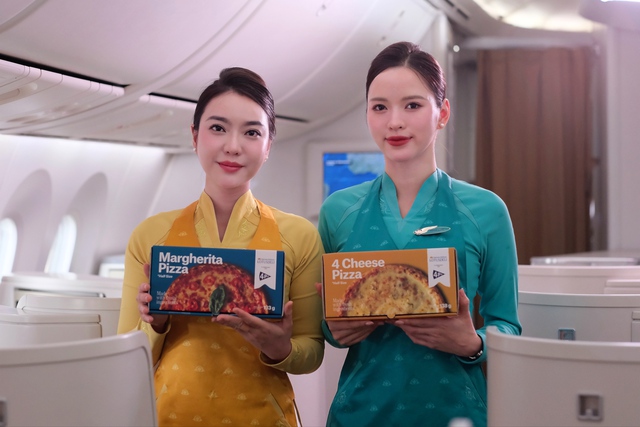
Two signature options from 4P’s, Pizza Margherita and Pizza 4 Cheese, will be available onboard. Passengers can pre-order these meals through Vietnam Airlines’ website or app as part of the airline’s new service model.
In addition to Pizza 4P’s, passengers can also pre-order Lotusdeli bubble tea products via Vietnam Airlines’ pre-order meal service.
Previously, at the 2025 Annual General Meeting of Shareholders held on June 25, Vietnam Airlines Chairman Dang Ngoc Hoa stated that ancillary revenue currently accounts for approximately 5% of the airline’s total revenue, equivalent to roughly 3.8 trillion VND in 2024.
“While it’s called ancillary revenue, it’s quite significant,” the Chairman remarked.
Mr. Hoa emphasized that this is a crucial revenue stream for the corporation and set a target to increase its share to 9-10% by 2030, aligning with the global aviation industry average and matching cargo transport revenue.
To achieve this goal, Vietnam Airlines has implemented various solutions and plans. The company’s leadership mentioned that they are introducing new products and services alongside existing ones to enhance passenger choices and encourage in-flight purchases. For current products and services, Vietnam Airlines aims to improve quality and appeal to customers.
Vietnam Airlines Completes Software Update Across Entire Airbus A320 and A321 Fleet
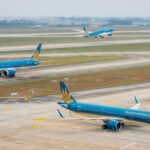
Vietnam Airlines has successfully completed the software update for its entire fleet of Airbus A320 and A321 aircraft, finishing well ahead of the deadline at 6:59 PM on November 30, Vietnam local time.
Vietnam Airlines Deputy Planning Director: We Do Not Squeeze Out Private Enterprises

Vietnam Airlines is strategically focusing on two key customer segments. The first targets those seeking a full-service experience, while the second maintains its dual-brand approach by operating a low-cost carrier (LCC) to cater to budget-conscious travelers who may not afford full-service options.
State-Owned Enterprises Advocate for ‘Special Mechanisms’ to Lead and Pioneer

State-owned enterprises such as Vietnam Airlines and Mobifone have proposed the implementation of tailored, flexible, and specialized mechanisms for investment approval. These measures aim to empower these companies to fulfill their role as leading, pioneering entities across various sectors.
Dividend Highlights Week 17-21/11: Three Companies Announce Massive Dividend Payouts
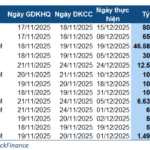
During the week of November 17–21, 2025, 13 companies will finalize dividend payouts in cash. The highest payout ratio stands at 80%, meaning shareholders will receive 8,000 VND per share.