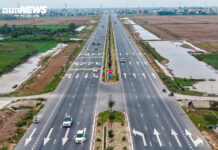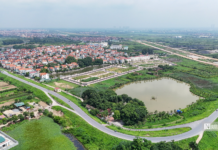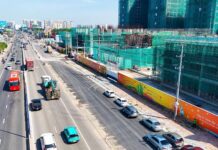







On November 27, 2025, the People’s Committee of Hanoi issued a decision to terminate the full effect of all documents and directives from the former Ha Tay Province’s People’s Committee (now part of Hanoi) related to the assignment of Posco E&C to develop the detailed planning and investment project for the Ngoc Liep – Dong Truc Urban Area (Zone 9) in Kieu Phu Commune, Hanoi. Previously, this area was part of Quoc Oai and Thach That Districts.
The termination is due to Posco E&C’s failure to complete the required investment procedures as stipulated by the laws on investment and new urban areas since the issuance of Document 5450/UBND-NV on December 31, 2007, and Decision 2278/QD-UBND on July 10, 2008. The project does not qualify for transitional provisions under the 2020 Investment Law and Decree 31/2021/ND-CP.
Decision 2278/QD-UBND of the former Ha Tay Province’s People’s Committee no longer aligns with current legal regulations on urban planning.
The Hanoi People’s Committee has tasked the Department of Planning and Architecture, the Department of Agriculture and Environment, the People’s Committee of Kieu Phu Commune, and relevant agencies with state management responsibilities for the proposed project area (following the termination of the aforementioned documents). These responsibilities are to be carried out in accordance with their assigned functions and current legal provisions.
The Department of Finance is instructed to inform Posco E&C about Hanoi’s investment priorities and guide the company on current investment procedures should they express interest in investing in projects within Hanoi.
The Ngoc Liep – Dong Truc Urban Area (Zone 9) spans 272 hectares, with a total investment value of 1.25 trillion VND as of 2009. The project was envisioned as an eco-urban area within the administrative boundaries of Quoc Oai and Thach That Districts, with Posco Engineering & Construction Co., Ltd. as the lead investor in planning.
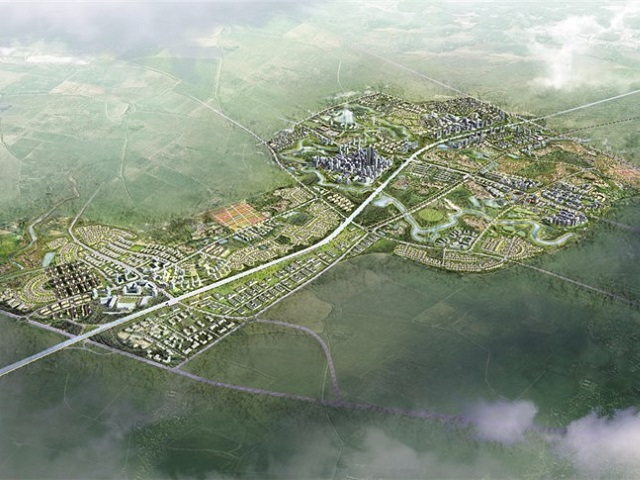
The project’s detailed construction plan at a scale of 1:2000 was approved by the former Ha Tay Province’s People’s Committee in Decision 437/QD-UBND on February 29, 2008, covering approximately 2,353 hectares. However, following the integration of Ha Tay into Hanoi and the subsequent issuance of Hanoi’s master plan, the Prime Minister and Hanoi People’s Committee ordered a halt to project implementation for review. Significant changes were made to the area’s boundaries, reducing the Ngoc Liep – Dong Truc Urban Area from over 2,300 hectares to around 700 hectares. The portion in Dong Truc Commune was excluded due to its location within the green belt, while the remaining area in Ngoc Liep Commune was designated for eco-urban development.
Posco E&C has been involved in numerous industrial, civil, and urban construction projects in Vietnam since the early 1990s, including the Diamond Plaza shopping center, the Posilama steel plant, the Formosa Ha Tinh Steel Complex, and 80 kilometers of the Noi Bai – Lao Cai Expressway. In 2008, the An Khanh New Urban Area Development Joint Venture Company (An Khanh JVC) was established with a charter capital of 384 billion VND, as a partnership between Vinaconex (VCG) and Posco E&C (South Korea), each holding 50% of the shares. By 2017, Posco E&C’s stake was acquired by another entity.
– 10:13 03/12/2025
“Lightning-Fast” Tunnel Boring Machine Completes Drilling for Four Underground Stations on the Nhon-Hanoi Metro Line
On December 1st, the TBM No. 1 “Thần Tốc” tunneling machine triumphantly reached its destination at Station S12 – Hà Nội Station, marking the successful completion of its journey through the first four underground stations of Metro Line 3, from Nhổn to Hà Nội Station.
Up-Close Look at the Series of Headquarters Set to Relocate from Hanoi’s Inner City
Hanoi has proposed relocating 51 industrial facilities and 15 government agency headquarters from the inner city, including several major enterprises currently occupying prime real estate locations.
FLC Group Receives Positive News Under Former Chairman Trinh Van Quyet’s Leadership
FLC Premier Parc, a residential project within the urban area of Dai Mo Ward, has been granted permission by the Hanoi Department of Construction to sell units to foreign organizations and individuals. Developed by FLC Group, this condominium project marks a significant milestone in the real estate market.
Skyrocketing Prices: Hanoi’s Social Housing Units Surge to 90 Million VND/m², a Fivefold Increase
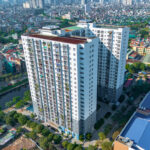
Social housing projects, once a beacon of affordability, are now commanding staggering prices on the secondary market. Just a few years after launch, units are being listed at 80-90 million VND/m², a 4-5 fold increase from their initial prices. This surge brings them on par with high-end condominiums, effectively pricing out the very low-income earners they were intended to serve.
Which Major Businesses Are Set to Relocate from Hanoi’s City Center?
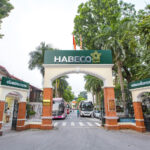
In the coming years, several key industrial facilities will be relocated from Hanoi’s inner city. These include the Hanoi Beer Factory, Thang Long Tobacco Company, Gia Lam Railway Factory, and the Vietnam Institute of Industrial Chemistry.