The Ho Chi Minh City Real Estate Association (HoREA) has submitted feedback to the National Assembly regarding the draft Resolution on mechanisms and policies to address challenges in implementing the Land Law.
In their submission, HoREA Chairman Le Hoang Chau highlights significant discrepancies in the calculation of land use fees and land rent, as applied by some localities, which multiply the land price in the price list by an adjustment factor (K1).
According to Mr. Chau, this formula significantly inflates the financial obligations of businesses compared to the surplus method, which is based on project revenue minus construction costs, management fees, loan interest, and profit.
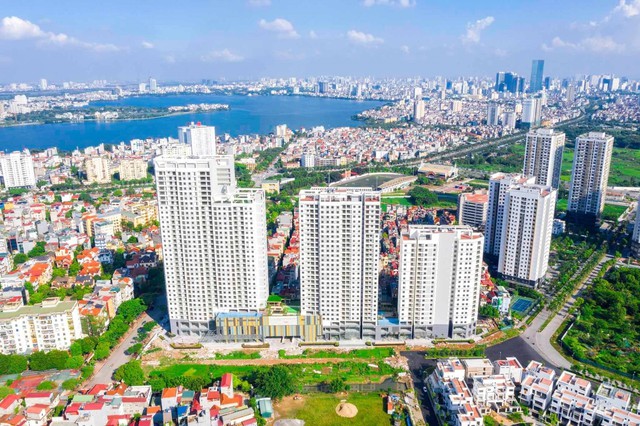
HoREA provides real-world examples to demonstrate the substantial differences between the two methods. For a 1-hectare plot on Nguyen Xien Street (Thu Duc City), the current land price is 56.6 million VND/m², with an adjustment factor of approximately 1.4, resulting in a calculated land price of 80 million VND/m².
However, applying the surplus method to a high-rise apartment project in the same location yields a surplus value of only about 35 million VND/m³, which is 2.28 times lower than the factor-based calculation.
Consequently, to avoid capital loss when paying land use fees under the current method, developers are forced to raise apartment prices above 100 million VND/m².
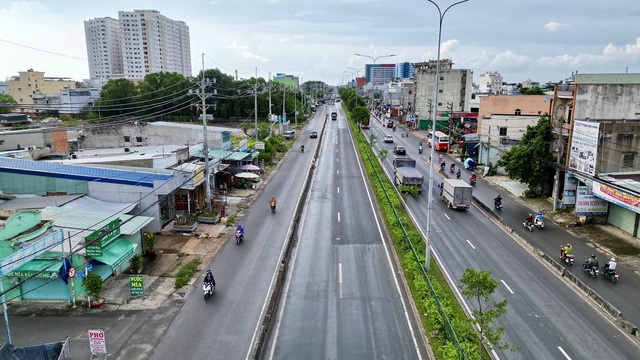
Another case on Dang Cong Binh Street (former Hoc Mon District) shows an even larger disparity. The land price is 18.5 million VND/m², and when multiplied by an adjustment factor of approximately 2, the land price surges to 37 million VND/m². Meanwhile, the surplus method yields only about 9 million VND/m² – six times lower.
This means developers may need to increase apartment prices to over 70 million VND/m² if using the factor-based calculation.
HoREA emphasizes that land valuation for high-rise apartment projects, urban areas, or commercial housing differs significantly from valuing small individual plots or single-family homes.
HoREA also cites the opinion of the Ho Chi Minh City Department of Natural Resources and Environment, which suggests that determining land prices using the formula “land price list multiplied by an adjustment factor” is inappropriate and requires careful study to analyze its economic impacts.
Based on these practical calculations, HoREA argues that applying land prices using the formula of the price list multiplied by an adjustment factor (K1) is unsuitable for large-scale real estate projects with high land use coefficients and complex technical characteristics.
Valuing land for high-rise apartment projects, urban areas, or commercial housing is fundamentally different from valuing small individual plots or single-family homes. The association notes that significant differences in land use scale, land use coefficients, and investment rates among affordable, mid-range, and luxury housing segments make a uniform adjustment factor impractical.
Therefore, HoREA proposes dividing the K factor into three groups: K1 as a general adjustment factor applied from January 1 each year; K2 for compensation calculations when the state reclaim land; and K3 as a specific factor for calculating land use fees and land rent for real estate projects.
According to HoREA, the K3 factor should be determined by the provincial People’s Committee for each project or project group. For example, on Nguyen Xien Street, if K1 is 1.4 but K3 is set at 0.4, the land price would drop from 80 million to 32 million VND/m².
Additionally, HoREA recommends that the Ho Chi Minh City People’s Committee issue specific decisions on land price adjustment factors for project groups of the same type, in the same area, or for large projects with unique characteristics.
“MP Highlights the ‘Most Sensitive Issue’ in Land Reclamation”

When it comes to land reclamation, the focus should not solely be on the compensation rate, but rather on the mechanisms that ensure fairness and transparency. As highlighted by delegate Hà Sỹ Đồng, the key lies in establishing a robust framework for determining compensation prices, fostering open dialogue, implementing effective resettlement schemes, and instituting independent oversight to safeguard the interests of all parties involved.
Lawmaker Proposes Citizens Receive Compensation Difference When Land Acquisition Prices Fall Below Agreed Rates

Every member of the National Assembly unanimously supported the proposal that citizens should receive the difference if the land compensation price is lower than the agreed-upon value.
Unblocking Land-Related Bottlenecks: A Comprehensive Solution

The National Assembly is considering the adoption of a resolution introducing new mechanisms and policies regarding land reclamation and land valuation. These measures aim to address existing challenges and meet the practical demands of the current situation.
Proposed Amendment: Establishing Land Valuation Timelines for BT Project Compensation

On November 29, 2025, the Ho Chi Minh City Real Estate Association (HoREA) submitted an official proposal to the People’s Committee of Ho Chi Minh City regarding the “Draft Resolution of the National Assembly on mechanisms and policies to address challenges and obstacles in the implementation of the Land Law.”
Finance Ministry Responds to Concerns Over High Land Use Fees
The Ministry of Finance has recently issued an official response to voter petitions from Ho Chi Minh City regarding the conversion of agricultural land to residential land use. This document addresses key issues and provides solutions to challenges in calculating land use fees, offering clarity and guidance for those navigating this complex process.