Poised to become a centrally governed city, Bac Ninh province is undergoing a transformative phase, aiming to establish itself as a smart city and a national hub for industry, logistics, and high technology. At the first Party Congress for the 2025–2030 term, the province set an ambitious goal of achieving double-digit growth from 2026 to 2030, focusing on advanced industrial development and the creation of a modern infrastructure ecosystem.
Once Vietnam’s smallest province by area, Bac Ninh now spans over 4,718 km² and boasts a population exceeding 3.6 million following administrative consolidations. This expanded development space, coupled with its strategic location, positions Bac Ninh as a new growth pole in the northern region.
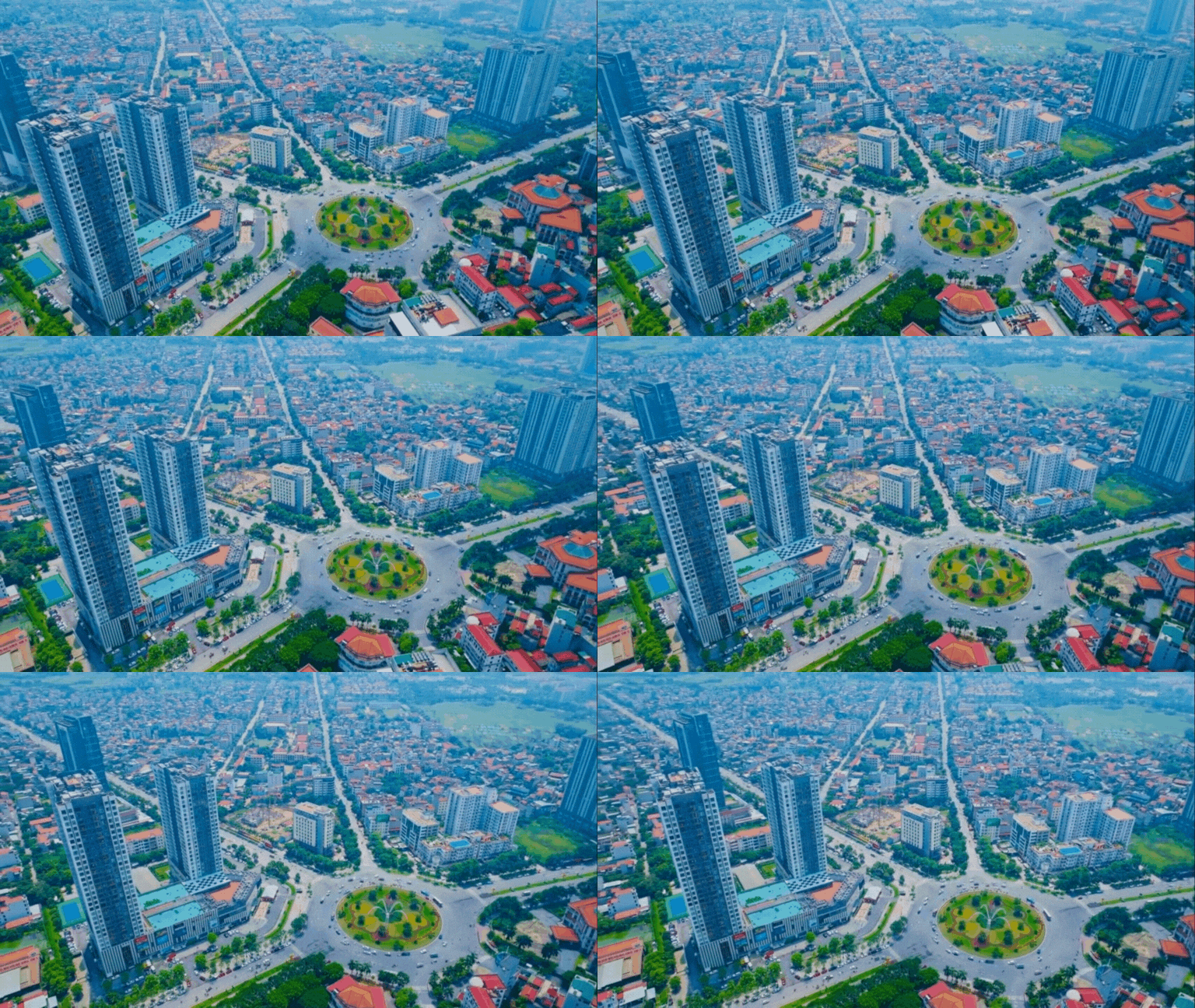
Aerial view of Bac Ninh’s central area
Gia Binh International Airport – A Next-Gen Smart Airport

AI-generated concept of Gia Binh Airport
The Gia Binh International Airport project, spanning nearly 2,000 hectares across Gia Binh, Luong Tai, Nhan Thang, and Lam Thao communes, is just 40 km from Hanoi’s center. Designed as a dual-use civil and defense facility meeting 4E international standards, it will serve as a vital gateway connecting Bac Ninh to major domestic and international economic centers.
Envisioned as a next-generation smart airport, Gia Binh will integrate biometric systems, automated operations, and ESG (Environmental, Social, Governance) compliance. Its terminals will offer premium services to deliver an internationally benchmarked passenger experience.

By 2030, Phase 1 will include two runways, a main terminal, and a VIP terminal, handling 30 million passengers and 1.6 million tons of cargo annually. Post-2030 expansions will add two more runways, increasing capacity to 50 million passengers and 2.5 million tons of cargo per year.
Service quality milestones include: Skytrax 4-star rating by 2029, 5-star by 2032, and ranking among the world’s top 10 most beautiful and passenger-friendly airports by 2037. Total investment exceeds 196 trillion VND, with land clearance costs alone surpassing 29.5 trillion VND.
Huong Son Dry Port: A Strategic Logistics Hub
Bac Ninh has approved plans for the 26.4-hectare Huong Son Dry Port, a critical link in the inter-regional infrastructure network connecting highways, national roads, ring roads, industrial zones in Bac Ninh and Bac Giang, Gia Binh Airport, and the Hai Phong–Quang Ninh seaport complex.
Upon completion, the dry port will alleviate pressure on seaports, reduce storage times, and lower transportation costs—especially for FDI enterprises—while fostering a regional logistics ecosystem.
Together, Gia Binh Airport, Huong Son Dry Port, and the Hai Phong–Quang Ninh seaports will form a three-tiered logistics network: road, air, and sea.
Regional Connectivity Projects Totaling Over 200 Trillion VND
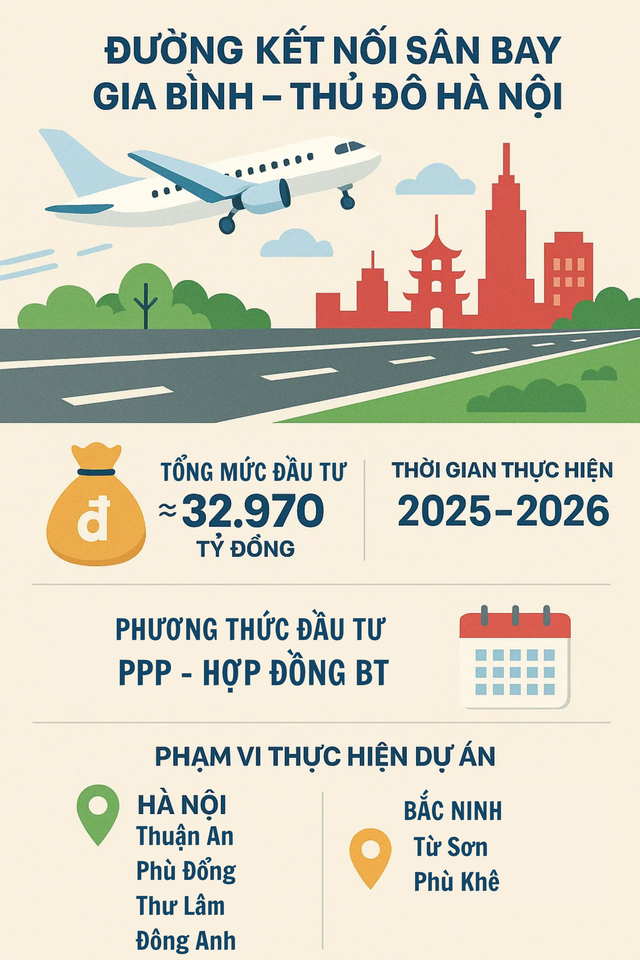
Hanoi’s People’s Council recently approved a PPP-model road linking Gia Binh Airport to Hanoi, with a total investment of 32.97 trillion VND. Construction will take place from 2025 to 2026, utilizing 723.3 hectares of land in Phu Dong and Thuan An. The Bac Ninh section spans 27.7 km.
The 112.8 km Ring Road 4 includes a 35.3 km section through Bac Ninh. The province is responsible for two components: compensation/resettlement and constructing parallel roads. This route is vital for developing the Capital Region and connecting key economic corridors.
The 390.9 km Lao Cai–Hanoi–Hai Phong high-speed railway, with Phase 1 costing over 203 trillion VND, includes a 3.76 km segment through Bac Ninh’s Phu Khe, Tu Son, and Song Lieu wards, featuring Yen Thuong Station. Land clearance in Bac Ninh is estimated at 1.085 trillion VND.
Pre-merger, Bac Ninh was Vietnam’s smallest province. Post-merger, it now spans from robust southern industrial zones to high-potential eastern and northern areas—ideal for next-gen industrial parks, satellite cities, and modern commercial hubs.
Integrated planning, substantial investment, and multi-tiered infrastructure are positioning Bac Ninh as Vietnam’s new industrial, service, and logistics center, driving growth across the Capital Region in the coming years.
Beyond its strategic location and transport network, Bac Ninh remains northern Vietnam’s industrial powerhouse, hosting major tech conglomerates and a stable production-supply network for years.
Expanded boundaries and land resources enable more scientific spatial planning, redistributing industrial zones and urban areas to reduce pressure on overdeveloped areas while fostering new growth poles.
These factors highlight Bac Ninh’s vast potential in infrastructure and real estate, meeting current demands while strategically advancing its goal of becoming a centrally governed city in the near future.
Northern Investors Pour Capital into Ho Chi Minh City: Unlocking Emerging Opportunities
Savvy investors from the North are increasingly funneling capital into Ho Chi Minh City’s rental apartment market, with a sharp focus on the Northeast region. This area, a magnet for a high concentration of professionals, boasts a robust industrial zone network and is on the cusp of completing several key infrastructure projects.
Vietnam Set to Witness Historic Milestone: Nearly 1 Million Trillion VND Transacted in a Single Day in Just 20 Days

On December 19th, a grand inauguration and groundbreaking ceremony will take place for 198 large-scale, significant projects and constructions, marking a special celebration in honor of the 14th National Congress of the Communist Party of Vietnam.
Long Thanh International Airport: The Final Sprint Before Its Maiden Flight

On December 19th, Long Thanh International Airport is set to welcome its inaugural flight. In the lead-up, nearly 14,000 experts, engineers, workers, and laborers, supported by over 3,000 construction machines, have been working tirelessly on-site to accelerate progress.
Completing the Ring Road 2.5 by Q1/2026
The Hanoi People’s Committee has urged local authorities and investors to expedite land clearance and construction to complete the Dam Hong – National Highway 1 section of Ring Road 2.5 by Q1/2026. The project developer submitted an updated progress report as of November 29th.
Billion-Dollar Cable-Stayed Bridge Connects to Future “Gold Mine” in Vietnam’s Wealthiest City
Vietnam’s wealthiest city has tasked the Department of Construction with urgently compiling and finalizing the dossiers for two investment proposals for a new bridge project.