Cross-Ownership and Bank Manipulation: How Does It Work?
Continuing the morning session of the National Assembly on December 3, delegate Nguyễn Thị Việt Nga (Hai Phong) provided feedback on the implementation of resolutions regarding questioning and supervision in the banking sector.
While agreeing with the contents of the bank’s report, Nga also identified several limitations. Notably, the “credit quota” mechanism has been reduced but lacks a clear roadmap for complete elimination. Citing Resolution 62 of the National Assembly, she emphasized the need to study and limit, eventually abolishing the mechanism of allocating credit growth targets to individual credit institutions.
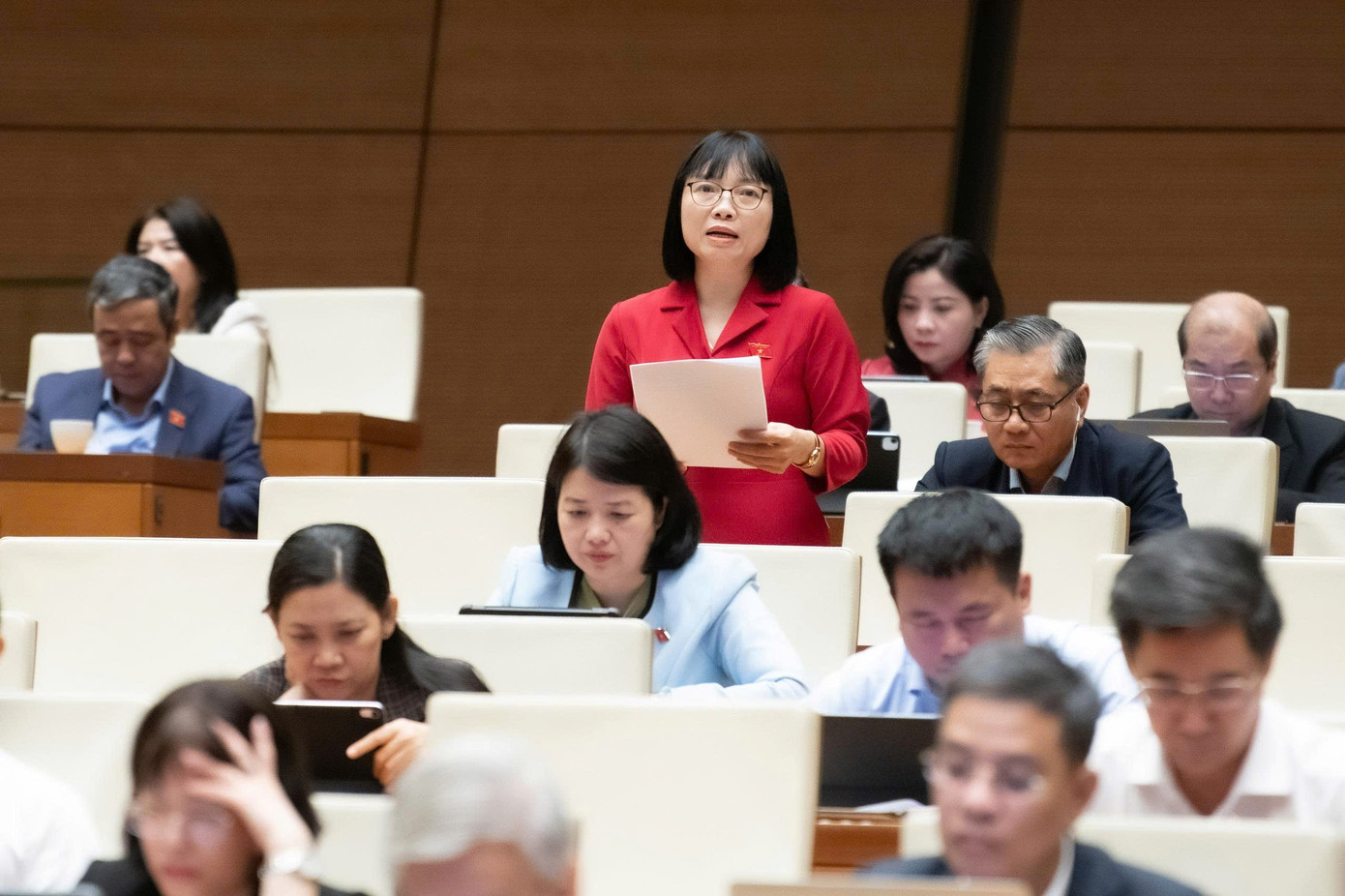
Delegate Nguyễn Thị Việt Nga. Photo: Như Ý
However, in practice, the “credit quota” mechanism persists, with specific targets assigned and adjusted for each credit institution. Nga noted, “The report focuses on describing current practices but fails to outline a clear roadmap for completely abolishing this mechanism. It also does not fully explain why, after many years, the call to ‘phase out quotas’ still lacks a specific timeline and accompanying solutions.”
Regarding the restructuring of weak credit institutions, the Hai Phong delegate stressed that National Assembly resolutions highlight the goal of fundamentally addressing weak credit institutions by 2025, preventing new weak institutions, tightly controlling cross-ownership and backdoor practices, and reducing bad debt to below 3%.
In this context, Nga argued that the report should address critical questions: How many weak credit institutions remain unresolved? What is the current ratio of bad debt and potential bad debt compared to the National Assembly’s target? To what extent has cross-ownership and bank manipulation been effectively addressed?
“These details are not clearly presented in the report. While we see efforts in processes and legal frameworks, the ‘real transformation’ within the credit institution system remains unclear,” Nga observed.
Based on this analysis, the Hai Phong delegate proposed that the State Bank develop and submit to the National Assembly a specific roadmap to gradually reduce and eventually eliminate the administratively allocated credit growth targets.
“Until complete elimination is achieved, credit target allocation should be stable, with mid-year adjustments minimized. Additionally, more credit institutions should be allowed to autonomously manage credit growth within a predefined ‘safety framework,'” she suggested.
How to Reorganize the Gold Market
Another notable issue highlighted by the delegate is the instability of the gold market. According to Nga, the State Bank has taken decisive actions in recent times, including increasing gold supply, auctions, business inspections, and amendments to Decree 24.
At times, the price gap between domestic and international gold has significantly narrowed. However, there have been periods when the price difference surged again, posing risks of speculation and market manipulation.
Nga noted that while the report details the measures taken, it fails to thoroughly analyze the root causes or outline a clear roadmap for reorganizing the gold market post-Decree 24 amendments. This reorganization should aim to reduce monopolies, foster healthy competition, prevent price manipulation, and ensure gold price fluctuations do not disrupt macroeconomic stability, as mandated by the National Assembly.
“Thus, the requirement of Resolution 173/2024 to ‘stabilize the gold market and prevent impacts on monetary stability and system safety’ has only been partially met, with sustainability remaining uncertain,” the Hai Phong delegate remarked.
Following the amendments to Decree 24, Nga urged the State Bank to promptly issue detailed guidelines and publicly announce the roadmap for reorganizing the gold market. This should ensure fair competition, reduce monopolies, and enhance transparency. Additionally, she called for research and reporting to the National Assembly on the feasibility of establishing a centralized gold trading platform with stringent management mechanisms, aligned with international standards.
Deputy Prime Minister Urgently Directs $16 Billion Long Thanh Airport, Ho Chi Minh City Ring Road 3, Hanoi Ring Road 4, and Key Expressway Projects

The Deputy Prime Minister has mandated the timely completion of critical national projects as outlined in the National Assembly’s resolutions. Efforts are underway to expedite progress, aiming for an earlier finish than initially planned.
Gold and Dollar’s 50-Year Cycle Nearing Reversal, 2026 to Mark the New Race, Says TTC Chairman Dang Van Thanh

Mr. Thanh asserts that the gold market lacks the tangible contributions of the capital market. The challenge lies in mobilizing the gold held by the public at a reasonable cost, to integrate it into national reserves.
Deputy Prime Minister: Government Implementing Comprehensive Measures to Control Gold and Real Estate Prices

On October 30th, Deputy Prime Minister Le Thanh Long addressed the National Assembly, providing clarifications on key economic and social issues raised during the discussion session. He elaborated on topics such as economic growth, public investment disbursement, the gold market, real estate, education, and legal framework development for the year 2025 and the 2021-2025 period.
Gold Price Surge Leaves Couples Struggling to Afford Wedding Rings, Says Delegate Nguyen Lam Thanh

Amidst soaring gold prices, members of the National Assembly have voiced significant concerns, urging the government to implement robust and effective regulatory measures to address the issue.
Morning of October 11: Domestic Gold Prices Continue to Rise
Opening today’s trading session, several gold retailers continued to adjust their prices upward for gold rings and gold bars, with the highest increase reaching 600,000 VND per tael.