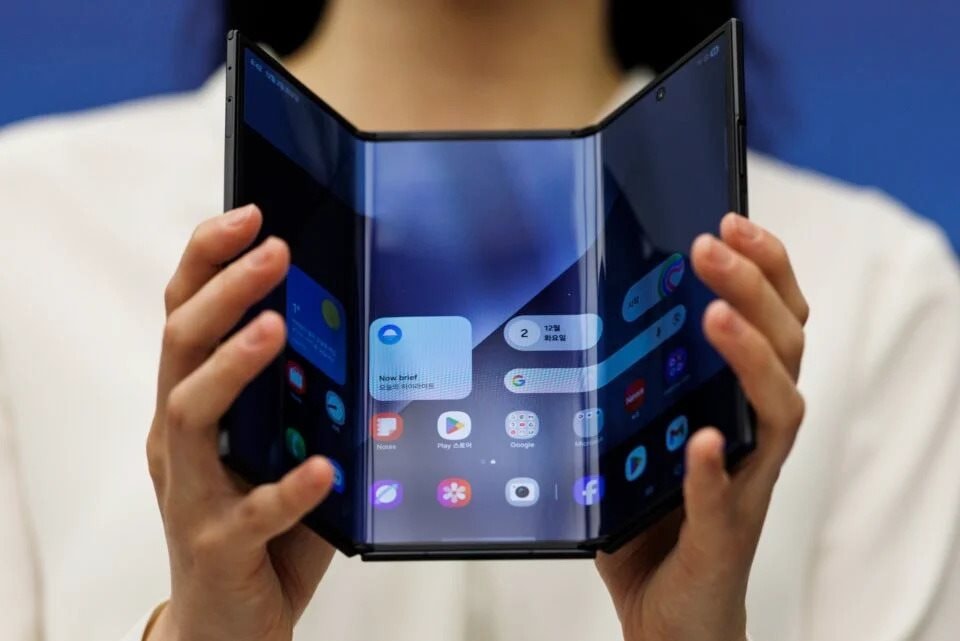
On December 2nd, Samsung unveiled a groundbreaking surprise with the official announcement of the Galaxy Z TriFold – the company’s first-ever triple-folding smartphone and one of the pioneering devices in the global market.
This move by the South Korean tech giant comes at a time when the smartphone market is experiencing prolonged saturation. For over a decade, the flat, rectangular bar design has dominated, with annual innovations becoming increasingly incremental – slight brightness boosts, minor camera megapixel upgrades, and marginal battery life improvements.
Consumers have grown weary, and the excitement surrounding new product launches has significantly faded.
In this context, the introduction of foldable devices in 2019, starting with the Galaxy Fold, was seen as a potential “savior” for innovation. However, after seven generations of the Z Fold and Z Flip, despite achieving commercial success and defining the premium segment, the dual-fold design is also showing signs of stagnation.
Users began to wonder, “What’s next?” Samsung’s answer is the Galaxy Z TriFold. More than just a new device, it represents an effort to redefine the physical boundaries between smartphones and tablets, realizing the long-envisioned dream of a true “All-in-One” device that the industry has pursued for two decades.
The launch of the Galaxy Z TriFold is not merely a commercial move. It’s a strategic counter to the intensifying competition from Chinese rivals, particularly Huawei, which unveiled its Mate XT Ultimate Design in September 2024.
Perceived as a late entrant in the triple-fold race, Samsung needed a product that not only catches up but also surpasses competitors in terms of refinement, practicality, and software ecosystem.
The Battle of Millimeters
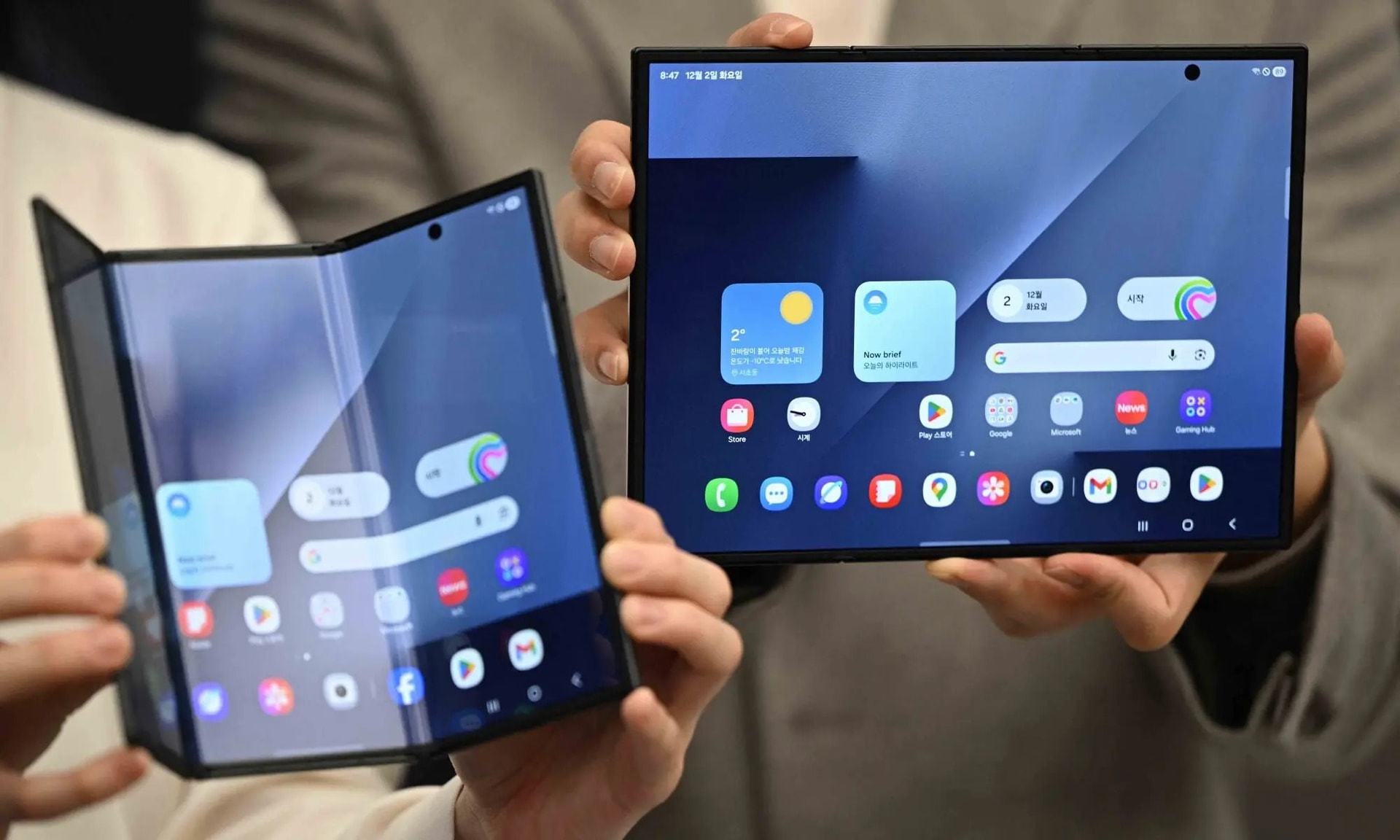
The Galaxy Z TriFold’s most striking feature is its massive 10-inch display when fully unfolded. This size officially blurs the line between phablets and tablets. For comparison, standard iPads range from 10.2 to 10.9 inches. Thus, for the first time, users can carry a “tablet” in their jeans or jacket pocket.
A perennial issue with foldable phones is the crease. With a triple-fold mechanism, this concern is doubled. Samsung employs the latest Ultra Thin Glass (UTG) technology, combined with an optimized flexible substrate structure, to minimize fold depth.
While the crease remains visible under certain angles and lighting, early hands-on reports suggest it’s less noticeable and smoother to swipe across, thanks to a high-grade elastic polymer coating.
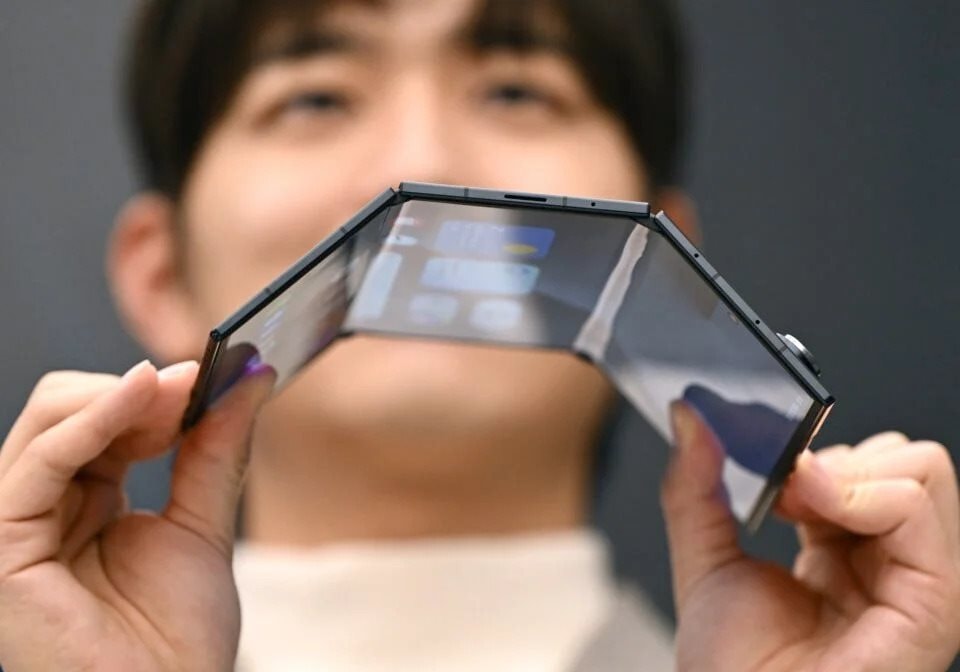
If the screen is the face, the hinge is the backbone. Samsung introduces the “Armor FlexHinge” dual-hinge system. This isn’t merely about installing two Z Fold hinges into one device.
Samsung uses an “Inward-Inward” folding mechanism (entirely inward). Unlike Huawei’s Mate XT, which uses a Z-shaped fold (one inward, one outward), Samsung opts for a safer approach: both side wings fold inward, enveloping the central screen.
This requires hinges of different sizes and radii. One hinge must create a larger gap to accommodate the folded screen of the other wing. Samsung uses a dual-rail structure to synchronize movement, ensuring smooth opening and closing while evenly distributing force across the delicate screen.
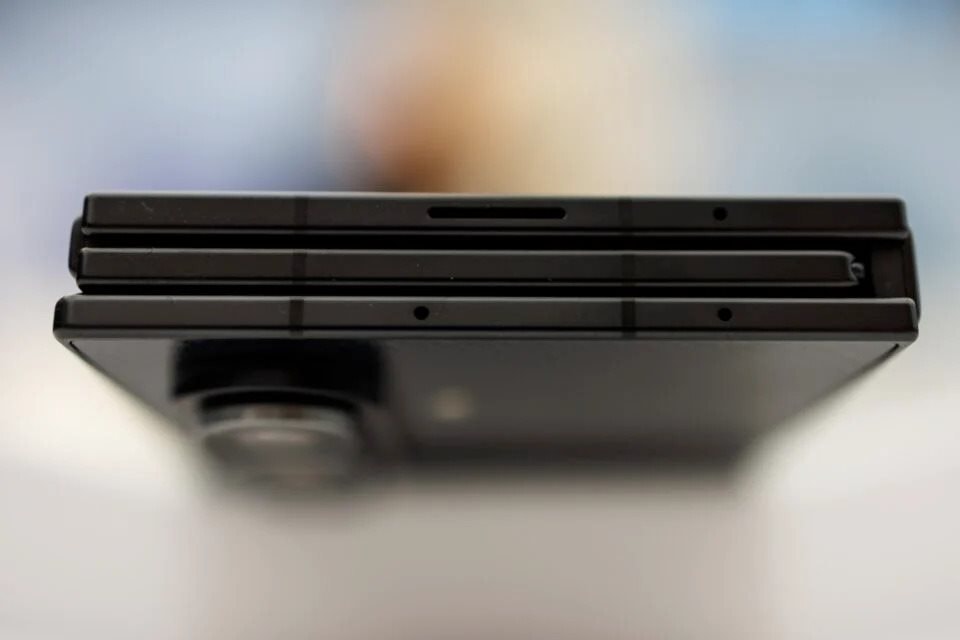
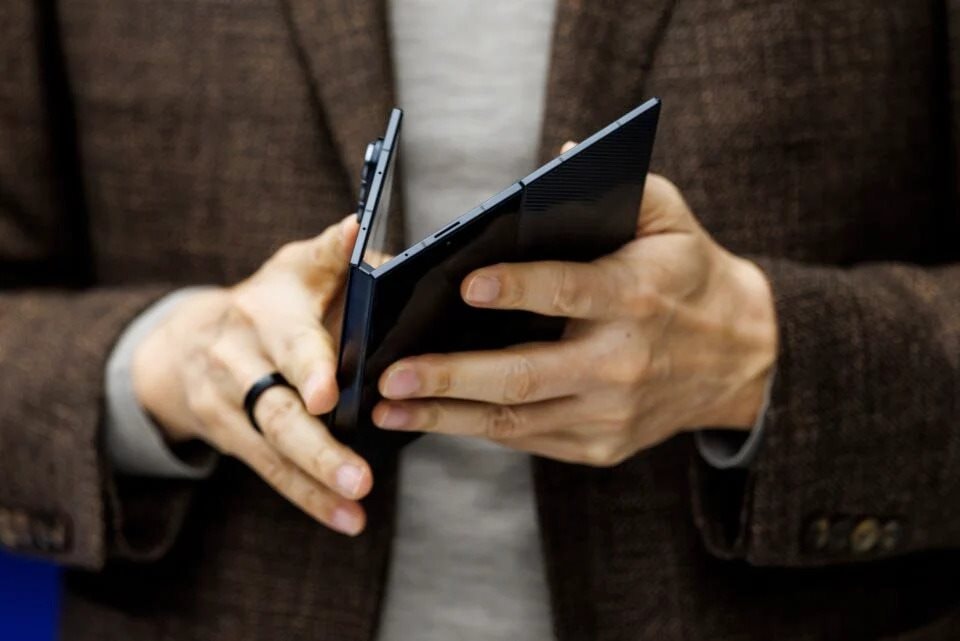
This design protects the entire flexible screen inside the device when closed. Users only interact with the secondary screen, shielded by durable Gorilla Glass. This addresses a major concern: the flexible screen being scratched by foreign objects in pockets.
Samsung claims the hinge and screen have undergone rigorous testing, enduring 200,000 folds – equivalent to five years of use at 100 folds per day.
The system also incorporates micro-brushes to prevent dust from entering the gear mechanism. Notably, the device achieves an IP48 water resistance rating, withstanding submersion in 1.5 meters of water for 30 minutes – a remarkable feat for such a complex mechanical structure.
The biggest challenge in crafting a triple-folding phone is thickness. Simply stacking three phones would result in a brick-like device. Samsung had to reduce the thickness of each screen wing to an unimaginable level.
When unfolded, the device measures just 3.9mm at the screen wings – thinner than a standard USB-C port. This forced Samsung to design a thicker central module (4.2mm) to house connectors and camera components.
When folded, the total thickness is 12.9mm. This is impressive compared to the Z Fold 6 (12.1mm). Despite adding an extra screen and hinge, the device is less than 1mm thicker. This ensures a comfortable grip when folded, similar to current dual-folding phones.
At 309g, the TriFold is significantly heavier than the S25 Ultra (~218g) or Z Fold 7. However, as a 10-inch tablet, 309g is remarkably light (the iPad Mini weighs around 293g). Weight distribution is carefully calculated to prevent top-heaviness when unfolded.
Unmatched Power in the Foldable World
To power three high-resolution screens and extensive multitasking, the Galaxy Z TriFold boasts the most powerful Android configuration.
It features the Qualcomm Snapdragon 8 Elite for Galaxy, built on the cutting-edge 3nm process. CPU and GPU clock speeds are higher than the standard version. Notably, the Neural Processing Unit (NPU) is optimized for on-device Galaxy AI tasks.
All models come with 16GB of LPDDR5X RAM, essential for smoothly running three apps simultaneously. Storage options range from 512GB to 1TB, using high-speed UFS 4.1.
With such a slim body, heat dissipation is a challenge. Samsung likely uses multi-layer graphite sheets across all three sections to distribute heat from the powerful yet heat-generating Snapdragon 8 Elite.
Z Fold users often compromise on camera quality compared to the S Ultra series. The Galaxy Z TriFold changes this.
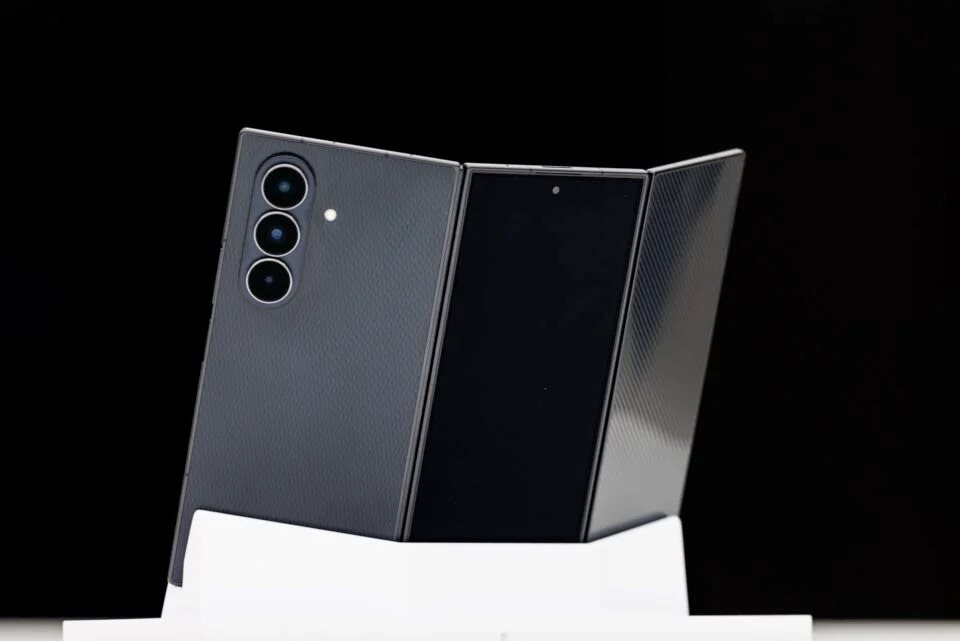
It features a 200MP ISOCELL primary sensor. Incorporating such a large sensor into a slim body forces the camera module to protrude significantly. However, it delivers exceptional detail and high-quality zoom cropping.
The 10MP telephoto camera offers 3x optical zoom. While lacking the 5x or 10x zoom of the S25 Ultra (due to thickness constraints preventing a large periscope module), 3x zoom combined with the 200MP sensor adequately meets portrait and moderate telephoto needs.
The 12MP ultra-wide camera ensures high-quality landscape and architectural shots.
The 5,600mAh battery is divided into three cells, one in each wing. This balances weight but complicates the power management system (PMIC).
The device supports 45W wired charging and 15W wireless charging. While not as fast as Chinese competitors (66W-100W), 45W is a safe level that Samsung maintains to ensure long-term battery health.
Why Now?
The Galaxy Z Fold series has become familiar. Innovations from the Fold 4 to Fold 6 are increasingly minor. Users no longer feel the “wow” factor needed to justify a $2,000 upgrade.
The TriFold serves as Samsung’s new flagship – not necessarily the best-selling, but the most desirable, refocusing market attention on the brand.
It’s also a message to Huawei’s Mate XT: Samsung isn’t technologically inferior. More importantly, the TriFold is a preemptive strike against Apple’s rumored foldable iPhone, expected in 2026-2027.
History shows that when Apple enters a market, it explodes, and Apple typically dominates the premium segment. Samsung’s strategy is a preemptive strike. By launching the TriFold 1-2 years before Apple, Samsung aims to establish itself as the “King of Foldables” in consumers’ minds.
Priced at around $2,450 (approximately $60-70 million), it’s twice as expensive as the Galaxy S25 Ultra or iPhone 17 Pro Max. Thus, the TriFold is a luxury device, not for everyone.
Upon launch, the TriFold sparked divided opinions. Some marvel at its cutting-edge technology and Samsung’s pioneering spirit. Others are more pragmatic, concerned about durability, screen creases, and a price tag that could buy a smartphone, tablet, and laptop combo.
Samsung’s foldable devices also face value retention issues. The Z Fold typically loses 30-40% of its value within a year, deterring many from investing in a $70 million device.
The Galaxy Z TriFold won’t immediately replace traditional smartphones or the Z Fold. It creates a new segment, likely appealing to tech enthusiasts or business professionals.
Long-term prospects are positive. As flexible glass technology becomes cheaper and more durable, the triple-fold form factor could become standard, pushing the Z Fold into a more accessible mass-market segment.
Unveiling Samsung’s Triple-Fold Smartphone: Everything You Need to Know

Samsung has officially entered the triple-folding smartphone race with the groundbreaking Galaxy Z TriFold. Featuring a unique dual-hinge design and an expansive display when unfolded, this device promises to redefine mobile multitasking.
How Are Samsung’s Four Major Vietnamese Factories Faring Post-Trump’s Tariffs and Natural Disasters in Thai Nguyen?
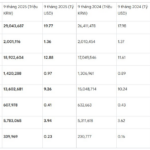
South Korean conglomerate Samsung has unveiled its Q3 2025 business results, highlighting the performance of its four key manufacturing facilities in Vietnam: Samsung Thai Nguyen (SEVT) in Thai Nguyen province, Samsung Bac Ninh (SEV), Samsung Display Vietnam (SDV) in Bac Ninh province, and Samsung Electronics HCMC CE Complex (SEHC) in Ho Chi Minh City.
Unbelievable Price Revealed: First 100 Foldable iPhones Put to the Test
The arrival of the foldable iPhone is poised to captivate the market and potentially redefine the entire foldable screen landscape in the near future.
After 14 Years, iPhone Finally Surpasses Samsung in Dominance: Is This the End of Blind Imitation?

What missteps did Samsung make to lose its decade-long reign as the “smartphone king” to the iPhone?
Unleashing Innovation: How Fundamental Scientific Foundations Spawn Emerging Technologies

Few realize that in Vietnam, a pioneering enterprise has chosen to build from the ground up by investing rigorously in fundamental science and innovation. This strategic approach lays the foundation for the sustainable development of multiple core technologies within a synergistic ecosystem.