










On December 2nd, the Traffic Police Department (Ministry of Public Security) announced a report on the absorption, explanation, and revision of the draft Law amending and supplementing certain provisions of 10 laws related to security and order. This report is based on the opinions of National Assembly deputies during group and plenary discussions.
Specifically, regarding Clause 3, Article 10 of the Road Traffic Order and Safety Law, which mandates the use of safety devices for children under 10 years old and less than 1.35 meters tall in cars, the Government has absorbed, explained, and revised the draft law as follows, based on feedback from National Assembly deputies during group discussions on October 31, 2025, and plenary discussions on November 17, 2025:
“When transporting children under 10 years old and less than 1.35 meters tall in cars, children must not sit in the same row as the driver, except in vehicles with only one row of seats. Drivers must use and guide the use of appropriate safety devices for children, except in commercial passenger transport vehicles.”
This regulation exempts commercial passenger transport vehicles from using appropriate safety devices for children, ensuring feasibility and aligning with Vietnam’s practical traffic conditions.
The Law amending and supplementing certain provisions of 10 laws related to security and order is currently being presented to the 10th session of the 15th National Assembly for approval and will take effect from January 1, 2026.
Why must children under 10 years old and less than 1.35 meters tall use child seats and safety devices?
According to the Traffic Police Department, the law mandates that children under 10 years old and less than 1.35 meters tall must not sit in the front row and must use safety devices for the following reasons:
First, for children under 1.35 meters tall, using the vehicle’s standard seatbelt does not ensure safety during collisions. At that height, the seatbelt only reaches the child’s head and neck, which is unsuitable and unsafe.
Second, children around 10 years old are more likely to listen to and follow instructions from adults. Children under 10 are more mischievous and require closer supervision.
Third, numerous international studies have been conducted, and regulatory authorities have applied these findings into law, making this a practical measure.
Many people believe holding a child in their lap is safe, but this is not the case. During a collision, the child can be thrown, causing injury. Even sudden braking can propel the child forward, posing a danger.
“Lessons from helmet use, seatbelt compliance, and preventing intoxicated drivers from operating vehicles are well-known. Children cannot protect themselves, so they rely on responsible adults and laws for protection. Citizens must adhere to traffic laws,” emphasized the Traffic Police Department representative.
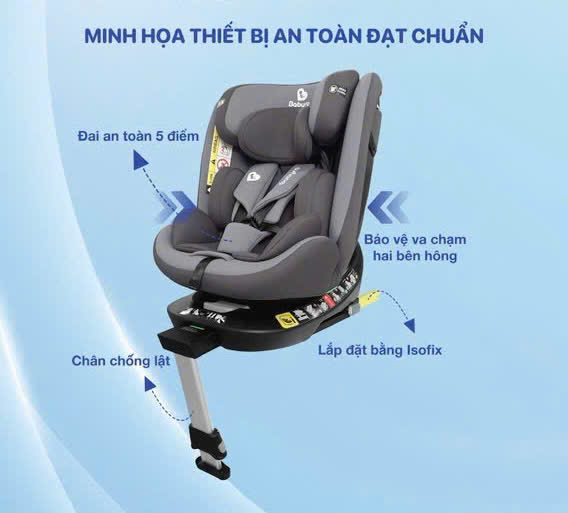
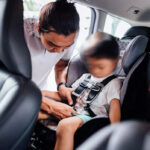
Illustrative image
Standards for Child Safety Devices
Subsection 2.1, Section 2 of Standard QCVN 123:2024/BGTVT outlines general requirements for child safety devices as follows:
(1) Child safety devices must be suitable for installation in cars.
(2) They must have no sharp edges or protruding parts that could damage clothing or the car’s seat upholstery.
(3) Hard components of the safety device must not have sharp edges that could wear down seatbelts at contact points.
(4) Components of the safety device must not be removable without specialized tools.
Any removable parts designed for maintenance or adjustment must prevent incorrect installation and misuse.
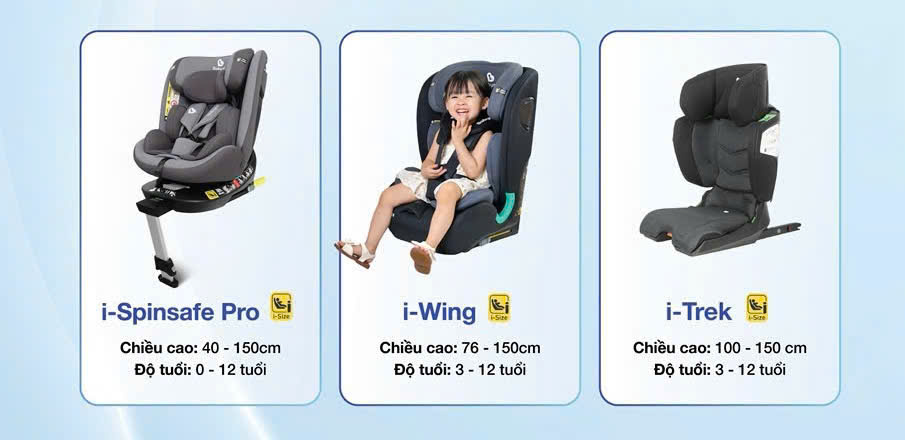
Illustrative image
According to Section 1.3.1, Subsection 1.3, Section 1 of Standard QCVN 123:2024/BGTVT:
Child safety devices are designed to ensure the safety of children in sitting or lying positions in cars, reducing the risk of injury during collisions or sudden deceleration by limiting body movement.
Child safety devices include:
Child Restraint Systems (CRS), which consist of seats, belts, safety locks, adjustment mechanisms, and accessories like cribs and impact shields, securely installed in vehicles.
Enhanced Child Restraint Systems (ECRS), including:
Integral Universal ISOFIX Child Restraint Systems (i-Size);
Integral “Specific Vehicle ISOFIX” Child Restraint Systems.
Rare Earth Prices Triple Since China’s Export Crackdown: What’s Driving the Surge?

Rare earth elements have seen their prices surge dramatically, despite the easing of trade tensions between the United States and China.
“Confused Car Owners: The Ultimate Guide to Choosing the Perfect Child Safety Seat”

Child car seats flood the market, ranging from just a few hundred thousand dong to tens of millions.
Car Seat Safety for Kids: Regulations Exist, So Why Are Parents Still Confused?
New regulations mandating the use of child safety devices in cars have sparked widespread debate, leaving many parents uncertain about proper implementation.
Breaking News: Traffic Police Department Issues Urgent Update on Critical Road Safety Concerns Affecting Millions of Commuters
The critical issue at hand revolves around child safety seats in vehicles. Ensuring the proper use of these seats is paramount to protecting young passengers during travel. This concern highlights the need for awareness, education, and adherence to safety standards to safeguard children on the road.
What Does the Traffic Police Department Say About the Regulation Requiring Child Seats for Children Under 10 in Cars?
According to the Traffic Police Department, recommendations for using child car seats have been in place for many years, and many drivers have already complied.