On December 4th, Selex Motors announced that they had submitted a proposal to the Management Board of HH Linh Đàm Apartment Complex (Hoàng Liệt Ward, Hanoi) regarding a partnership to implement an electric bike battery swapping station. This initiative aims to enhance fire safety (PCCC) and support the residents of HH Linh Đàm.
The Management Board of HH Linh Đàm Apartment Complex plans to halt the parking and charging services for electric motorbikes and bicycles to ensure fire safety within the complex. HH Linh Đàm is a densely populated area with a growing demand for eco-friendly transportation.
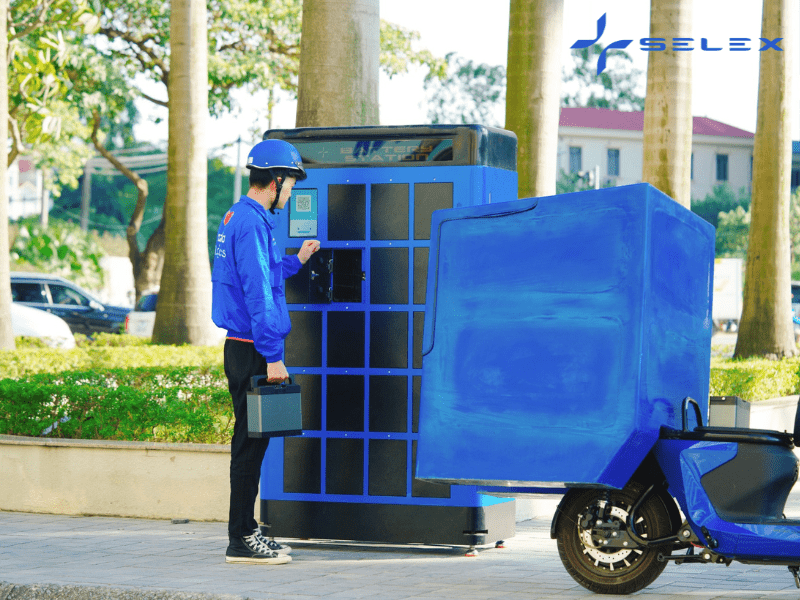
In response to the increasing restrictions or bans on charging electric vehicles in basements due to fire safety concerns, Selex Motors proposes setting up a battery swapping station within the premises of the apartment complex.
The battery swapping station will be located on the ground level, ensuring fire safety and convenience. Users can swap batteries in just 2 minutes, eliminating the need for basement charging. Selex’s proprietary technology ensures compatibility with approximately 70% of popular electric motorbike models, facilitating a seamless transition for residents. The battery swapping service is 20-30% cheaper than gasoline.
Selex Motors has proposed installing 2-5 battery swapping stations at suitable locations within the complex to enhance convenience. To encourage residents to adopt this service, Selex Motors is offering a 25% discount on battery swapping fees for the first year.
Selex Motors is the first company in Vietnam to implement a shared electric motorbike battery swapping solution, with all technology and production localized. Currently, Selex Motors operates 50 battery swapping stations in Hanoi, serving a wide range of electric motorbike users, including delivery drivers from platforms like Grab, Be, and Ahamove.
Earlier in December, the Management Board of HH Linh Đàm Apartment Complex issued a notice refusing to provide parking services for electric vehicles. The board cited the high risk of fire and explosion due to electrical malfunctions or improper charging practices.
In the event of a fire in the basement, the rapid spread of flames and toxic smoke would hinder evacuation, posing a significant threat to residents’ lives and property. Additionally, the number of vehicles has exceeded the safe capacity designed for the building.
As a result, starting December 1st, the Management Board will stop accepting new registrations for electric vehicle parking. From January 1, 2026, they will no longer provide parking services for electric vehicles in the basements of the 12 apartment buildings.
This announcement sparked outrage among residents.
On December 4th, the People’s Committee of Hoàng Liệt Ward stated that they had instructed the Management Board of HH Linh Đàm Apartment Complex not to refuse parking services for electric vehicles.
Furthermore, the People’s Committee mandated that the Management Board enhance patrol efforts to promptly address any incidents or issues arising during vehicle parking in the basement.
They also required the maintenance of fire prevention, fighting, rescue, and emergency systems to ensure stable operation and compliance with design functions in case of emergencies.
The People’s Committee of Hoàng Liệt Ward emphasized that, according to the 2023 Housing Law, parking areas in apartment complexes include spaces for both cars and motorbikes, regardless of whether they run on gasoline or electricity. Additionally, the Fire Prevention and Fighting Law does not prohibit or restrict the parking or charging of electric vehicles in apartment complexes.
To ensure safety and minimize fire risks, the Management Board must designate separate charging areas, ensure safety measures, and provide firefighting equipment and supervision, rather than imposing a ban.