















Land Conversion Fees Surge Tenfold
Following the implementation of the 2024 Land Law, Vietnamese citizens face significant challenges when converting agricultural land to residential use due to a sharp increase in associated fees. Mr. Lê Phú from Thanh Hóa shared his experience, stating that in 2022, he applied to convert approximately 90m² of agricultural land into residential land.
Due to incomplete paperwork, by early 2025, Mr. Phú was informed that the conversion fee had nearly tripled. “My family relies solely on farming. My son is of marrying age, so I need to convert additional land to meet the area requirements for a separate land title to build a house. However, the soaring costs are beyond our financial means,” Mr. Phú explained.
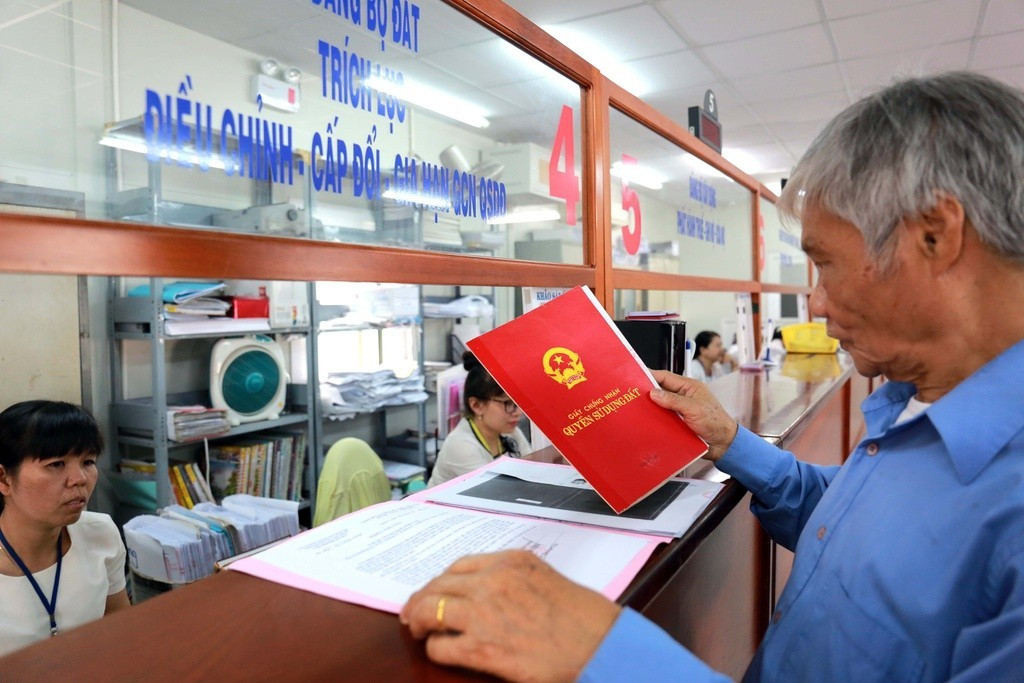
Citizens processing land use right certificates (Illustrative image)
Mr. Phú is not alone in facing these difficulties. In mid-2025, Mr. Trần Duy Đông from Vinh, Nghệ An, was required to pay nearly VND 4.5 billion in taxes to convert 300m² of garden land into residential land, sparking public outcry.
Authorities explained that the fee is calculated based on land prices: VND 15 million/m² for residential land and VND 85,000/m² for agricultural land. Mr. Đông must pay the full difference, amounting to VND 4.5 billion.
The surge in conversion fees from agricultural to residential land is widespread across many localities. The Ministry of Finance has received numerous complaints regarding the high costs, which are several times higher than previous rates.
In a document submitted to the National Assembly’s Ombudsman and Supervisory Committee, delegations from Ho Chi Minh City and Da Nang proposed reducing land prices and conversion fees for agricultural-to-residential land use.
Voters in Ho Chi Minh City argued that current land prices are incompatible with the income levels of residents, particularly low- and middle-income workers. Some families, despite facing financial hardships, need to subdivide land and build homes but cannot afford the conversion costs. Therefore, they urged authorities to review and adjust land conversion fees, considering reductions in personal income tax for real estate transfers.
“A mechanism allowing low-income households to pay conversion fees in installments over an extended period would help stabilize housing for citizens,” the Ho Chi Minh City delegation suggested.
Echoing this sentiment, Da Nang voters highlighted that taxes, fees, and land use charges for conversion procedures are excessively high, exceeding the financial capabilities of many residents. This hinders their ability to exercise legal rights related to housing, production, and business.
Da Nang voters proposed that authorities reduce taxes, fees, and land use charges by 20-30% to align with the socio-economic conditions and financial capabilities of the population.
Beyond Fee Reductions
A representative from the Department of Public Asset Management (Ministry of Finance) stated that a draft resolution has been proposed to address the sudden spike in land prices in some localities compared to previous rates.
The draft suggests that for agricultural-to-residential conversions within local land allocation limits, the minimum fee should be 30% of the price difference between residential and agricultural land (currently set at 100%). For areas exceeding local land allocation limits, the minimum fee would be 50% of the difference, capped at the local residential land limit. If the area exceeds the residential land limit, the fee remains at 100% of the difference. The draft has been reviewed by the Ministry of Justice, and the Ministry of Finance is finalizing it for government approval.
The Ministry of Finance proposes that for agricultural-to-residential conversions within local land allocation limits, the minimum fee should be 30% of the price difference between residential and agricultural land (currently set at 100%). For areas exceeding local land allocation limits, the minimum fee would be 50% of the difference, capped at the local residential land limit. If the area exceeds the residential land limit, the fee remains at 100% of the difference.
In an interview with Tiền Phong, tax expert Nguyễn Ngọc Tú, former director of the General Department of Taxation (now the Tax Department), noted that previously, agricultural-to-residential land conversions enjoyed various exemptions and reductions. For instance, individuals with meritorious service to the revolution paid only 40% of the fee.
However, under the 2024 Land Law, households and individuals must pay the full 100% price difference when converting agricultural land to residential use. This change has created significant challenges for many families in suburban and rural areas, effectively forcing them to repurchase land inherited from their ancestors.
“Residential land prices should be based on the average over the past five years to ensure stability and affordability for citizens. Reducing land use fees for agricultural-to-residential conversions is essential, as it also helps the government fulfill its responsibility to develop housing,” Mr. Tú said.
The expert believes that even the proposed 30% tax rate within land limits is still too high, given the already elevated land prices. In addition to reducing tax rates, authorities should allow citizens to pay conversion fees in installments or defer payments within land limits. Full payment would be required upon land transfer, balancing citizens’ housing needs with measures to prevent speculation.
Developing Social Housing Land Funds
Reducing agricultural-to-residential conversion fees is just one solution for citizens. Establishing social housing land policies in rural areas to meet housing demands and prevent speculation is an urgent necessity.
In an interview with Tiền Phong, Mr. Đặng Hùng Võ, former Deputy Minister of Natural Resources and Environment (now the Ministry of Agriculture and Environment), pointed out that the Housing Law lacks provisions for social housing in rural areas.
Many families require land for small households as children grow up. Therefore, social housing land policies in rural areas are essential to meet citizens’ housing needs.
“Authorities could develop rural social housing land policies similar to urban social housing policies. Local governments should assess residents’ incomes and propose converting agricultural land to residential use at a fraction of the land price table,” Mr. Võ suggested.
Mr. Lê Hoàng Châu, Chairman of the Ho Chi Minh City Real Estate Association (HoREA), proposed setting conversion fees at 20% of the price difference between residential and agricultural land, with 30% for areas exceeding land limits.
“Most land is acquired through household establishment or inheritance. Many multi-generational families live and farm together, needing land conversions for subdivision among members.
Authorities must implement fair and reasonable policies while strictly controlling them to prevent unscrupulous businesses from exploiting loopholes for illegal gains,” Mr. Châu emphasized.
He provided an example: a family with three married children and grandchildren living in a 2,000m² house with fruit trees, livestock pens, and ponds inherited from ancestors.
With a residential land price of VND 10 million/m², agricultural land at VND 300,000/m², a land price adjustment coefficient of 1.5, and a land allocation limit of 200m², the family would need to pay over VND 24 billion under current rates, almost equivalent to repurchasing their own land. HoREA experts calculate a more reasonable fee of approximately VND 11.6 billion.
Soaring Land Conversion Fees from Garden to Residential: Experts Urge Immediate Reduction

Many experts argue that the cost of converting agricultural land to residential land should be significantly reduced and made more flexible to alleviate the burden and protect the legitimate rights of citizens.
Critical Land Certificate Changes Effective January 1, 2026: A Must-Read for All Hanoi Residents!
The Hanoi People’s Council has recently approved a significant and special adjustment, marking a pivotal moment for the city’s development and future prospects.
Đà Lạt Valley Flower Estate Owner Loses Over 1.5 Hectares of Land to Lâm Đồng Province’s Reclamation
The People’s Committee of Lam Dong Province has officially reclaimed the entire 15,214 square meters of land previously allocated to Saigon Construction and Investment Trading Company Limited. This land, originally designated for the development of the Da Lat Flower Valley residential project, is now fully under the province’s control.
Land Use Fee Installment Proposal: Ministry of Finance Responds
In response to local and public appeals for installment payments on land use fees to alleviate financial burdens, the Ministry of Finance has stated that current legislation does not permit such arrangements. However, they have indicated that this issue will be considered during the revision of relevant decrees.
Critical Announcement: Red Book Recall Notice – All Citizens Urged to Take Immediate Action!
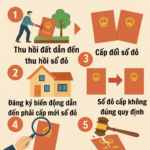
The 2024 Land Law explicitly outlines six scenarios in which a land title certificate (red book) can be revoked.