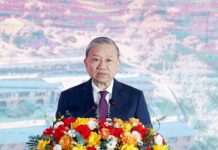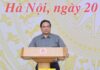















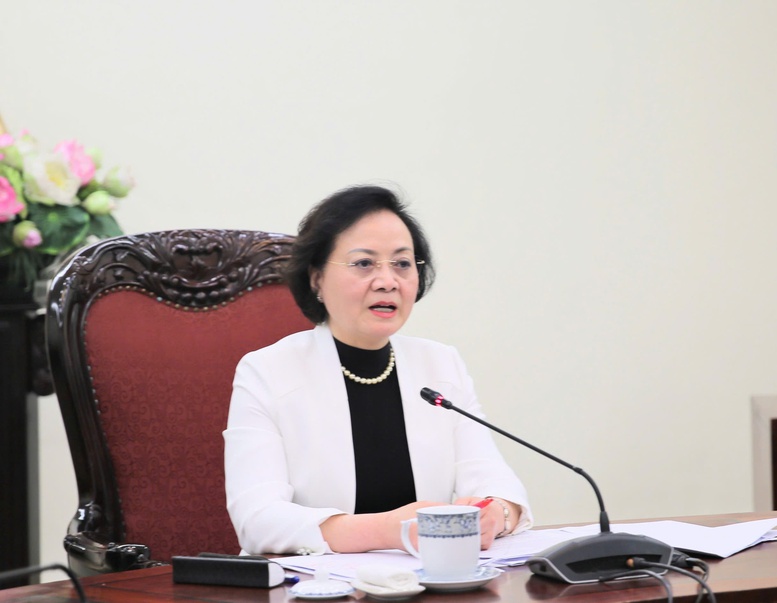
Deputy Prime Minister Pham Thi Thanh Tra speaks at the meeting – Photo: VGP/Thu Giang
On the afternoon of December 4th, at the Government Office, Deputy Prime Minister Pham Thi Thanh Tra held a working session with the Ministry of Home Affairs regarding the implementation of institutional building tasks and urgent requirements to be completed by the end of December 2025.
Reporting at the meeting, Minister of Home Affairs Do Thanh Binh stated that in October and November 2025, the Ministry had advised the Politburo and the Secretariat on four reports, proposals, and submissions; advised the Government to submit three resolutions to the National Assembly Standing Committee; and submitted six decrees, four Government resolutions, and five Prime Minister’s decisions for approval. This significant workload reflects the industry’s efforts amidst multiple concurrent major tasks.
Notably, following the November 2025 meeting with the Deputy Prime Minister, the Ministry of Home Affairs submitted and obtained Government approval for four crucial decrees. These include regulations on minimum wages for contract workers, the framework for the number of Deputy Chairpersons of the People’s Committee, the composition of People’s Committee members, procedures for approving election results, and handling of People’s Committee Chairperson and Deputy Chairperson positions. Additionally, Decree No. 303/2025/NĐ-CP dated November 19, 2025, outlines the functions, tasks, powers, and organizational structure of ministries and ministerial-level agencies, while Decree No. 307/2025/NĐ-CP dated November 27, 2025, addresses the classification of administrative units.
According to the plan, in December 2025, the Ministry of Home Affairs must submit a total of 27 documents to the Government for issuance. Of these, 13 have been submitted; 8 are under review by the Ministry of Justice; 4 are being finalized for submission; and 2 have been postponed to March 2026 due to their specific nature. Minister Do Thanh Binh acknowledged that this timeline presents a significant challenge, requiring the entire sector to mobilize all efforts to meet the deadline.
During the meeting, leaders of the Ministry and specialized units also reported on the progress of drafting decrees guiding the implementation of the 2025 Law on Local Government Organization, the 2025 Law on Civil Servants, the Employment Law, and the Occupational Safety and Health Law. Many documents involve complex content with broad impacts, necessitating thorough review to ensure both timely completion and quality.
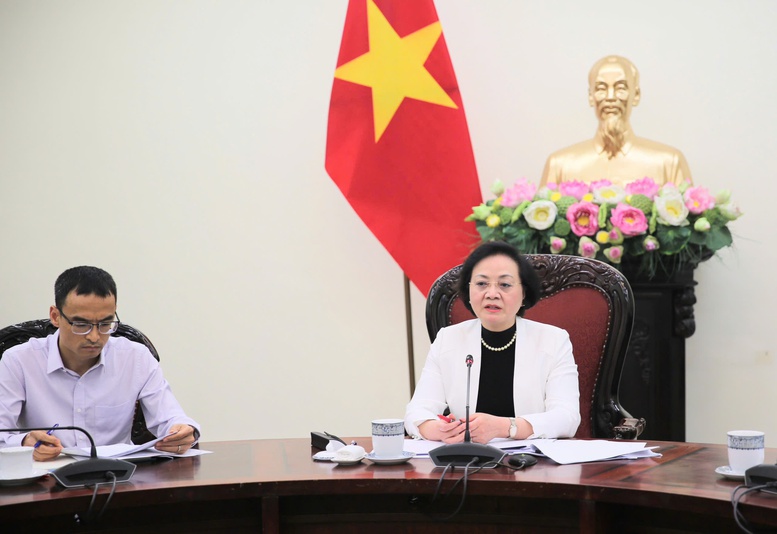
Deputy Prime Minister Pham Thi Thanh Tra comments on the deadline for completing decrees – Photo: VGP/Thu Giang
Pressure is the Driving Force
Concluding the meeting, Deputy Prime Minister Pham Thi Thanh Tra acknowledged the Ministry of Home Affairs’ efforts, particularly in drafting decrees—a key focus for 2025.
However, she emphasized the need for even greater effort and work ethic, as failing to accelerate would make it difficult to complete all assigned tasks.
According to the Deputy Prime Minister, from now until year-end, the Ministry’s work enters a “campaign phase,” requiring high-intensity implementation and daily monitoring of all tasks.
The Deputy Prime Minister affirmed that the Government would provide all necessary support for the Ministry to fulfill its duties. However, the Ministry must maximize its proactive spirit, innovate working methods, enhance coordination, and closely monitor progress. The ultimate goal is to complete all institutional building tasks in 2025—a critical mission determining the administrative apparatus’s effectiveness in the next phase.
“First and foremost is the working method. It must be specific, effective, and closely monitored. Without changing our approach, we cannot complete the workload. Political responsibility and determination must be prioritized,” Deputy Prime Minister Pham Thi Thanh Tra stressed.
The Deputy Prime Minister instructed the Ministry of Home Affairs to strengthen coordination with other ministries, sectors, and the Government Office, especially in drafting legal documents. For major, important documents, a lack of quick, flexible coordination mechanisms will undoubtedly delay submission to the Government and the Prime Minister.
“Pressure is the driving force for work,” the Deputy Prime Minister noted, urging Ministry leaders to directly address challenges and resolve outstanding issues.
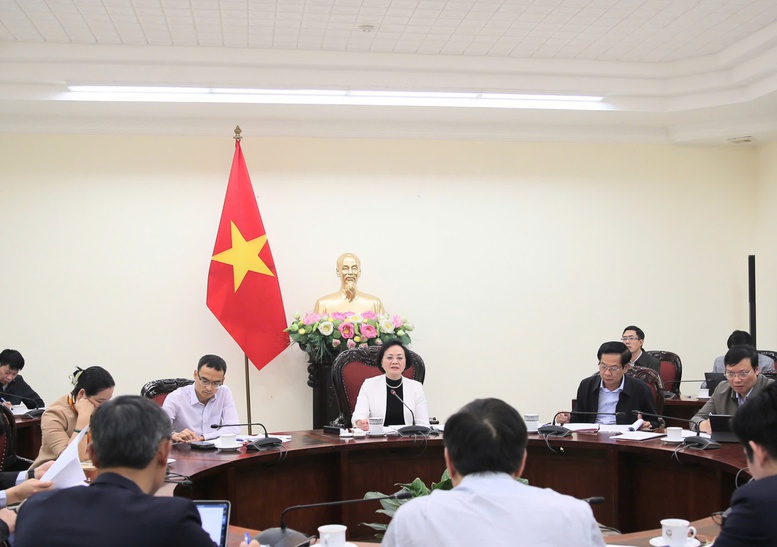
Deputy Prime Minister Pham Thi Thanh Tra works with the Ministry of Home Affairs – Photo: VGP/Thu Giang
Comprehensive Preparation for the National Emulation Congress
Regarding priority tasks, the Deputy Prime Minister identified three major groups: institutional building; preparations for the National Emulation Congress and the 5-year review of administrative reform under Resolution No. 76; and addressing challenges in the two-tier local government model and the reorganization of ministries and ministerial-level agencies.
For decree groups, the Deputy Prime Minister set specific milestones for December 7th, 15th, and 25th, requiring units to adhere strictly to these deadlines. Some special decrees will be postponed to 2026, while others must be completed in December.
Specifically, the Deputy Prime Minister urged acceleration of the Decree on Labor Registration and the Labor Market Information System, ensuring openness, connectivity, and data interoperability to support domestic and international labor market regulation. The National Job Transaction Platform must operate effectively, with real transactions and integration with the National Population Database. If on schedule, the Ministry could launch it in December.
Regarding the Decree on Job Positions, the Deputy Prime Minister emphasized the need for simultaneous development and review to establish a comprehensive legal framework, facilitating ministries, sectors, and localities in determining job positions. She urged the Ministry to expedite the draft to meet practical needs.
For the Decree on Civil Servant and Public Employee Evaluation and Classification, the Deputy Prime Minister stressed the importance of thoroughly assessing impacts, particularly evaluation methods—a critical factor in implementation quality. She directed the Ministry to conduct broad consultations and continue refining the draft during this process.
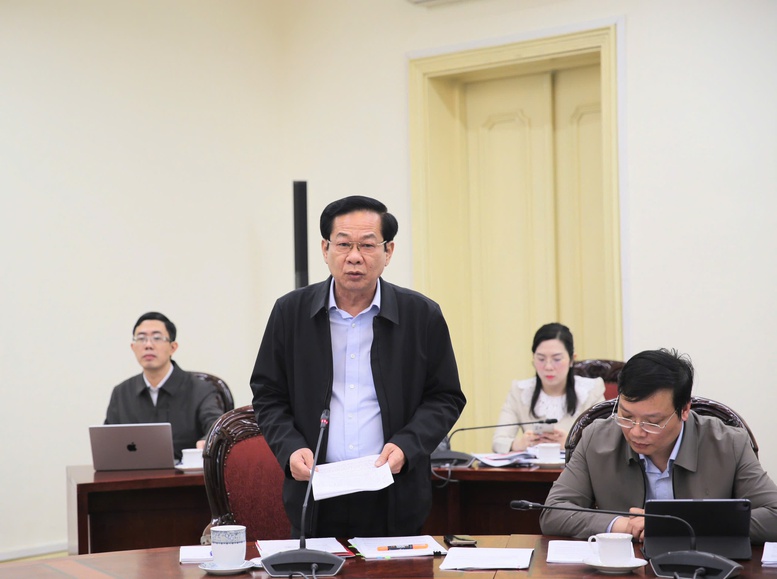
Minister of Home Affairs Do Thanh Binh reports at the meeting – Photo: VGP/Thu Giang
Beyond institutional workload, the Deputy Prime Minister highlighted December’s political priority: preparing for the National Emulation Congress. She announced plans to personally review all preparations next week, including documentary films, program scripts, and progress on protocol, publicity, and exhibitions. This major event demands comprehensive, meticulous, and impressive preparation.
Additionally, the Ministry must continue resolving challenges in the two-tier local government model, focusing on decentralization, authority delineation, and jurisdiction clarification.
The Deputy Prime Minister also addressed administrative procedure issues, noting both citizen-facing and internal procedures. She cited a case in Da Nang where a unit had to verify 7,000 student birthplaces, despite the National Population Database already containing this information. This inefficiency in internal processes causes unnecessary hassle and requires immediate correction.
“Agencies, units, and organizations must not unilaterally introduce additional administrative procedures beyond regulations,” the Deputy Prime Minister emphasized.
Furthermore, she directed the Ministry of Home Affairs to collaborate closely with the Ministry of Education and Training and the Ministry of Health to complete the reorganization of public educational institutions and commune-level health stations by December 31, 2025. This ensures a streamlined, efficient system aligned with local conditions, as guided by the Politburo.
What is the Anticipated Leadership Position Coefficient for Commune, Ward, and Department Levels?

The Ministry of Home Affairs has proposed adjustments to the leadership allowance coefficients for department heads within the Ministry and commune-level leaders, effective January 1, 2026. These revisions aim to align allowances with the specific responsibilities of each position following organizational restructuring.
Accelerating the Implementation of Key Projects in Phú Thọ Province

The Government Office has issued Announcement No. 636/TB-VPCP dated November 24, 2025, outlining Deputy Prime Minister Bùi Thanh Sơn’s conclusions from his working session with the leadership of Phú Thọ Province.
Resolving Local Governance Challenges: Overcoming Obstacles at the Commune Level in Two-Tier Local Administration

The Government’s Steering Committee urges local authorities and party committees to prioritize the restructuring of organizational apparatuses and the enhancement of staff, civil servants, and public employees at the commune level. This critical and urgent task must be substantially completed by December 2025, with a focus on resolving existing challenges.
Proposed Amendments and Additions to the Social Insurance Law 2024

The core provisions of the Social Insurance Law remain intact, with amendments and additions focusing solely on organizational restructuring.
Government Inspectorate Urges Recovery of Over $1 Billion for State Budget Following Audits
According to data from the Inspection Monitoring, Urging, and Post-Inspection Handling Department (Department XIV under the Government Inspectorate), from 2018 to September 2025, the Government Inspectorate has urged the implementation of 246 inspection conclusions, recovering 24,418 billion VND for the state budget.