






On the afternoon of December 4th, during the 52nd session, Minister of Construction Tran Hong Minh presented to the National Assembly Standing Committee a draft resolution on special mechanisms and policies applicable to the North-South high-speed railway project.
According to the government’s proposal, at the time the Politburo approved the investment policy for the North-South high-speed railway, public investment had not attracted any interested investors. Following the issuance of Resolution 68 on private economic development, several businesses proposed participating in the project.
However, National Assembly Resolution 172 on the investment policy for this railway project only addresses public investment and lacks a legal framework for other investment methods. Additionally, the project’s massive scale, extensive investment, prolonged timeline, and complex technology make it challenging to foresee all potential difficulties.
Therefore, the government deems it necessary to continue reviewing and supplementing mechanisms and policies if non-budgetary investment methods are chosen.
The government proposes that during non-session periods, the National Assembly authorizes the Standing Committee to consider and decide on supplementing or adjusting special mechanisms and policies for various investment methods (if any). Furthermore, the government requests facilitating private sector participation in the project to ensure timely progress.
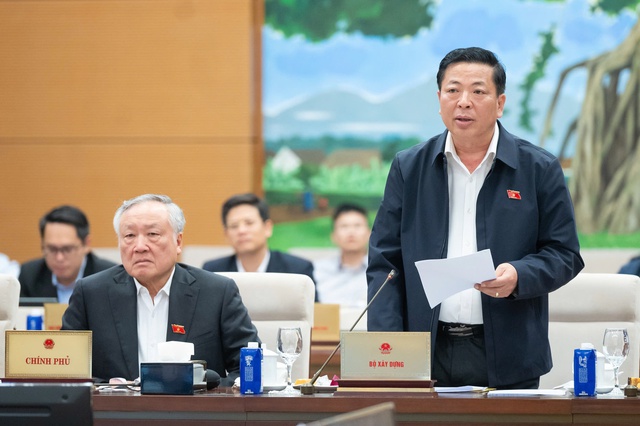
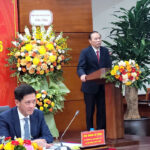
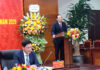
Minister of Construction Tran Hong Minh speaks at the December 4th session – Photo: VGP/Nguyễn Hoàng
Presenting the proposal, Minister of Construction Tran Hong Minh stated that the government suggests separating compensation, support, resettlement, and the relocation of electrical infrastructure with voltages of 110 kV or higher into independent projects. Funding will be allocated from the central and local budgets.
Local authorities and Vietnam Electricity (EVN) will be responsible for preparing, approving, and implementing compensation, support, and resettlement projects within their jurisdictions. Investment in these components will not require an investment policy approval.
Central budget funds will be directly allocated to local authorities and EVN for implementation. If the central budget cannot be arranged in time, local authorities may use their budgets, with the central budget reimbursing them later.
Minister Tran Hong Minh explained that separating these components into independent projects would allow compensation, support, resettlement, and electrical infrastructure relocation to proceed independently and concurrently with the feasibility study report preparation.
Reviewing the proposal, Chairman of the Economic and Financial Committee Phan Van Mai stated that the committee generally agrees with the government’s proposal. “Supplementing mechanisms and policies for the project is necessary and aligns with the Party’s policy of mobilizing societal resources for strategic projects and unlocking private investment in critical infrastructure,” he said.
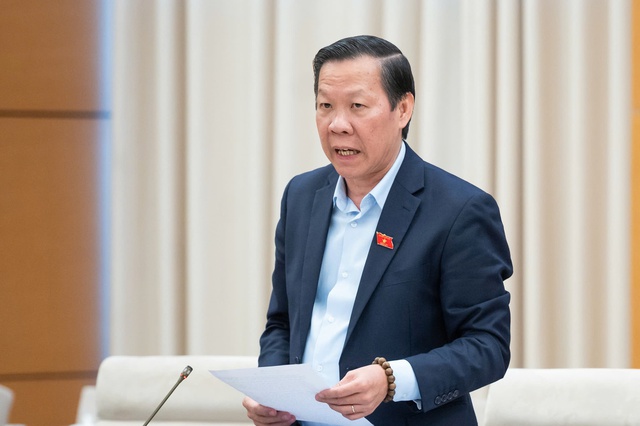
Chairman of the Economic and Financial Committee Phan Van Mai presents the review report.
Regarding the proposal to separate compensation, support, resettlement, and electrical infrastructure relocation into independent projects, the committee finds it justified. According to the reviewing agency, the National Assembly has previously allowed land acquisition, compensation, and resettlement for nationally important projects to be separated into component projects, as seen in the Long Thanh International Airport project.
However, the Economic and Financial Committee recommends that the government consider separating these into independent component projects. Subsequently, the government should direct local authorities and ministries to prepare feasibility study reports to ensure synchronization, determine total investment, land acquisition areas, and completion timelines.
Regarding the proposal for the National Assembly to authorize the Standing Committee to consider and decide on special mechanisms, the Economic and Financial Committee deems it “unnecessary” since Resolution 172 already provides for this. Additionally, during the 9th session, the National Assembly approved the addition of public-private partnership (PPP) investment methods for the North-South high-speed railway project.
Attending and speaking at the session, Standing Deputy Prime Minister Nguyen Hoa Binh noted that this is the final session of the National Assembly’s term. Meanwhile, the government is determined to implement the high-speed railway project as soon as possible, once preparations are complete.
Regarding policies for resettlement support and the relocation of electrical infrastructure from 110 kV, Standing Deputy Prime Minister Nguyen Hoa Binh suggested a more comprehensive approach. This would ensure that not only electrical projects from 110 kV and above but also accompanying projects such as transportation infrastructure for railway operations, stations, and docks—which are essential for the high-speed railway’s functionality—benefit from similar policies.
Vĩnh Long Launches Construction of VND 2.8 Trillion Đình Khao Bridge on December 19th
Vĩnh Long officially commenced construction on the Đình Khao Bridge and several other key projects on December 19th, in celebration of the upcoming 14th National Party Congress.
Proposed Sea Bridge Connecting Can Gio – Vung Tau: Construction Could Begin in 2026
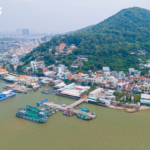
Spanning a total length of 14.67 km, including an 11 km over-sea bridge, this groundbreaking project is set to commence construction in 2026 and is anticipated to be fully operational by 2029.
Proposed Clarification: Identifying the Executing Authority for Phú Mỹ 2 Bridge and Two Inter-Regional Projects
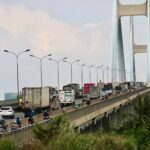
The Phú Mỹ 2 Bridge project has been identified as a critical initiative to significantly reduce travel time between Ho Chi Minh City and Long Thành International Airport. It is expected to be presented to the Ho Chi Minh City People’s Council for approval during the upcoming session.
Why Does Ho Chi Minh City Require $450 Million for High-Speed Rail Development?
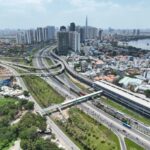
Ho Chi Minh City has released a progress report on its urban railway projects, with a key focus on land clearance for the North-South high-speed rail line.
Unveiling Southeast Vietnam’s Crown Jewel: Sơn Hải Group’s Vision for the Most Breathtaking Highway in the Southeast and Central Highlands
The route spans approximately 65.88 kilometers, traversing through Dong Nai Province for about 11.91 kilometers and Lam Dong Province for roughly 53.97 kilometers.