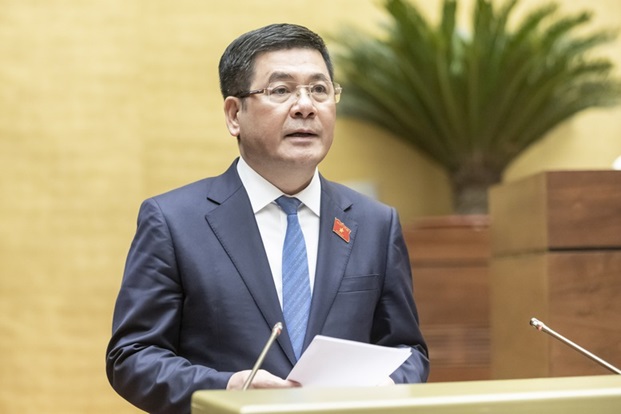
Minister of Industry and Trade Nguyen Hong Dien presented the Proposal for the National Assembly’s Resolution on mechanisms and policies for national energy development during the 2026-2030 period – Photo: VGP/Nhat Bac
|
On the afternoon of December 4th, the National Assembly listened to the Proposal and Verification Report on the draft Resolution regarding mechanisms and policies for national energy development during the 2026-2030 period. The Resolution aims to address bottlenecks, create breakthroughs for critical energy projects, ensure energy security, and meet the sustainable development requirements of the country in the new phase.
Focusing on Unblocking Institutional Bottlenecks to Drive Key Energy Projects
Presenting the Proposal to the National Assembly, Minister of Industry and Trade Nguyen Hong Dien stated that the issuance of the Resolution is essential to promptly resolve institutional, mechanism, and policy bottlenecks hindering the progress of large-scale energy projects. The ultimate goal is to ensure robust national energy security, supporting socio-economic development during the 2026-2030 period and achieving sustainable development objectives.
The draft Resolution consists of 8 Chapters and 24 Articles, focusing on specific mechanisms to mobilize resources and create a unified legal framework for implementing energy projects. It covers key areas such as adjustments to power development planning, transmission/distribution network development schemes, investment mechanisms for power projects, offshore wind power development, direct power purchase agreements, investment in oil and gas projects, coal, and national petroleum reserve policies.
The Resolution also clearly outlines principles for flexible planning adjustments and the responsibilities of the Ministry of Industry and Trade in guiding dossiers, procedures, and adjustment authorities. Some power grid projects are proposed to apply a mechanism replacing the investment policy approval decision, aiming to shorten preparation time and accelerate implementation.
Clarifying Mechanisms Related to Planning and Investment Procedures
Reviewing the Proposal, Chairman of the Economic and Financial Committee Phan Van Mai stated that the Committee generally agrees with the necessity of issuing the Resolution to concretize Resolution No. 70-NQ/TW of the Politburo on national energy development. This is a key requirement to meet the rapid and sustainable development goals of the country in the new phase.
The Committee requests a thorough review of the draft content, specifying only issues within the National Assembly’s jurisdiction and avoiding content under the authority of the Government, ministries, sectors, or localities to issue legal documents. This ensures consistency with the spirit of legal innovation outlined in Resolution No. 66-NQ/TW.
The Government is requested to provide clearer explanations for new mechanisms to ensure feasibility and risk mitigation during implementation.
The Verification Report highlights several points requiring detailed Government explanation. These include the proposal to exempt investment policy approval procedures for power grid projects within the Power Master Plan or provincial power grid schemes. However, according to the amended Law on Planning, these plans are directive in nature and do not list specific projects. Therefore, determining whether a project falls within the plan needs clarification to ensure reasonableness and feasibility.
Regarding the proposal to use planning approval decisions in place of investment policy approvals, the Committee recommends cautious evaluation to avoid conflicts with the new approach of the amended Law on Planning, which focuses on orientation without specifying project lists.
Demanding Transparency in Project Allocation to Ensure Compliance
Concerning the mechanism for direct allocation of certain projects to ensure progress, the Economic and Financial Committee requests clear conditions and criteria to ensure this special mechanism is used appropriately.
Establishing criteria also helps distinguish between projects allocated directly and those requiring investor selection through standard bidding procedures.
Mechanisms related to offshore wind power, oil and gas, power grids, and petroleum reserves need synchronized consideration, ensuring alignment with the implementation capabilities of ministries, sectors, localities, and enterprises, while managing practical risks.
– 18:59 04/12/2025