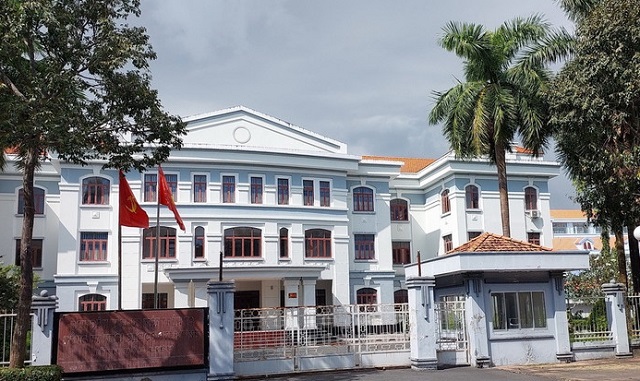
The former headquarters of the Fatherland Front and provincial associations in Bac Lieu are proposed to be transferred to the Land Development Center for auction or investment solicitation. (Photo: Tuan Kiet/TTXVN)
|
On December 4th, the Ministry of Finance held an online conference on the allocation, arrangement, and disposal of headquarters and public assets following the reorganization of administrative units and machinery.
Speaking at the conference, Deputy Minister of Finance Do Thanh Trung stated that, in line with directives from the Politburo, the Party Central Committee’s Secretariat, the Government, and the Prime Minister, the Ministry of Finance has issued numerous directives and guidelines. These aim to ensure uninterrupted operations for new machinery while effectively managing and disposing of surplus public assets to prevent waste and loss.
For challenges beyond its authority, the Ministry has promptly compiled and reported them to the Politburo and the Party Central Committee’s Secretariat for resolution.
According to the Ministry of Finance, many localities have taken decisive action with noticeable results. The provision of cars for newly reorganized communes is largely complete.
Machinery and equipment at the commune level are also largely secured and continue to be upgraded.
The disposal of surplus land and facilities has shown positive progress, with numbers decreasing over time; some localities, such as Nghe An, An Giang, Dien Bien, and Quang Ninh, have acted swiftly.
Director of the State Property Management Department Nguyen Tan Thinh reported that in November alone, localities disposed of 2,352 surplus land and facilities.
As of December 1st, a total of 17,496 facilities have been disposed of, equivalent to 65.89%. Of these, 798 facilities were allocated for healthcare, 4,002 for education, 1,314 for culture and sports, and 7,952 for administrative offices or public service operations.
However, reports from localities indicate that a significant number of surplus land and facilities still require disposal, with 9,056 facilities remaining as of December 1st, 2025.
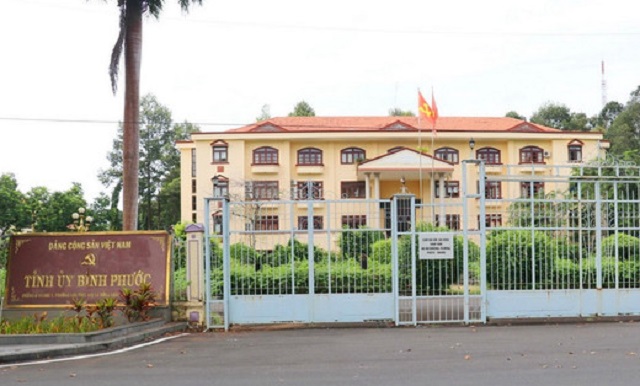
The People’s Committee of Dong Nai Province approved the People’s Committee of Binh Phuoc Ward to take over the former headquarters of the Binh Phuoc Provincial Party Committee for management and conversion into the new Binh Phuoc Ward Administrative Center under a dual-use model. (Photo: Nhat Binh/TTXVN)
|
At the conference, a representative from Hanoi reported that the city proactively implemented related tasks immediately after the Central Committee issued its conclusions and resolutions.
The Hanoi Party Committee issued a specialized resolution on the allocation, arrangement, and disposal of headquarters and public assets following administrative unit reorganization, providing a basis for the People’s Committee and the Department of Finance to guide and direct districts, wards, and communes.
The city collaborated with consulting units to review all land and facilities and organized multiple inspection and survey teams to accurately assess asset conditions.
To date, Hanoi has approved various disposal plans, including transferring headquarters, converting functions for cultural, sports, and public purposes; handing over to central agencies; transferring to public service units for management; or recovering and assigning to the Department of Natural Resources and Environment for processing as per regulations.
Hanoi has also essentially completed the provision of vehicles and machinery for newly reorganized administrative units.
Nghe An Province stands out for its comprehensive plans and regulations to review and dispose of unnecessary headquarters and land facilities.
The province has categorized, converted functions, or transferred assets to local management; it has also allocated vehicles to communes according to standards.
Challenges faced by Nghe An include incomplete legal documents for some facilities, inconsistent planning, a vast area, newly merged communes far from centers, and localized staffing surpluses or shortages.
Regarding upcoming tasks, Mr. Nguyen Tan Thinh stated that the Ministry of Finance will focus on key areas in line with directives from the Politburo, the Party Central Committee’s Secretariat, and Government regulations.
Localities are required to update and adjust land use planning, construction planning, and related plans following the transfer and functional conversion of land facilities; provincial planning must be completed by December 31st, 2025.
Asset disposal will comply with the Law on Management and Use of Public Assets and related decrees; ensuring infrastructure (headquarters) for new machinery and operations of officials, civil servants, and employees, with priority given to healthcare, education, culture, sports, and public purposes.
If surpluses remain, they will be utilized for socio-economic development goals, ensuring efficiency, compliance with laws, and preventing loss or waste.
For recovered or transferred assets such as schools, land facilities in remote or mountainous areas no longer suitable for headquarters, public service operations, healthcare, culture, sports, or other public purposes, and with no organizations or individuals requesting land allocation or lease, demolition and asset removal may be carried out. Land will then be managed by the People’s Committee of the commune or the Land Development Organization as per land law regulations.
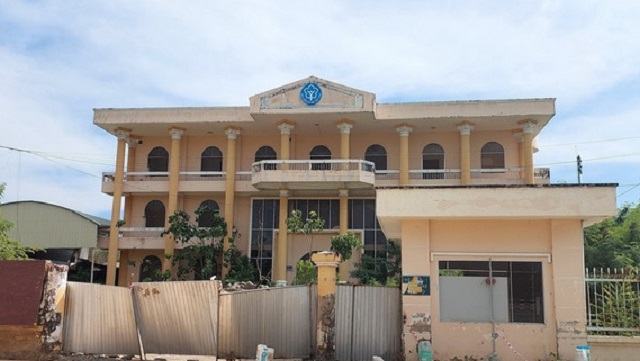
The former headquarters of the Bac Lieu Provincial Social Insurance Agency is currently vacant and deteriorating. (Photo: Tuan Kiet/TTXVN)
|
The Ministry of Finance also urges localities to promptly delegate authority for public asset disposal decisions; review and accurately identify surplus assets; issue appropriate disposal plans; and accelerate implementation to prevent deterioration and waste.
Cases involving transfers or functional conversions for healthcare, education, culture, sports, and commune police headquarters will be prioritized for upgrade and repair funding to expedite use.
For cars and machinery, localities must review all equipment according to standards; usable assets should be immediately transferred to units lacking such assets for efficient use and budget savings. Damaged or unusable assets must be promptly liquidated, with proceeds submitted to the budget, and funds should be proactively allocated for supplementary purchases.
Chairpersons of provincial and city People’s Committees should promptly announce deadlines for centralized procurement registration as per regulations to determine suitable procurement methods./.
Thuy Duong
– 12:21 04/12/2025
Over 9,000 Surplus Land and Property Facilities Nationwide
Streamlining administrative units and organizational structures, the Ministry of Finance reveals that over 9,000 surplus land and property assets remain nationwide, requiring further resolution. Starting this December, the progress of handling these redundant facilities will be made public.
Upcoming Proposals for Salary Increases and Allowance Benefits

Following the preliminary review of Resolution No. 27, the Ministry of Home Affairs will take the lead in collaborating with relevant ministries and agencies to thoroughly assess the feasibility and propose updated salary structures, new allowance systems, and bonus schemes.
The Ultimate Guide to Air Purifier Placement: Save on Energy Bills Without Compromising on Air Quality

Many families believe that investing in an air purifier guarantees a breath of fresh air. However, the truth is that incorrect placement renders the device almost useless, wasting electricity and failing to effectively filter out fine particles.