Cashless Travel on Cat Linh – Ha Dong Metro Line Starting December 5th
According to the Government’s electronic information portal, on the morning of December 5th, Hanoi Metro Company officially implemented an automated ticketing system utilizing electronic identification, authentication, biometric recognition, and cashless payment for passengers on the Cat Linh-Ha Dong urban railway line (Line 2A).
Over the past period, Hanoi Metro has collaborated with Visa and Thang Long Software Company to assess the current state of the AFC system on Lines 2A and 3.1. They developed solutions to upgrade the AFC management software, data servers, multi-standard readers, control circuits, and maximize the use of existing infrastructure, ensuring absolute safety and uninterrupted operation.

Chairman of Hanoi Metro’s Board of Directors, Khuất Việt Hùng, introduces the automated ticketing system with electronic identification, authentication, biometric recognition, and cashless payment to delegates (Photo: VGP).
According to Mr. Khuất Việt Hùng, Chairman of Hanoi Metro’s Board of Directors, after more than 4 months of implementing Plan 428, under the guidance of ministries, Hanoi People’s Committee, and close coordination with C06, RAR Center, and related units, Hanoi Metro has completed all tasks as required.
In terms of technology, Hanoi Metro has completed the installation of multi-standard readers, AI cameras, upgraded gate control circuits, servers, and system security; integrated with incident handling and fire alarm systems.
The company has completed account verification on the Hanoi Metro App, collaborated with relevant units to assess system security, and synchronized ticket data with VNeID, allowing citizens to check and use tickets directly on the app.
Simultaneously, they have implemented ticket sales on the national VNeID platform and developed an e-ticketing app on App Store and Google Play, supporting various ticket types and authentication methods (QR, NFC, chip ID cards), and deployed biometric recognition and cashless payment via e-wallets and bank cards using the “Tap & Go” model.
Laying the Foundation for a “Digital Transportation Passport” for Citizens
Speaking at the ceremony, Vice Chairman of Hanoi People’s Committee, Trương Việt Dũng, emphasized that today’s event marks a significant milestone—the first time a public transportation system in Vietnam integrates electronic identification, biometrics, and open EMV payment into actual operation.
The results of Phase 1 go beyond the scope of a technological solution. For the first time, a public transport system in Vietnam operates under a digital identity, biometric, and open payment model; passenger data, operational data, and payment data are integrated on a unified platform, laying the foundation for a “digital transportation passport” for Hanoi citizens.
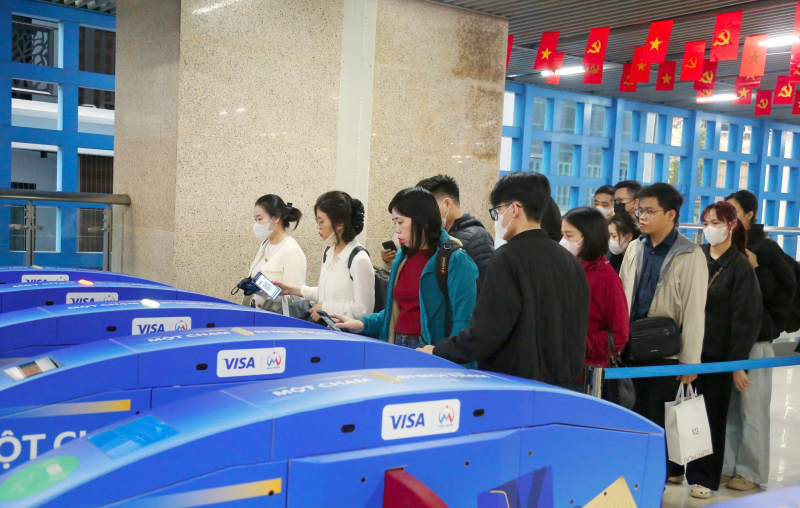
Citizens enthusiastically adopt the new ticketing method (Photo: People’s Police).
In Phase 2, the critical task is not only to expand the technical scale but also to enhance the connectivity of the entire urban transportation system. Vice Chairman Trương Việt Dũng urged Hanoi Metro to focus on three strategic pillars:
First, connect digital identities: Complete the integration of the AFC system with VNeID, the national ticketing platform, and the Ministry of Public Security’s transportation hub, aiming for one identity to access all transport modes and payment methods. This is the foundation for smart transportation and data-driven urban governance.
Second, connect metro infrastructure: Promptly establish a unified AFC system for both Lines 2A and 3.1, enabling Hanoi to operate two metro lines as a network for the first time, optimizing operational flow and enhancing service efficiency, instead of the current independent line model.
Third, connect the entire public transportation ecosystem: Proactively expand digital identity, biometrics, and open payment to national railway stations, buses, parking lots, and the city’s inter-connected ticketing system, moving towards a unified, smart, and convenient Hanoi transportation platform.
Metro Bến Thành – Suối Tiên: 104 Billion VND in Ticket Sales, 142 Billion VND Loss in First Half of 2025

During this period, Hanoi Metro Company Limited (Hà Nội Metro), the operator of the Cát Linh-Hà Đông and Nhổn-Ga Hà Nội metro lines, reported a post-tax profit of 9.98 billion VND.
Cát Linh – Hà Đông Metro Suspends Monthly and Daily Ticket Sales Starting November 10th

Starting November 10th, Hanoi Metro will discontinue the sale of monthly, weekly, and daily passes on the Cat Linh – Ha Dong urban railway line. This change is being implemented to facilitate the introduction of a QR code-based ticketing system, which will utilize biometric authentication for a more streamlined and secure passenger experience.
Appointing the CEO of Hanoi Metro

The Hanoi People’s Committee has officially appointed Mr. Le Bang An, a member of the Board of Directors at Vietnam Railways Corporation, as the new General Director of Hanoi Metro.
Great news for Vinhomes, An Khánh, and The Matrix One residents: The “Super Metro” 62,000-billion-VND project is about to begin construction, reducing travel time to the capital’s center.

The upcoming launch of Metro Line 5 is set to revolutionize travel, offering significantly reduced travel times and a host of benefits for residents and businesses along its route. This new line will directly connect and enhance the accessibility of numerous key urban areas and large-scale projects, transforming the way people move and interact within the city.
Almost 1.8 Million Passengers Took the Metro During the National Day Holiday

“Hanoi Metro, a limited liability company, has released passenger service statistics for the Cat Linh – Ha Dong and Nhon – Cau Giay urban railway lines during the recent National Day holiday peak. Impressively, these two lines served approximately 1.8 million passengers, showcasing a significant demand for the electric train service.”