At the 8th Annual Forum (AF8) themed “Regional Board Excellence: Building Trust and Reputation in the Capital Market,” organized by VIOD on December 5th, Mr. Michael Kokalari, Chief Economist at VinaCapital Fund Management, projected Vietnam’s GDP growth to reach 7.5% in 2025 and 8% in 2026.
Vietnam’s current GDP growth hinges on two key factors: exports to the U.S. and the recovery of Chinese tourism. Exports to the U.S. surged by 28% in the first nine months of 2025, contributing approximately 2 percentage points to the year’s GDP. This boom benefits from the U.S.’s “K-shaped economy,” where the affluent (accounting for nearly 50% of total U.S. spending) maintain robust purchasing power.
Additionally, the rebound in international tourism, with a 20% increase in visitors in 2025, adds another 1 percentage point to growth. “Stripping away the tourism-driven growth, particularly the return of Chinese tourists, reveals that Vietnamese household spending is growing at just 5%, significantly below pre-pandemic trends,” noted the VinaCapital expert.
This slowdown stems from post-COVID household financial behavior. VinaCapital’s analysis shows that savings depleted during lockdowns, leading to a “belt-tightening” phase to rebuild reserves. Household savings rates have soared to nearly 30% of income, 10 points above the pre-pandemic average of 20%. This explains why disposable income growth of 6-7% hasn’t translated into higher consumption—funds are parked in defensive assets rather than circulating in the economy, creating pent-up demand.
However, this sets the stage for VinaCapital’s optimistic 2025 forecast. Mr. Kokalari predicts peak growth in mid-2026 once the savings rebuild is complete.
The 8% GDP growth in 2026 will come from sustainable export and tourism growth, coupled with normalized domestic spending. The most significant driver will be infrastructure investment. The Vietnamese government has pledged substantial spending, but commitments (up 43% year-to-date) far exceed actual construction outlays (9%). This gap is expected to translate into real projects and market liquidity in 2026, boosting infrastructure investment from 7% of GDP in 2025 to 10% in 2026. Key projects like the North-South Expressway will decentralize FDI, encouraging production in regions with more competitive labor costs.
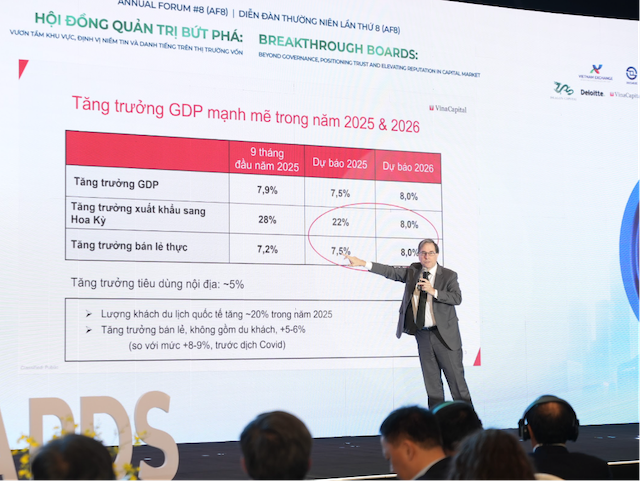
Mr. Michael Kokalari, Chief Economist at VinaCapital
|
Cost of Capital and Corporate Governance
Alongside growth optimism, VinaCapital highlights the challenge of high Cost of Capital. Mr. Kokalari notes Vietnam’s equity cost of capital at 15.2%, the highest in the region, compared to Thailand (8.1%) and Indonesia (13%). This hampers international competitiveness.
To address this, Mr. Kokalari outlines two goals: upgrading Vietnam’s market status from frontier to emerging (via FTSE and MSCI) and achieving investment-grade credit ratings. These steps are expected to lower international borrowing costs for the nation and its businesses.
On corporate governance (CG) and transparency, Ms. Alejandra Medina, OECD’s Asia CG Program Manager, highlights Vietnam’s gaps with global standards. Vietnam is absent from the “OECD Corporate Governance Factbook” (covering 52 countries, including 8 in Asia like China and India). This lack of standardized data deters institutional investors managing $125 trillion in global market capitalization.
“Foreign investors expect timely, transparent information. Vietnamese firms’ limited IFRS adoption and English reporting are significant barriers,” Ms. Medina emphasized.
She also notes Asia’s unique ownership structure, with institutional investors holding just 18% of market capitalization versus 47% globally, increasing agency risks. CG reforms, especially amid ESG and dual-class share trends, are crucial for attracting long-term capital.
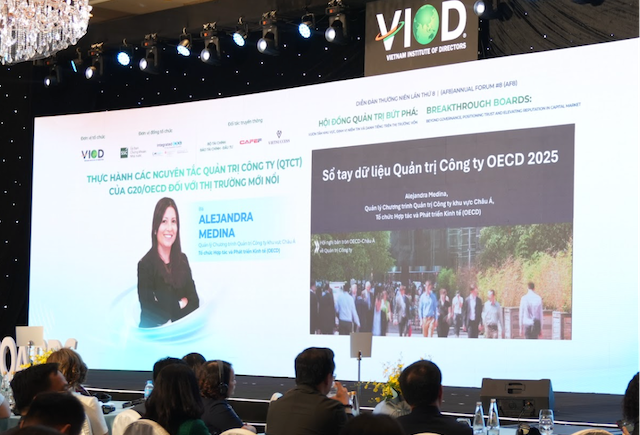
Ms. Alejandra Medina, OECD Asia CG Program Manager
|
Innovation Reform 2.0 and Vietnam’s AI Advantage
VinaCapital’s confidence in sustainable growth stems not only from cyclical data but also from government reforms. Mr. Kokalari praises the “Innovation 2.0” phase, aiming to shift growth drivers from FDI to domestic productivity.
Long-term, he recommends emulating East Asian models like Japan and South Korea, focusing on Michael Porter’s industrial clusters. Vietnam should leverage its AI talent advantage and allow universities to commercialize tech innovations, particularly in healthcare and AI.
Despite currency pressures from low forex reserves (2.5 months of imports), potentially weakening the VND by 4-5% in 2025-2026, Mr. Kokalari forecasts a 25% stock market rise in 2026, driven by strong corporate earnings as consumption and infrastructure peak.
– 13:04 05/12/2025
Global Capital Flows Prioritize Markets with Transparency and Strong Governance
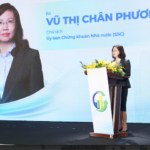
FTSE Russell’s upgrade of Vietnam to secondary emerging market status marks a pivotal phase of growth, demanding heightened transparency and governance. While progress has been made, the ASEAN Corporate Governance Scorecard reveals Vietnam still lags behind regional leaders. As global capital increasingly favors transparent economies, elevating governance standards has become a critical strategy for Vietnamese businesses to seize new opportunities.
SHS Honored for the 6th Time Among VLCA’s Top 10 Best Annual Reports
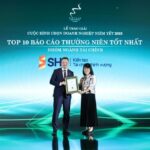
On December 3, 2025, Saigon-Hanoi Securities Corporation (SHS) was honored among the Top 10 Best Annual Reports in the Financial Sector at the 18th Vietnam Listed Companies Awards (VLCA) 2025.
ACB Honored Among “Top 10 Best Annual Reports” in the Financial Sector

ACB has been honored as one of the Top 10 Best Annual Reports in the financial sector at the 2025 Listed Company Awards (VLCA 2025). This prestigious recognition highlights ACB’s commitment to maintaining high standards of transparent and accurate information disclosure, truly reflecting its strategic development vision.
EVNGENCO3 Secures Spot in Top 20 Best Annual Reports for Non-Financial Sector in 2025

At the 2025 Vietnam Listed Company Awards (VLCA) and Listed Company Conference held on December 3, 2025, Power Generation Corporation 3 – JSC (stock code PGV – HoSE) was honored to receive the Top 20 Best Annual Reports award in the non-financial sector category.
Dragon Capital Securities Bags Double Honors at VLCA 2025
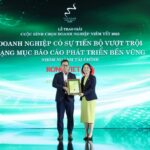
On December 3, 2025, at the Listed Company Awards Ceremony, Vietnam Dragon Securities Corporation (VDSC) was honored to receive two prestigious accolades: the Outstanding Progress Award in the Sustainable Development Report category and a place among the Top 10 Companies for Best Corporate Governance.