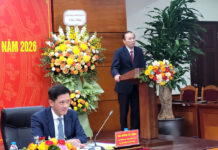












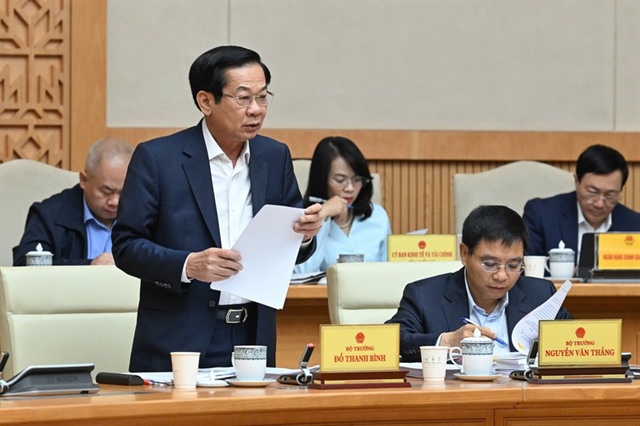
Minister of Home Affairs Do Thanh Binh reports on the operation of the two-tier local government system – Image: VGP |
This information was presented by Minister of Home Affairs Do Thanh Binh during the regular November 2025 government meeting, as part of the assessment of the two-tier local government system’s operation.
Minister Do Thanh Binh stated that from June 1 to December 3, 2025, the government issued over 170 legal documents and guidelines related to the implementation of the two-tier local government model.
Notably, in November, the government issued Resolution No. 374/NQ-CP on November 19, 2025, approving a support package of 2,615 billion VND for 27 localities (second phase) to repair, upgrade facilities, and procure equipment and vehicles for commune-level administrative units, facilitating the implementation of the two-tier local government model.
Additionally, the Government Steering Committee and relevant ministries have promptly issued guidelines, conducted training, and addressed local challenges to ensure the unified and synchronized operation of the two-tier local government system.
Streamlined Organizational Structure and Personnel
Regarding organizational structure, Minister Do Thanh Binh reported that all localities have essentially completed the appointment of leadership positions in the People’s Committees and People’s Councils; only 5 localities still have vacancies and are working to fill them promptly.
466 provincial-level specialized agencies and 9,916 commune-level specialized divisions have commenced operations. According to the Ministry of Agriculture and Environment, as of December 2, 24 out of 34 provinces and cities have developed plans to streamline the functions and tasks of provincial-level agricultural extension centers; 24 out of 34 provinces and cities have organized and streamlined commune-level agricultural extension units, with 10 provinces and cities actively implementing these measures as directed by the Central Government and relevant guidelines.
The review, arrangement, and deployment of officials and civil servants at the commune level to meet task requirements have received significant attention from many localities, yielding positive results.
To date, nearly 4,000 officials, civil servants, and public employees have been transferred, seconded, accepted, and assigned to commune-level positions across various localities. Some localities with large-scale implementations include Hanoi, An Giang, Can Tho, Bac Ninh, and Phu Tho. Notably, Hanoi alone has reassigned approximately 1,200 officials.
Localities have also intensified training and skill development to ensure that the cadre workforce remains closely aligned with practical needs, addressing emerging issues at the grassroots level promptly.
61.54% of Delegated Tasks Deemed Highly Feasible
Based on reports from 30 out of 34 localities and feedback from all 12 ministries, the Ministry of Home Affairs has submitted a report to the Prime Minister regarding the feasibility of 949 tasks delegated from the Central Government to local authorities.
Accordingly, 584 out of 949 tasks (61.54%) are considered feasible for implementation; 355 out of 949 tasks (37.41%) require the issuance of legal documents or implementation guidelines, and 10 out of 949 tasks (1.05%) necessitate adjustments to the authority between the Central Government and local authorities or among different levels of local government.
Regarding finance, budget, facilities, public assets, and official residence arrangements, according to the Ministry of Finance, 178 commune-level units in 4 provinces lacking equipment have now been fully equipped. All commune-level units have opened treasury accounts and been provided with machinery for their operations.
In public asset management, significant achievements have been noted: 17,496 land and property cases have been processed, with 9,056 cases still under review. Only 89 communes (2.68%) in 3 provinces still lack service vehicles; localities have allocated funds for procurement.
Localities have also actively arranged official residences based on actual needs. In November, Quang Ngai and Da Nang issued separate resolutions to support officials at one-stop service centers and workers post-restructuring.
From July 1 to November 30, 34 localities received 21.8 million administrative procedure dossiers, an increase of 5.9 million compared to the previous month, with 18.4 million submitted online. Commune-level units alone received 13.4 million online dossiers.
The rate of administrative procedure dossiers processed on or before the deadline, based on synchronized dossiers across localities, reached 92.78%.
As of December 1, nationwide efforts have brought electricity to 47 out of 129 previously unconnected villages, an increase of 11 villages from the previous month. However, 82 villages remain without electricity, many located deep in special-use forests or highland areas with challenging construction conditions and frequent natural disaster impacts.
Despite these positive outcomes, Minister Do Thanh Binh acknowledged that the two-tier government model still faces challenges. In terms of institutions and policies, 355 tasks still require guiding documents, and 10 tasks need authority adjustments.
Some regulations remain incompatible with the two-tier local government model, such as: operating licenses for medical examination and treatment at restructured health stations; restructuring of provincial-level Industrial and Economic Zone Management Boards; public service units under provincial People’s Committees; recruitment authority for education sector employees at commune-level public service units; and administrative penalties in the field of beliefs and religions.
Regarding administrative procedures, according to the Government Office, 29 citizen-related procedures in residence management and 42 procedures related to criminal record certificates still need improvement, requiring further reduction and simplification. Many administrative procedures have regulations unsuitable for full-process online public services…
Additionally, the database system lacks synchronization; despite positive outcomes, the progress in signal coverage and electrification remains slow.
Enhancing Legal Framework, Promoting Digital Transformation, and Ensuring System Connectivity
To ensure the effective operation of the two-tier local government model, Minister of Home Affairs proposed that ministries and sectors urgently resolve bottlenecks in accordance with Central Committee conclusions and the Government Steering Committee’s requirements.
This includes promptly issuing guidelines for the implementation of 355 tasks; developing proposals for authority adjustments and outlining amendments to laws, decrees, and existing legal documents. For issues that cannot be resolved immediately, specific assignment plans, timelines, and comprehensive information should be provided to agencies, units, and localities.
Simultaneously, administrative procedures should be reduced and simplified in line with Resolution 66/NQ-CP; information technology should be applied, and digital transformation should be promoted in management and administration to ensure data connectivity between national and local systems.
Localities should expedite the streamlining of agricultural extension units and land registration offices according to the two-tier model; arrange public employees at the commune level, establish comprehensive public service provision units; continue to refine organizational structures, arrange sufficient commune-level officials to meet assigned tasks, and boldly replace underperforming officials.
Attention should be given to providing adequate transmission and connection signals; completing digital infrastructure, platforms, and data to ensure seamless connectivity between central and commune-level authorities…
– 8:30 PM, December 6, 2025
Prime Minister: Eliminating Institutional Bottlenecks with the ‘3 No’s’ Spirit

Prime Minister Pham Minh Chinh emphasized the need to address institutional bottlenecks with innovative thinking, urgent action, and a “3 No” spirit: no perfectionism, no haste, and no missed opportunities. This approach aims to transform legal frameworks from obstacles into competitive advantages.
Prime Minister Chairs October Government Meeting, Deliberating Key National Agendas
On the morning of November 8th, Prime Minister Pham Minh Chinh chaired the regular October 2025 government meeting, held online with local authorities across the country.
Prime Minister: All Obstacles in Two-Tier Government Operations Must Be Resolved by End of 2025

On the afternoon of October 29th, Prime Minister Phạm Minh Chính chaired a government meeting to discuss the implementation progress of Central Committee and National Assembly resolutions regarding the organization and operation of two-tier local governments.
Can Tho City: Public Investment Disbursement Falls Below National Average
The Chairman of Can Tho City has urged all departments, agencies, and local authorities to accelerate their efforts in the fourth quarter of 2025 to ensure the timely completion of assigned tasks.
Prime Location in Ho Chi Minh City: Establishing a Free Trade Hub
Leveraging the inherent advantages of the locale, the leadership of Saigon Ward has expressed a vision to establish several duty-free shopping centers. These hubs would primarily offer tax exemptions, reduced taxes, or permit transactions in foreign currencies, strategically designed to attract international visitors and bolster foreign currency inflows.