Dr. Nguyen Duy Quang from the University of Economics and Finance (UEF) in Ho Chi Minh City shared his insights with Nguoi Lao Dong Newspaper regarding the proposed taxation on gold bar transactions, a topic currently attracting significant attention.
+ Reporter: Do you think imposing personal income tax on gold bar transactions will effectively curb speculation or increase costs for individuals who traditionally store gold?

Dr. Nguyen Duy Quang
A 0.1% tax on the total transaction value will undoubtedly increase transaction costs, thereby reducing the profit margins for short-term speculators and day traders. Since the tax is directly proportional to the transaction volume, speculators must carefully consider their potential gains and losses before acting, which helps mitigate the sensitivity of hot money flows into gold.
However, for small-scale savers who do not engage in trading, this additional cost remains, despite their actual profits being negligible.
+ The Ministry of Finance plans to specify the threshold for taxable gold bar transactions, exempting individuals who buy and sell gold for savings purposes (not for business). What do you consider a reasonable transaction value threshold for taxation?
A reasonable tax threshold should be based on the average transaction volume and value per capita over a defined period (quarterly or annually). For instance, 10 taels of gold per person per quarter could serve as a reference point, as amounts below this typically fall under traditional savings. This threshold should also be periodically adjusted to reflect gold price fluctuations and inflation rates, ensuring it remains effective in categorizing different groups.
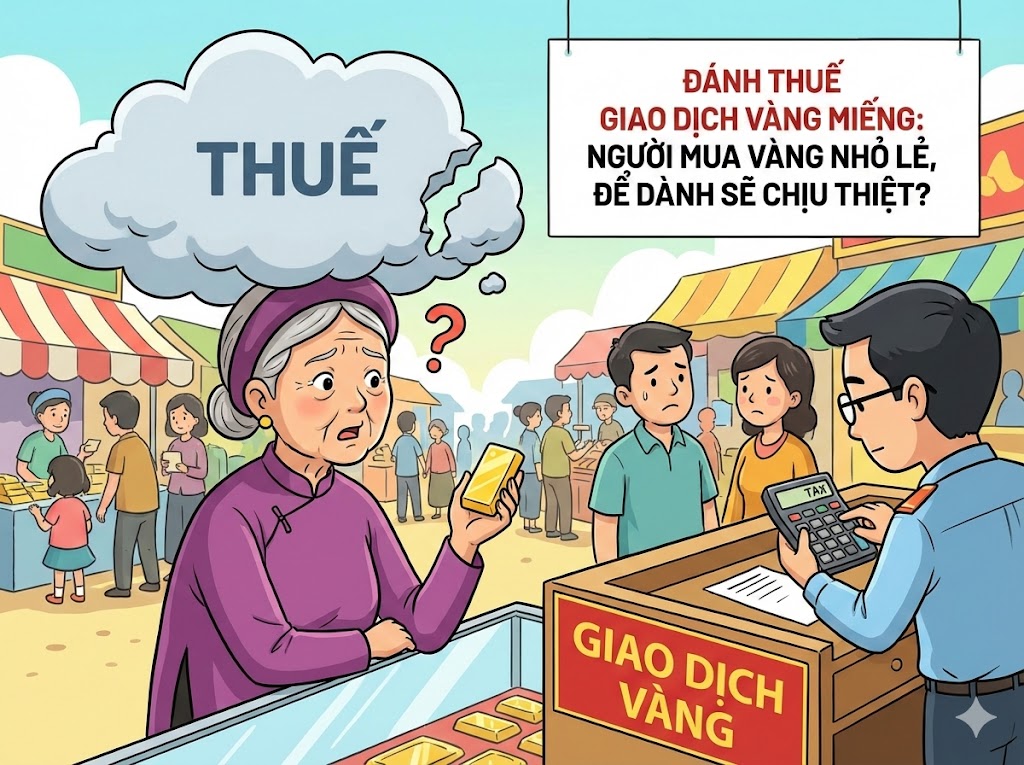
Illustrative image: Gemini – V.Vinh
In other words, a reasonable criterion for determining the tax threshold should be based on the average gold transaction volume per household (e.g., 5-10 taels per month), combined with the nature of the transactions (frequent buying and selling within a period) and the proportion of transactions exceeding the threshold relative to the individual’s total financial assets.
In addition to absolute volume, transaction frequency criteria can be applied: taxation only occurs when the total value exceeds the threshold and the number of transactions within the period surpasses a specified limit (e.g., more than 5 transactions per quarter). This approach combines both quantitative and behavioral aspects, minimizing the likelihood of small-scale savers being taxed unfairly for occasional sales. Thus, only transactions with clear speculative intent would be taxed, while practical small-scale savings would remain exempt.
+ Could setting a tax threshold lead to transaction splitting or using others’ names to avoid taxation?
Currently, regulations require any individual transaction exceeding 20 million VND to be conducted via bank transfer linked to their citizen identification number, allowing tax authorities to automatically cross-check. This measure aims to curb cash-based transactions while holding both buyers and sellers accountable. The cash limit for transactions below the threshold protects small-scale savers, but transactions above the threshold must be disclosed through bank transfers.
Additionally, regulations mandate the recording of serial numbers on each gold bar at the point of sale, stored in a centralized electronic ledger. During transactions, sellers must provide the serial number, which is cross-checked against the ledger to determine the total transaction volume.
Combining both approaches, transactions below the threshold can still be conducted in cash without electronic ledger updates, while transactions above the threshold require bank transfers and serial number updates. Blockchain technology can also be employed to record ownership chains, prevent counterfeiting, and deter disguised splitting. This mechanism simplifies processes for ordinary citizens while effectively preventing speculation and transaction splitting across multiple names.
Two Strategic Measures
Dr. Nguyen Duy Quang also suggests implementing a progressive tax mechanism based on holding periods. Transactions occurring after 12 months from the purchase date would be subject to a lower tax rate, encouraging long-term savings and reducing short-term speculation.
Simultaneously, developing a digital gold market on a blockchain platform, where physical gold bars are certified by the state or financial institutions and tokenized, would enhance transparency and traceability while reducing storage and physical verification costs. Integrating tax policies within a modern financial and monetary framework would support the healthy development of the traditional gold market.
International Organizations Maintain Positive Outlook on Vietnam’s Economic Prospects

On the afternoon of December 6th, the Government Office held its regular November 2025 press conference. Minister and Chairman of the Office of the Government, Trần Văn Sơn, who also serves as the Government Spokesperson, chaired the event. The conference provided updates on the socio-economic situation for November and the first 11 months of 2025.
CIO Techcombank in the Hot Seat: Leveraging AI for Real-World Problem Solving

“A.I Thực Chiến,” the first-ever national TV competition focused on artificial intelligence and a flagship AI program nationwide, is nearing the end of its semi-final rounds. In the latest episode, teams tackled the theme “Building a Bank’s Financial Report,” judged by special guest Mr. Nguyễn Anh Tuấn, Director of Technology Division at Techcombank. During the segment, Techcombank’s CIO unveiled a four-step process to transform data-driven ideas into complete AI solutions, while also discussing the role of businesses in nurturing Vietnam’s next generation of AI talent.
Credit Reaches VND 18.2 Trillion as of November 27, Up 16.56% Year-to-Date

Credit growth is showing promising signs, with a positive trajectory compared to previous years. As of November 27, 2025, the economy’s credit reached over 18.2 million billion VND, marking a 16.56% increase from the end of 2024. This growth is particularly notable when compared to the same period in 2024, which saw an 11.47% increase from the end of 2023, and the end of 2024, which recorded a 15.09% rise from the end of 2023.
Unveiling the International Tea Festival: Celebrating a Legacy of Record-Breaking Achievements

The International Tea Festival – World T.E.A Fest 2025 officially opens on the evening of December 5th at Lam Vien Square (Da Lat). Featuring an international scale and the participation of numerous experts, ambassadors, and domestic and foreign businesses, the festival marks a significant milestone in promoting Vietnamese tea culture and propelling the tea industry onto the global stage.
Tax Expert: No Tax Hikes for Registered Businesses—Maintain 1% Sales Revenue and 4.5% Service Rates, but Accurate Reporting is Mandatory

Experts suggest that transitioning from lump-sum tax to self-assessment enhances transparency and reduces risks, rather than burdening small businesses.