Establishment of the Government Investment Fund in December 2025
Regarding key directives, tasks, and solutions, the Prime Minister has instructed ministers, heads of sectors, and requested secretaries and chairpersons of local authorities to focus on the vigorous, synchronized, timely, and effective implementation of resolutions and conclusions from the Party Central Committee, the Politburo, and the Secretariat. This includes Conclusion No. 199-KL/TW dated October 10, 2025, on the socio-economic agenda for 2025-2026, as well as directives from General Secretary Tô Lâm, National Assembly resolutions, government decrees, and the Prime Minister’s instructions. Proactive measures must be taken to address any unforeseen issues promptly.
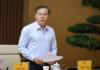
 November’s Regular Government Meeting. Photo: VGP
|
The Prime Minister emphasized that all government members, ministers, sector heads, provincial leaders, and civil servants at every level must work responsibly and diligently, prioritizing national and public interests. Special attention must be given to post-flood recovery efforts, including the repair of 34,352 damaged homes and the construction of 1,628 new homes for affected families. Repairs must be completed by December 31, 2025, and new constructions by January 31, 2026, ensuring “everyone has a home, every family celebrates Tết, and no one is left behind.” Efforts should also focus on restoring production, creating jobs, and disbursing public investment capital to stimulate economic development.
The Prime Minister outlined ten key task groups and solutions, emphasizing thorough preparation for the 10th National Assembly session’s closing, draft proposals, reports for the Party Central Committee, Politburo, and Secretariat, and the National Emulation Congress, leading up to the 14th National Party Congress.
Ministers and sector heads are to meticulously review and prepare draft proposals, reports, and legislation for submission to the Party Central Committee, Politburo, Secretariat, and National Assembly, ensuring quality and timeliness. Priority should be given to finalizing laws and resolutions for approval during the 10th National Assembly session.
Preparations for the National Emulation Congress must be organized effectively, with the Ministry of Home Affairs expediting the recognition of outstanding individuals and organizations by December 10, 2025.
Second, maintaining macroeconomic stability, controlling inflation, ensuring economic balances, and fostering growth remain top priorities.
Monetary policy must be proactive, flexible, and efficient, coordinated with a focused fiscal expansion policy. The State Bank of Vietnam (SBV) is tasked with inflation control, interest rate management, and credit allocation for growth sectors, while ensuring financial stability and addressing risks in real estate and other sectors. The establishment of a gold trading platform is to be proposed by December 2025.
The Ministry of Finance will enhance its role in growth promotion through public investment disbursement, tax incentives, and government bond issuance for major projects. Efforts aim to exceed the 2025 state budget collection target by 25% and finalize Draft Resolution 01 for 2026 by December 15, 2025.
The Ministries of Finance, Industry and Trade, and Agriculture and Environment will collaborate to ensure market stability, particularly during year-end festivities, preventing shortages and price hikes.
Third, revitalizing traditional growth drivers and fostering new ones is essential.
The Ministry of Finance will focus on full disbursement of public investment, establishment of the International Financial Center, and attracting FDI and private investment. The Government Investment Fund is set for launch in December 2025, alongside the 2026 state budget and investment plan allocation.
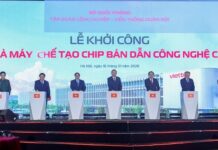
The Ministry of Construction will oversee the inauguration and commencement of key projects by December 19, 2025, finalize railway project standards, and establish the State-Managed Real Estate and Land Use Rights Trading Center by December 15, 2025.
The Ministry of Industry and Trade will boost domestic consumption through e-commerce, essential goods supply, and year-end promotions, while combating trade fraud and establishing the National Trade Fair Steering Committee by December 10, 2025.
Export promotion efforts will focus on market and product diversification, with negotiations for FTAs with GCC, Pakistan, Egypt, and South America, aiming for one agreement by year-end 2025. The Ministry of Agriculture and Environment will work on market access for Vietnamese agricultural products and address IUU fishing issues by December 2025.
New growth drivers will include institutional reforms, technological innovation, digital transformation, green and circular economies, and emerging sectors like semiconductors and AI. Regional connectivity, urban development, and exploration of underground, space, and marine resources are also prioritized.
Fourth, resolute implementation of Politburo Resolutions 57, 59, 66, 68, 70, 71, and 72, with new resolutions on state economy, FDI, and culture to be proposed.
The Ministry of Science and Technology will finalize the National Science and Technology Program for strategic products by December 10, 2025, and submit the National Startup Innovation Strategy by December 2025.
Fifth, legal frameworks for planning and approved plans will be revised to align with the two-tier local government model and double-digit growth targets.
Sixth, administrative reforms and the two-tier local government model will be prioritized, with the Ministry of Home Affairs submitting implementation documents for Conclusion 206-KL/TW by December 15, 2025.
Seventh, addressing long-delayed projects is crucial, with SBV restructuring SCB Bank and the Ministry of Finance implementing solutions for 3,000 stalled projects.
Eighth, ongoing disaster recovery and preparedness efforts will focus on aid distribution, infrastructure restoration, and community resilience, led by the Ministry of Agriculture and Environment.
Ninth, social welfare, cultural development, and affordable housing are key, with a target of 100,000 social housing units in 2025.
Tenth, strengthening defense, security, and international cooperation, while enhancing public communication and countering misinformation, is essential for social consensus.
The Prime Minister urged all leaders to ensure effective implementation of these tasks, striving for the highest achievements in 2025 and the 2021-2025 period, setting the stage for the 14th National Party Congress.
– 17:30 06/12/2025
International Organizations Maintain Positive Outlook on Vietnam’s Economic Prospects

On the afternoon of December 6th, the Government Office held its regular November 2025 press conference. Minister and Chairman of the Office of the Government, Trần Văn Sơn, who also serves as the Government Spokesperson, chaired the event. The conference provided updates on the socio-economic situation for November and the first 11 months of 2025.
Gold Prices, Real Estate Soar, Inflationary Pressures Mount

On the morning of December 6th, Prime Minister Pham Minh Chinh chaired the regular November government meeting, focusing on discussions surrounding several critical agenda items.
Ho Chi Minh City Mandates Public Disclosure of Delayed Project Lists
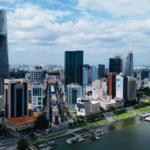
Ho Chi Minh City has directed relevant units to review and promptly reallocate capital from delayed projects to those with better disbursement potential. Additionally, the city will publicly disclose projects that are behind schedule.
Accelerating Infrastructure: Ho Chi Minh City Urges Faster Progress on Multiple Highways and Metro Projects
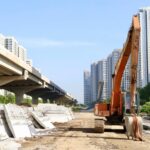
Ho Chi Minh City mandates the timely handover of all land areas, strictly prohibiting any actions that hinder construction, to ensure the punctual completion of critical infrastructure projects.
Striving for Disbursement to Fuel Growth
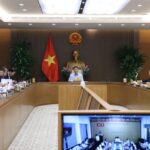
This morning, November 27th, Deputy Prime Minister Le Thanh Long chaired a meeting at the Government Office to discuss the disbursement of public investment capital for the Ministry of Health and the Ministry of Education and Training. The meeting also addressed An Giang province’s production and business activities, public investment capital disbursement, import-export, infrastructure development, social housing, national target programs, and the implementation of the two-tier local government system.