THACO Group and Hyundai Rotem (South Korea) have signed a strategic partnership agreement to localize the production of rolling stock for urban railways and high-speed trains in Vietnam. The agreement was signed by Mr. Lee Yong-bae, CEO of Hyundai Rotem, and Mr. Tran Ba Duong, Chairman of THACO’s Board of Directors, amidst Vietnam’s push to develop its railway industry and modernize its transportation infrastructure.
Under the agreement, Hyundai Rotem will transfer core technology and support THACO in manufacturing urban railway and high-speed trains under a Vietnamese brand.
Beyond technology transfer, the two companies will collaborate to build an integrated system encompassing rolling stock, signaling, electrical and mechanical (E&M) systems, as well as comprehensive operation, maintenance, and repair services.
The goal is to enable THACO to master the railway value chain, optimize costs, and meet international technical standards.
THACO plans to establish a Railway Industrial Complex within the 786-hectare Mechanical and Supporting Industry Park in Binh Co Ward, Ho Chi Minh City. The complex will include a rolling stock production area, a closed-loop test track, and a major maintenance and repair center.
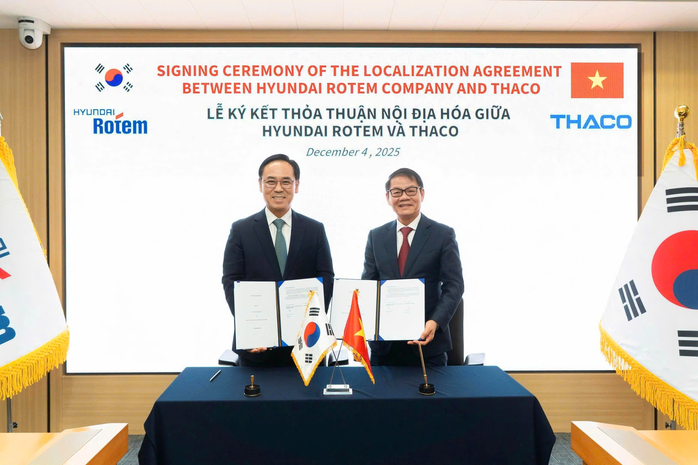
Mr. Tran Ba Duong, Chairman of THACO’s Board of Directors, and Mr. Lee Yong-bae, CEO of Hyundai Rotem, at the signing ceremony
From June to August 2025, THACO’s leadership visited South Korea to work directly with Hyundai Rotem, attended a railway exhibition, and signed a memorandum of understanding at the Vietnam-Korea Economic Forum, witnessed by high-ranking officials from both countries.
On December 4, a THACO delegation inspected the Shinbundang Metro Line—a fully automated, driverless GoA4 system operating 24/7. The team also studied maintenance models and technical processes at the DXLine Depot to inform the design of a domestic maintenance center.
In addition to technology collaboration, THACO has proposed investing in the North-South High-Speed Railway project, with a total capital of over 1,560 trillion VND (61.35 billion USD, excluding land clearance). The company aims to hold at least 51% of the project’s equity, contributing approximately 312 trillion VND directly. The remaining 80% will be financed through domestic and international loans, backed by government guarantees and a 30-year interest rate subsidy. After this period, THACO will repay the funds according to the agreed financial plan.
Government Proposes Facilitating Private Investment in North-South High-Speed Railway Project
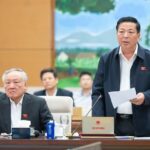
The government emphasizes the necessity of continually reviewing and enhancing mechanisms and policies when opting for non-budgetary investment models for the North-South high-speed railway project.
Why Does Ho Chi Minh City Require $450 Million for High-Speed Rail Development?
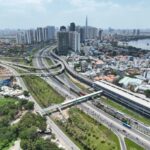
Ho Chi Minh City has released a progress report on its urban railway projects, with a key focus on land clearance for the North-South high-speed rail line.
Ho Chi Minh City Set to Launch Series of Metro and Rail Projects Starting 2026
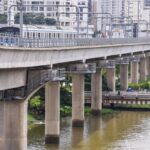
Ho Chi Minh City is accelerating the development of multiple metro and rail projects, aiming to complete a modern transportation network by 2035.
Why Are Billionaires Pham Nhat Vuong, Tran Dinh Long, and Tran Ba Duong Competing to Propose the North-South High-Speed Railway Project?
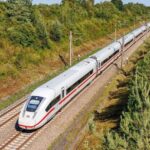
The North-South High-Speed Railway is the nation’s backbone and lifeline, designed with dual functionality to drive socioeconomic development and bolster national defense and security.
FiinGroup Chairman: Core Challenge of North-South High-Speed Railway Project Lies Beyond “Capital” or “Funding”

The Chairman of FiinGroup asserts that while capital mobilization for the North-South high-speed railway project presents a significant challenge, the core issue transcends mere “capital” or “funding.”