The final months of 2025 have seen a surge in the aviation market as airlines launch new domestic and international routes to meet the growing demand for travel and tourism.
Massive Expansion of New Routes
Vietnam Airlines has announced the operation of the Ho Chi Minh City – Dien Bien – Hanoi route starting December 24. Earlier, on December 3, the airline also launched a direct route from Hanoi to Cebu, connecting Vietnam’s capital with the Philippines’ renowned tourist destination. Notably, from December 15, Vietnam Airlines will inaugurate a direct route from Ho Chi Minh City to Copenhagen, Denmark, expanding its European network.
Meanwhile, Vietjet is accelerating its growth with multiple new flight plans. From December 3, the airline resumed flights connecting Hanoi and Ho Chi Minh City with Con Dao, operating one round-trip flight daily.
From December 19, Vietjet increased the frequency of its Ho Chi Minh City – Manila route to daily flights. The airline also boosted the Hiroshima – Hanoi route to four round-trip flights weekly from December 20, bringing the total number of flights connecting Vietnam with major Japanese cities—Tokyo, Osaka, Nagoya, Fukuoka, and Hiroshima—to 70 weekly flights.
Additionally, Vietjet recently launched a route connecting Kuala Lumpur, Malaysia, with Da Nang, marking the third route between Malaysia and Vietnam after Hanoi and Ho Chi Minh City.
Vietjet has also announced the acquisition of 22 aircraft in less than a month, preparing for the peak Tet 2026 season and expanding its international network. The fleet includes 9 Boeing aircraft, 7 Airbus aircraft, 4 wet-leased aircraft, and 2 COMAC aircraft.
The new airline, Sun PhuQuoc Airways, has taken delivery of its first four Airbus A321NX and Airbus A321CEO aircraft, part of the eight aircraft planned for operation in 2025. Mr. Nguyen Manh Quan, CEO of Sun PhuQuoc Airways, stated, “The addition of these aircraft will significantly enhance our operational capacity at a time when market demand is soaring. This is a crucial step in preparing to increase flight frequencies and launch new routes in 2026.”
Starting March 2026, Sun PhuQuoc Airways will operate regular flights from Da Nang to Phu Quoc and Nha Trang to Phu Quoc. The airline also plans to launch international routes from Phu Quoc to South Korea, Taiwan (China), Thailand, Singapore, Hong Kong (China), and India in 2026.
Alongside new routes, aviation infrastructure is also being upgraded. Vinh Airport (Nghe An) will reopen and welcome its first flight on December 19 after a period of renovation. The expansion project of Terminal 2 at Noi Bai Airport is scheduled for completion on December 19.
At Phu Quoc International Airport, a representative from Sun Group’s airport management company reported peak season operations with over 120 flights daily. After officially taking over the airport’s operations on January 1, 2026, the company will renovate and expand Terminal 1, increasing its capacity to 8 million passengers annually.
The Civil Aviation Authority of Vietnam estimates that by the end of 2025, the industry will serve approximately 84 million passengers and 1.4 million tons of cargo, representing an 11.4% and 18% increase, respectively, compared to the previous year. “The rising demand for air travel, coupled with effective international cooperation, has facilitated the recovery and growth of airlines,” said Director of the Civil Aviation Authority of Vietnam, Uong Viet Dung.
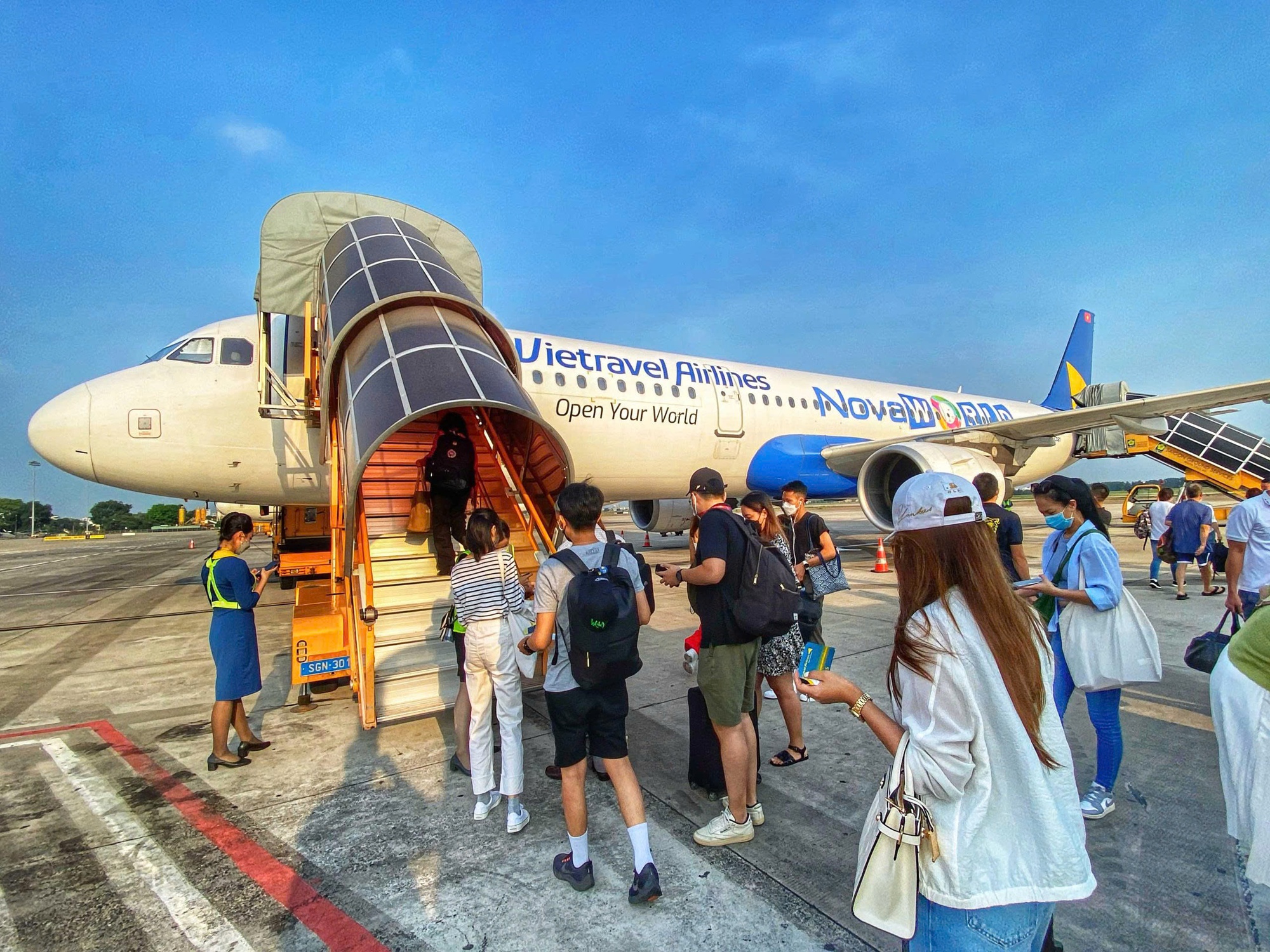
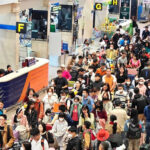
The aviation industry aims to achieve 95 million passengers in 2026, a 13% increase from 2025. Photo: HOANG TRIEU
Addressing Critical Bottlenecks
In 2026, the Civil Aviation Authority of Vietnam aims to reach 95 million passengers and 1.6 million tons of cargo, representing a 13% and 15% increase, respectively, compared to 2025.
According to Director Uong Viet Dung, the National Assembly’s approval of a GDP growth target of 10% or higher in 2026 is expected to significantly boost consumption and tourism—two sectors directly linked to aviation.
Additionally, the implementation of the new Civil Aviation Law and supportive policies will create a more streamlined legal framework for transportation. Strategic infrastructure projects such as Long Thanh Airport (Phase 1), Gia Binh Airport, and Phu Quoc Airport are being expedited, promising to enhance the industry’s operational capacity.
“The 2026 transportation management strategy focuses on institutional and policy improvements, promoting negotiations and agreements, and adopting technological solutions,” Director Uong Viet Dung added.
The Civil Aviation Authority emphasizes that achieving these goals requires promptly addressing existing bottlenecks in infrastructure and policies. Specifically, it urges the Ministry of Construction and relevant authorities to invest in expanding key international airports to prevent prolonged congestion, which increases logistics costs and hinders growth. Additionally, tax incentives, fee reductions, and favorable credit rates are needed to support the restructuring of aviation enterprises, enabling airlines to enhance financial capacity and achieve sustainable recovery and development.
Enhancing Customer Care Policies
Since returning to FLC Group’s management, Bamboo Airways has consistently upgraded its customer care policies for loyal customers and attracted new ones. “In every phase, Bamboo Airways strives to operate flights on time, safely, and minimize cancellations while continuously improving customer care policies. Enhancing service quality is key to retaining loyal customers and gaining a competitive edge in the dynamic aviation market,” said a company representative.
Mr. Nguyen Minh Man, Deputy General Director of VinaGroup International Travel Company:
Reshaping International Tourist Flows
The development of new direct routes in 2024-2025 is key to expanding Vietnam’s tourism market. This is not just a transportation issue but a long-term strategy to proactively reshape international tourist flows.
Increasing frequencies and diversifying destinations between Da Nang, Cam Ranh, and Phu Quoc to South Korea, China, and Japan helps distribute tourist flows, reduce pressure on Hanoi and Ho Chi Minh City, and foster sustainable growth.
India is an emerging market with significant potential for Vietnam’s tourism, given its large group travel, MICE, and spiritual tourism demands. The biggest barrier is the lack of direct flights to major population centers like Mumbai, Hyderabad, and Bengaluru. If Vietnam proactively opens these routes, tourist numbers will increase rapidly and steadily, similar to the early direct flight phases.
Australia and Europe are high-spending markets with long-term travel demands. Long-haul routes should be viewed as strategic investments. Once frequencies stabilize, costs will become more competitive, boosting both beach resorts and cultural-heritage tourism, which are Vietnam’s strengths.
To make tourism a key economic sector, synchronized efforts are needed in aviation infrastructure, visa policies, market promotion, and inter-regional connectivity. When direct routes are launched at the right time and to the right markets, Vietnam will not only grow in numbers but also enhance value, benefiting new destinations and improving regional competitiveness. Now is the time for Vietnam to take bold, calculated steps to leverage its open skies advantage.
Mr. Sheldon Hee, Vice President for Asia-Pacific, International Air Transport Association (IATA):
Developing Suitable Products and Services
In Vietnam, IATA recognizes the aviation sector’s growing contribution to the economy, from direct GDP to employment in aviation and tourism. Aviation development has been a key driver of trade, tourism, and socio-economic connectivity nationwide. As a result, Vietnam’s position on the regional aviation map has improved significantly, rising from 11th in 2014 to 8th in 2024. Among the top 10 international markets to Vietnam, 7 have doubled their growth in just a decade. Notably, Indian tourists have increased tenfold, and South Korean tourists fivefold. Vietnam is now ASEAN’s fourth-largest international market, after Thailand, Singapore, and Malaysia.
Vietnamese aviation should prioritize identifying target segments and key markets to develop suitable products and services, optimize resources, and expand reach effectively. Strengthening collaboration within the tourism ecosystem will create attractive combined packages, drawing more international visitors.
Lunar New Year 2026 Flights Selling Out Fast for Popular Routes

Despite a significant price hike, airline tickets for the 2026 Lunar New Year are selling out rapidly on numerous routes, leaving customers struggling to secure their travel plans.
Vietnam Airlines and aT Center Partner to Promote Korean Grapes on International Flights

Korea Agro-Fisheries & Food Trade Corporation (aT Center), the Korean Grape Export Association (K-grape), and Vietnam Airlines have collaborated to launch an in-flight promotional campaign for Korean grapes on international flights departing from Vietnam.
Vietjet Sets Record: 22 Aircraft Delivered in Less Than a Month
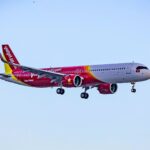
On December 4, 2025, Vietjet proudly welcomed its newest addition—the A321neo ACF aircraft, registered as VN-A580. This state-of-the-art plane further strengthens Vietjet’s fleet, solidifying its position as a leader in modern, fuel-efficient aviation across the region.
Unprecedented Collaboration: FPT and Vietnam Airlines Launch “Dating Flight” Matchmaking for Single Employees

Two businesses are excited to create a unique networking opportunity for their employees, hoping these encounters might spark connections that could lead to introducing a special someone to the family during the upcoming Lunar New Year celebrations.
Aviation: Not Just Another Easy Game
The domestic aviation market is entering its most dynamic phase in nearly a decade. The emergence of new airlines, restructuring efforts by established carriers, fluctuating ticket prices, and pronounced segmentation are reshaping the industry landscape.