As global trends like generative AI, climate change, and geopolitical shifts render traditional growth drivers less effective, Vietnam presents a distinct environment. Its economy maintains significant resilience, bolstered by the government’s structural reforms. Notably, Resolution 68 is pivotal, formally recognizing the private sector as the economy’s primary driver and providing clear guidance for businesses to innovate through digital and green transformations.
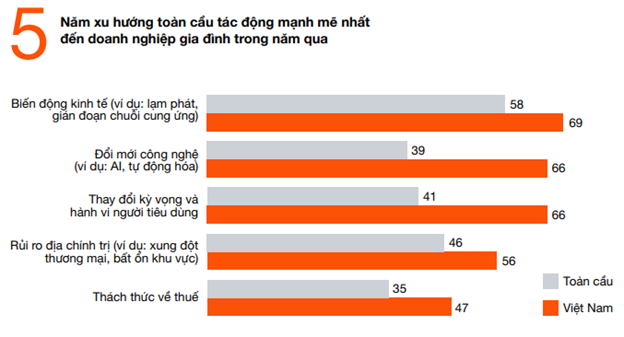
For Vietnamese family businesses, this creates new opportunities. By aligning their strategies with national priorities, they can unlock new value and lead the nation’s next growth phase. However, this opportunity exists within a hyper-dynamic market, where leaders feel the impact of global trends more acutely than family businesses in other regions, creating both a challenging and promising environment for those ready to act.
Vietnamese family businesses are turning opportunities into exceptional results, with 75% reporting sales growth in the last fiscal year, fueling a strong resurgence in confidence for future growth.
Source: PwC
|
Looking ahead five years, leaders share a clear and consistent strategic vision. Top long-term priorities include ensuring long-term business resilience, investing in innovation, and accelerating digital transformation.
Technology is seen as the primary growth driver but also a significant barrier to action due to deep-seated concerns. Specifically, leaders overwhelmingly identify technological advancements as the greatest opportunity. However, a substantial portion views artificial intelligence as a major execution risk, hindering the strong commitment needed to realize transformation goals.
This concern is evident in current priorities, as resources are concentrated in familiar areas. Expanding core business remains the top priority, with a significant gap from other objectives, while investment in new ventures ranks near the bottom. This indicates that even the high priority for digital transformation focuses on optimizing current operations rather than breakthrough reinvention.
To turn ambition into sustainable growth, family businesses must move beyond traditional operating models. The path forward requires a fundamental shift: from relying on past strengths to proactively building future capabilities.
The immediate focus must be on mindset change. Currently, leaders perceive their advantages primarily in operational terms, such as cost efficiency. To build true resilience, PwC argues they must re-leverage a powerful yet undervalued strategic asset: their long-term vision.
The primary barriers to resilience are internal, not external. Leaders must directly address key obstacles to adaptability, specifically the lack of internal expertise and intergenerational consensus.
Additionally, businesses need to implement fundamental reforms, such as adding independent, non-family experts to leadership teams and restructuring boards.
Strategic levers for sustainable growth
PwC believes clear, standardized goals are the foundation for growth-driving capabilities. Therefore, Vietnamese family businesses should integrate these goals into marketing and external communications. This transforms internal values into a public competitive advantage, strengthening brand and customer trust.
Furthermore, businesses should directly link goals to customer value propositions and employee engagement programs. This ensures goals guide business decisions and support talent attraction and retention, turning goals from paper statements into living assets that drive performance.
High-performing family businesses are moving toward centralized decision-making models. Establishing a family constitution and clear shareholder agreements is essential. This creates a stable foundation for decision-making, defines roles, and empowers leaders to execute strategies swiftly and confidently.
For true agility, boards must be professionalized. Adding at least two independent, non-family members with diverse industry experience brings fresh perspectives. This introduces new thinking, challenges traditional views, and provides the expertise needed to turn caution into calculated strategic action.
PwC’s Global Family Business Study reveals a clear lesson: family businesses with long-term investments in technology and sustainability consistently outperform peers, turning long-term bets into short-term results. Thus, short-term, risk-averse thinking can be a strategic liability.
The real advantage of long-term capital lies not in avoiding risk, but in embracing strategic long-term risks that competitors cannot.
In leadership transitions, the founder’s business instincts must be replaced by a formal framework. This includes standardized investment philosophies and decision-making processes to ensure intergenerational consensus and maintain long-term competitive advantage.
Uniting generations in a new era
Vietnamese family businesses have a clear “reason for being.” Long-term goals are deeply focused on family legacy, providing a strong foundation for growth ambitions.
However, conflict rates in Vietnamese family businesses are high (81% vs. 48% globally), highlighting governance gaps. Despite frequent conflicts, most are resolved internally, lacking formal mechanisms for transparency and sustainability.
PwC notes that formal governance tools like shareholder agreements (22%) and family constitutions remain underdeveloped. This lack of structure increases leadership transition risks.
Governance gaps also hinder next-generation (NextGen) preparation. Challenges include not only talent identification but also family motivation.
Therefore, PwC suggests using family goals to create a unified voice. Organize strategic dialogues to align priorities, especially incorporating NextGen perspectives on new areas.
Treat intergenerational consensus as a strategic goal. Build on existing business direction harmony to address priority differences, turning potential conflicts into innovation drivers and competitive strength.
– 14:05 07/12/2025
Vietnam Plans to Establish Free Trade Zones in Three Centrally-Governed Cities by 2026
By 2026, Vietnam plans to establish free trade zones in Da Nang, Hai Phong, and Ho Chi Minh City. The vision extends to 2045, aiming for 8-10 internationally accredited free trade zones and similar models nationwide.
Prime Minister’s Critical Directive on Salaries and Allowances for Officials and Civil Servants
The Ministry of Home Affairs is tasked with urgently submitting to the competent authorities the necessary documents to implement Conclusion 206 of the Politburo regarding salaries, allowances, and the reorganization of the apparatus and local government structures at two levels, to be presented no later than December 15, 2025.
Unlocking a New Growth Cycle: The Revised Investment Law

The global economy is undergoing profound transformations: supply chains are shifting, FDI flows are being reallocated, and a wave of new technologies is reshaping the competitive landscape of nations. For Vietnam, this presents both a significant challenge and a rare opportunity to surge ahead.
Phú Quốc Unveils a Stunning New Look

With APEC 2027 just two years away, Phu Quoc is undergoing a dramatic transformation. Major infrastructure projects, including an expanded airport, a world-class convention center, a grand boulevard, and a new rail line, are reshaping the island’s identity. These developments are crafting a new Phu Quoc—modern, better connected, and poised to become the focal point of the Asia-Pacific region.
Tech Projects Over $260 Million May Qualify for Extended Tax Exemptions and Reductions
Businesses investing in concentrated digital technology zones are entitled to exclusive benefits, including corporate income tax reductions and streamlined customs procedures.