The Ho Chi Minh City People’s Committee’s socio-economic report, presented to the City Council at its 6th session on December 9, 2025, estimates a Gross Regional Domestic Product (GRDP) growth rate of 8.03%. The total GRDP value reaches 2.74 million billion VND, accounting for 23.5% of the nation’s GDP.
In 2025, HCMC’s per capita GRDP is estimated at 8,066 USD. The former HCMC area has the lowest figure at 7,947 USD, followed by Binh Duong at 8,554 USD, and Ba Ria – Vung Tau at the highest with 14,139 USD (including oil and gas).

In 2025, HCMC’s estimated GRDP growth reaches 8.03%.
Notably, the city’s state budget revenue this year is estimated at 748,438 billion VND, up 9.6% year-on-year, contributing 31.2% to the national budget. This marks the first year HCMC has met its budget collection target as early as October.
Currently, industry, construction, and services account for about 90% of HCMC’s economic structure. In 2025, many socio-economic indicators showed strong growth, reflecting the economy’s clear recovery.
Tourism saw the strongest growth, with total revenue estimated at 260,000 billion VND, up 36.1% year-on-year.
Total retail sales and consumer service revenue are estimated to grow by 13.5%; transport sector revenue by 14.3%; and industrial production index by 9%…
This year, 59,750 new enterprises were established with a total registered and additional capital of 2,067,284 billion VND.
Foreign direct investment also reached a high level, at approximately 8.1 billion USD, up 21.1% year-on-year.

The year-end City Council session will address pressing issues such as food safety, traffic congestion, and delayed housing registration books.
The city has aggressively resolved difficulties and obstacles for 670 out of 838 stalled projects and land plots, reaching an 80% resolution rate. This has unlocked over 804 trillion VND in investment capital, covering approximately 16,200 hectares.
HCMC has set its 2026 socio-economic development theme as “Institutional Breakthrough, Resource Liberation, Infrastructure Leap, Service Quality Enhancement, and Substantial Development Transformation.”
The city has developed two growth scenarios for the new year. The baseline scenario targets an 8.5-9% GRDP growth rate.
The ambitious scenario aims for a 9.5% growth, with a nominal GRDP of approximately 3,412 trillion VND. Per capita GRDP is expected to reach 9,800 USD…
The 2026 state budget revenue target is set above 805,000 billion VND, with FDI attraction aimed at 11 billion USD.

By boosting public investment to drive private investment, HCMC aims for a 9.5-10% growth in 2026.
However, the HCMC People’s Committee notes that with the early effectiveness of Resolution 98’s amended mechanism and support from strategic investors, the city’s growth could reach 10%, meeting the government’s double-digit growth target.
Alongside economic growth, HCMC is committed to achieving social welfare targets set by the 1st Congress Resolution for the 2025-2030 term. These include regular health check-ups, electronic health records for lifecycle health management, and a 95% health insurance coverage rate.
By the end of 2026, HCMC aims to provide 25,287 social housing units, with per capita living space reaching 27.69 m².
The city will also complete the relocation and clearance of 1,900 temporary and canal-side houses in 2026.
The TOD plan and land fund exploitation strategy to increase land revenue will be accelerated from 2026.
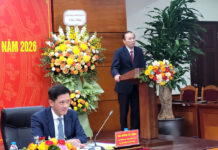
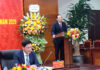
In his opening speech, HCMC People’s Council Chairman Vo Van Minh emphasized that the city’s 2025 GRDP growth, estimated higher than the national average (around 8%), reaffirms its role as the nation’s economic locomotive and significantly enhances its international standing.
However, some socio-economic targets remain unmet; key projects and public investment progress slowly; and infrastructure for transport, urban development, and social services is overburdened. Notably, a portion of the population still faces housing, employment, and income challenges, while environmental issues, flooding, traffic congestion, and security concerns persist.
During this session, delegates will discuss and decide on critical matters directly impacting the city’s 2026 development direction and beyond. These include key solutions for 2026 and 2026-2030 socio-economic development, 2026 and 2026-2030 budget plans, financial and public investment plans, and other important issues within the council’s jurisdiction.
Ho Chi Minh City Offers Up to VND 20 Million in Support for Tourist Groups
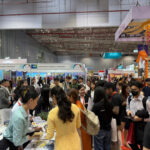
For groups of 100 guests or more, staying a minimum of 3 days with a confirmed city tour itinerary, receive up to 20 million VND in support. This includes entrance tickets, meeting room rental fees, and more.
Ho Chi Minh City Approves High-Speed Rail Project Connecting Ben Thanh to Can Gio
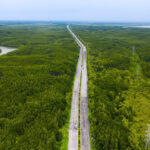
Ho Chi Minh City has officially approved the investment plan for the Ben Thanh – Can Gio railway line, a project spearheaded by Vinspeed. This ambitious initiative aims to commence operations by 2028, marking a significant milestone in the city’s transportation infrastructure development.
Accelerating the Metro Link Between Tan Son Nhat and Long Thanh
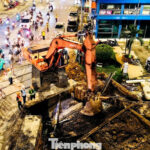
Metro Line 2 (Bến Thành – Tham Lương) is slated to break ground before January 19, 2026. Concurrently, the segments connecting Bến Thành – Thủ Thiêm and Thủ Thiêm – Long Thành are in the investment preparation phase. All three lines are projected to be operational before 2030, establishing a high-capacity, modern transit axis linking Tan Son Nhat and Long Thanh International Airports.
Revealed: Top Regions with Double-Digit GRDP Growth in 2025 – Only One Centrally Governed City Makes the List
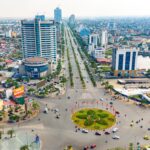
According to the Ministry of Finance’s report, based on the growth of localities, it is estimated that 20 out of 34 localities will achieve a GRDP growth rate of 8% or higher in 2025.