











During the regular November government meeting held last weekend, Prime Minister Pham Minh Chinh directed the Ministry of Construction to urgently submit a plan for establishing a real estate (RE) and land use rights transaction center managed by the state, to be completed by December 15.
Saving Time and Costs
Previously, the Ministry of Construction submitted a draft resolution to the government for piloting a model of a RE and land use rights transaction center, planned for nationwide implementation in 2026–2027. This model aims to streamline all procedures, from providing information, legal verification, electronic contract establishment, to issuing land use right certificates, on a unified data platform. The center will also integrate data on housing, land, taxes, transactions, and secured assets to support management and promote the digitalization of the RE market.
According to Deputy Minister of Construction Nguyen Van Sinh, the establishment of the RE and land use rights transaction center aims to innovate transaction methods, reduce administrative procedures, and save time and costs for citizens and businesses. Additionally, the model will enhance the application of information technology, drive digital transformation, and contribute to the transparency and openness of the RE market. The goal is to stabilize the RE market with more synchronized institutions, promptly addressing issues of manipulation, speculation, and property price inflation.
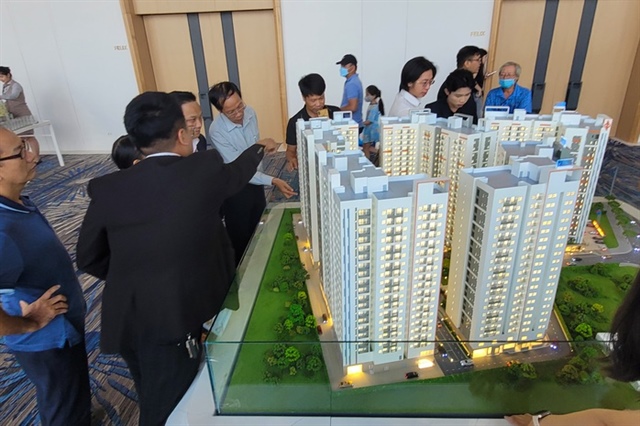
The establishment of the real estate and land use rights transaction center aims to innovate transaction methods, reduce administrative procedures, and save time and costs for citizens and businesses. Photo: TAN THANH |
Dr. Nguyen Van Dinh, Chairman of the Vietnam Real Estate Brokerage Association (VARS) and Vice Chairman of the Vietnam Real Estate Association, noted that the establishment of a national RE transaction center will serve as a hub for collecting, verifying, and processing all information related to each property. When citizens need to transfer or purchase property, they will only need to access this system. The center will automatically contact and verify information with relevant authorities, providing results within a short time. “Citizens only need to input their property information into the system. The national data center will verify and provide official results, confirming the legal right to transact. The state will then be legally responsible for that data, rather than citizens having to navigate multiple agencies,” said Mr. Dinh.
Currently, procedures related to RE transactions are cumbersome, time-consuming, and costly. Citizens must complete multiple steps such as notarization, tax payment, and registration of changes, with an average processing time of 45–60 days. Once the transaction center is implemented, these procedures will be completed quickly, within 1–3 days, reducing costs and inconveniences. This center will not replace the functions of other agencies but will serve as a connector and processor of data on a digital platform.
Ms. Hoang Thu Hang, Deputy Director of the Department of Housing and Real Estate Market Management at the Ministry of Construction, acknowledged that previously, to complete a RE transaction, citizens might have to visit multiple locations for buying, selling, and processing procedures. Additionally, citizens faced difficulties in determining whether a property was eligible for sale. With the establishment of the RE transaction center, the state will manage and be responsible for ensuring that only eligible properties are sold on the market. Ms. Hang stated that the Ministry of Construction has completed the preparation and submission of the proposal and draft government resolution for piloting this model.
Classifying Transactions, No Additional Procedures
From a business perspective, Mr. Vo Hong Thang, Deputy General Director of DKRA Group, suggested that when RE transactions are conducted through an official platform, information must be accurate, and brokers must provide correct data, reducing discrepancies. This will minimize risks for buyers and increase transparency.
This requires the national RE transaction platform to be designed as a fair playing field with strict monitoring mechanisms and clear penalties. “If businesses do not meet standards or fail to comply with transparency requirements, they will be eliminated. However, to ensure fairness, the monitoring and violation handling mechanisms must be transparent, avoiding situations where some are listed and others are not,” he said.
A RE expert noted that the transaction platform model still needs time to be clearly defined. According to this expert, if it is merely a data listing platform without intervening in pricing or buyer-seller matching, the model will greatly support the state in data management, reducing duplication and facilitating traceability. Citizens particularly look forward to convenience and transparency, not additional procedures or penalties. “Simply integrating a RE QR code into the citizen ID card would suffice for transactions,” the expert proposed.
From a policy perspective, Dr. Can Van Luc, a member of the Prime Minister’s Advisory Council, emphasized that the RE transaction center, once established, must adhere to two principles: transparency and no additional procedures or costs.
He suggested that the pilot period should only last 2–3 years to evaluate effectiveness before widespread implementation. Additionally, there should be a clear classification of transaction types that must be conducted on the platform and those that only require data updates. For example, commercial transfers and high-value transactions should be conducted on the platform, while gifts and inheritances within families may only require notification for updates.
Dr. Can Van Luc also proposed establishing participation criteria for the platform, as not all RE businesses may qualify. Participation should be limited to groups with clear functions, such as brokerage, valuation, project development, and asset management. A public-private partnership (PPP) mechanism could also be applied to leverage technology, surveys, and operations from the private sector while the state maintains its guiding and controlling role.
Another requirement emphasized by Dr. Luc is that transaction fees should be kept as low as possible to avoid the platform becoming a barrier. Additionally, the data collection and sharing system must be built cohesively to prevent the current “data fragmentation” issue.
Furthermore, Dr. Luc warned of the risk of creating “two markets” if the process design is too complex—one official and one “black market” for underground transactions to avoid procedures. To prevent this, the RE transaction center must demonstrate tangible benefits: faster processing times, clearer information, and lower costs.
“Regarding the operating model, we can refer to the transaction models of stock exchanges, e-commerce platforms, or commodity exchanges, without making it overly complex. Most importantly, the system should be designed to be simple and easy to operate, avoiding the creation of a cumbersome bureaucracy. Personnel can be drawn from existing resources, and experts should be recruited boldly to ensure effective operation from the outset,” suggested Dr. Can Van Luc.
|
Establishing Strong Legal Tools The Ho Chi Minh City Real Estate Association (HoREA) proposed that instead of adding another layer of procedures, management agencies should only require developers to publicly disclose the full legal status, sales conditions, and product information (existing housing, future housing, land use rights with infrastructure) on the housing and RE market data systems of the Ministry of Construction, provincial People’s Committees, and on company websites for supervisory purposes. HoREA also suggested adding penalties for falsely reporting information, delaying disclosures, or selling products that are not yet eligible for transactions. Simultaneously, the Law on Real Estate Business should be urgently amended to establish strong legal tools ensuring a transparent, healthy market, limiting speculation, and protecting buyer interests. |
VAN DUAN – SON NHUNG – THAI PHUONG
– 06:25 09/12/2025
Unlocking Real Estate Investment: Strategies to Dodge 12-15% Floating Interest Rates

Facing soaring interest rates that burden homebuyers, An Gia (AGG) has launched a groundbreaking support policy for The Gió Riverside apartments. Buyers will enjoy a 100% interest subsidy for 36 months (including 12 months post-handover) and a 60-month principal repayment holiday, easing financial pressures and making homeownership more accessible.
Indochine Secures Major Win as Exclusive Northern Distributor for Happy One Mori Project

On the morning of December 7th, the nation’s market witnessed a groundbreaking milestone as 98% of the units in the Happy One Mori project found their owners during the project launch and customer appreciation event, themed “Live The Moment: Move Moment – Mori More,” held simultaneously in both the North and South regions.
NamAn Realty Unveils New Headquarters, Revolutionizing Full-Service Real Estate Brokerage

On the morning of December 9, 2025, NamAn Realty proudly inaugurated its new headquarters at 24-26 Street 38, An Khánh Ward. This milestone signifies the company’s commitment to sustainable growth and reinforces its pioneering vision of the ‘all-encompassing real estate brokerage model,’ poised to thrive in the new era.
Sun Property Owner Witnesses Phú Quốc’s Transformation Ahead of APEC 2027

Embark on a journey to paradise with “Boarding to Paradise,” an exclusive appreciation event series spanning three waves, designed to honor Sun Property owners. This initiative aims to create lasting impressions among esteemed clients, reinforcing their confidence in their forward-thinking investment choice within the thriving Phú Quốc Special Economic Zone.
Trần Hưng Đạo Bridge: Catalyzing East Hanoi’s Real Estate Boom

Following the commencement of the Trần Hưng Đạo bridge construction nearly two months ago, the Long Biên real estate market has witnessed robust growth, setting a new benchmark for property prices—the highest recorded in the past six years.