The cashew tree, often referred to as “green gold,” is celebrated for its exceptional economic value and health benefits.
On December 6th, at the Cuban Ministry of Agriculture headquarters in Havana, Royal Vietnam International Food Joint Stock Company and Alquizar Agricultural Company—part of the Artemisa Agricultural and Forestry Enterprise Group (Cuba)—signed an economic cooperation agreement. The partnership focuses on cultivating cashew trees and short-term crops like peanuts, black beans, mung beans, and soybeans.
The signing ceremony was witnessed by Cuban Deputy Minister of Agriculture Telcel Abdel González, Vietnamese Ambassador to Cuba Lê Quang Long, and other agricultural leaders. According to the agreement, Vietnam will cultivate cashews and short-term crops on 2,000 hectares of land in Artemisa province. Royal Vietnam will provide seeds, agricultural supplies, machinery, technology, and expertise, while Cuba will supply land, labor, and support for seamless project implementation.
As reported by Vietnam News Agency (VNA), Mr. Nguyễn Khắc Hoàng, Director of Royal Vietnam, noted that Cuba’s climate and soil conditions closely resemble those of Vietnam, making it ideal for various industrial crops, with cashews as the flagship.
“We are fully confident investing in Cuba, given the enduring and strong relationship between our nations,” he stated.
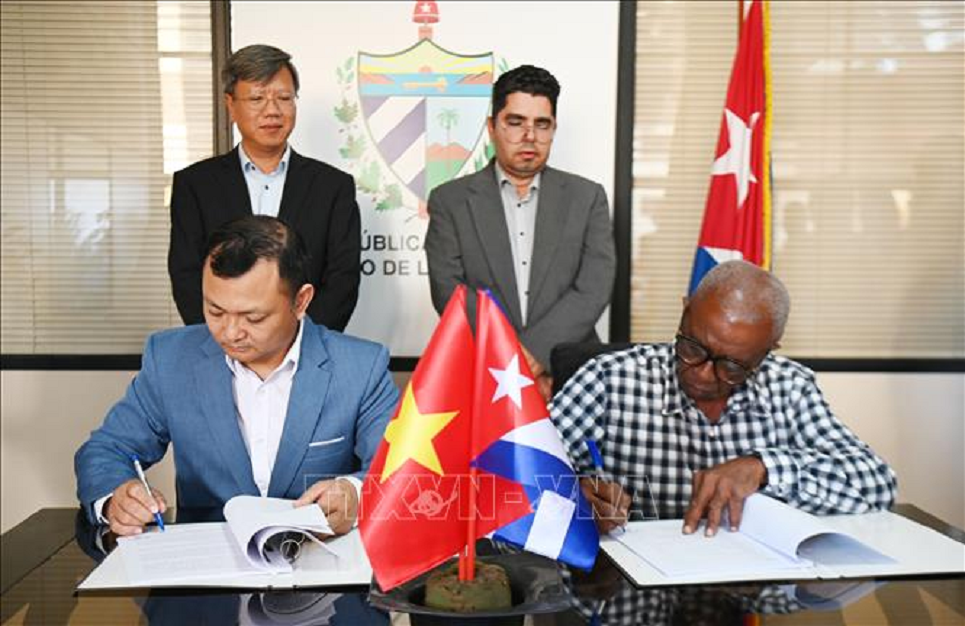
Vietnam signs cashew cultivation agreement in Cuba (Photo: VNA).
Vietnam is currently the largest Asian investor in Cuba, with at least seven active projects totaling over $160 million in committed capital. In agriculture, Vietnam has helped Cuba achieve significant results in rice, corn, soybean production, and aquaculture.
The Cashew Tree: A Tropical Agricultural Treasure
For years, the cashew tree has been a lifeline in Vietnam’s arid regions. Its deep taproot, drought resistance, and broad canopy for moisture retention enable it to thrive where other crops fail.
In former Bình Phước province (now part of Đồng Nai) and the Central Highlands, a single rainy season is enough for cashew orchards to flourish, even with minimal fertilizer or irrigation.
According to the General Department of Vietnam Customs, Vietnam’s cashew exports in 2024 are estimated at 730,000 tons, valued at $4.37 billion. Compared to 2023, this represents a 13.3% increase in volume and a 20.2% rise in value. The average export price reached $6,003 per ton, up 6.1%.
Cashew cultivation offers low investment costs, ease of farming, and a stable export market. The U.S., China, and the European Union (EU) are the world’s largest cashew consumers. Notably, cooperatives in former Bình Phước have adopted digital technology, boosting processed cashew value to $7,500 per ton by June 2025.
Cuba selected Vietnamese cashews due to their suitability for hot, dry climates; ease of cultivation in nutrient-poor soil; low investment costs aligned with Cuba’s need to increase food production; and a versatile value chain for processing expansion.
The 2,000-hectare cashew project is more than an agricultural initiative—it’s a gateway to expanding Vietnamese cashew cultivation in Cuba, mirroring the success of previous rice projects. The endeavor is expected to encourage more Vietnamese businesses to invest in Cuba, further strengthening the two nations’ historic friendship.
China’s Urgent Pursuit of Vietnamese Cashews: Unveiling the Strategy
In the first seven months of the year, Vietnam exported 412,000 tons of cashew nuts, raking in a impressive $2.8 billion. In recent months, China has surpassed the US as Vietnam’s largest cashew nut importer, showcasing a shift in the global market for this sought-after commodity.
“US Imposes 20% Tariffs on Vietnamese Goods: Businesses and Experts Hope for Further Reductions”
The 20% tax rate, despite being a significant reduction from the initial proposed rate of 46%, still leaves experts and businesses hopeful for further negotiations to drive it down even lower.