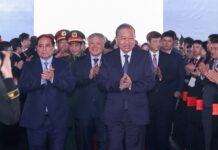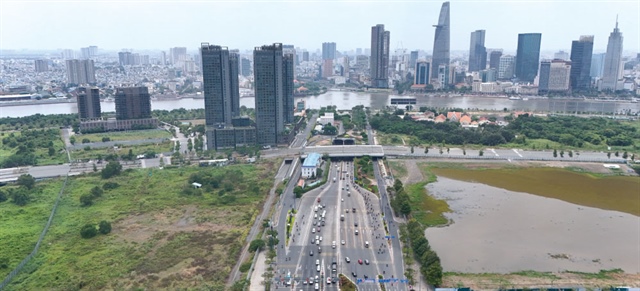
Ho Chi Minh City cannot adopt the same institutional framework as other localities. Photo: LÊ VŨ |
Megacities require broader institutional space
On the morning of December 8, 2025, the National Assembly discussed special mechanisms and policies for Hanoi, Ho Chi Minh City, and Da Nang.
As the first to comment on the draft Resolution amending and supplementing some articles of Resolution 98/2023/QH15 on piloting special mechanisms and policies for Ho Chi Minh City’s development, Delegate Hoang Van Cuong (Hanoi) stated that Ho Chi Minh City was once the country’s largest economic hub, pioneering new management institutions for later nationwide replication. After its merger (with Binh Duong and Ba Ria – Vung Tau), the city’s potential and status have grown stronger, unmatched by any other locality. “An entity as large as Ho Chi Minh City cannot adopt the same institutional framework as other localities; it needs a broader, unique framework to freely innovate and develop,” he expressed.
Sharing the same view, Delegate Pham Van Hoa (Dong Thap) believed that Resolution 98 does not meet the new development requirements of Ho Chi Minh City. The city aims to become Southeast Asia’s financial hub, leading in smart urban development, green transformation, and technological innovation, while converging three growth poles, a vast economic space, and strong regional connectivity. To become a global city, legal frameworks must lead the way. Therefore, Ho Chi Minh City needs greater authority in planning, investment attraction, and innovative mechanism operations. He warned, “Any delay will cause the city to lose its competitive edge in a deeply integrated context.”
Reflecting on two years of implementing Resolution 98, Delegate Tran Khanh Thu (Hung Yen) noted that while there have been positive changes, many aspects remain unsuitable and fail to match the city’s current status and future development goals.
Ho Chi Minh City is now a “megacity,” the country’s largest with a population of 13.6 million, contributing 23% of GDP and about one-third of the national budget revenue. The city’s responsibility for national economic growth and macro-stability is greater, and the nation’s expectations are higher. Thus, unprecedented mechanisms and policies for Ho Chi Minh City are not just a local matter but a strong political commitment from the National Assembly and Government to empower the city to lead, pioneer, and test nationally impactful development models.
“We cannot expect new progress with old tools and mechanisms. Ho Chi Minh City’s mechanisms must be stronger and more competitive to unleash resources, and more flexible to seize rapid and sustainable development opportunities.” Furthermore, “This Resolution should not just expand development space for a locality but create a national policy laboratory to test new, breakthrough models before scaling them up,” emphasized the delegate from Hung Yen.
“Empowering the city means adding a growth engine for the nation,” added Delegate Pham Trong Nhan (Ho Chi Minh City). A strong nation cannot rely on a few sectors but must leverage development spaces capable of leading, and Ho Chi Minh City is one such space.
Opening TOD space, mobilizing capital for transport infrastructure
Among the new mechanisms for Ho Chi Minh City, the Government proposes amending policies for transit-oriented urban development (TOD) to accelerate metro projects and optimize land use.
Specifically, the city can use TOD-generated land to pay for metro projects under the BT (Build-Transfer) model. Around metro stations, depots, repair facilities, and areas near Ring Road 3 intersections, the city can allow investors to develop housing, commercial services, public utilities, and community facilities.
Additionally, the city retains 100% of TOD land revenue to invest in local metro projects and TOD-related transport infrastructure. “This is a crucial step, and I fully support it,” said Delegate Thach Phuoc Binh (Tra Vinh). He cited Japan, South Korea, and Singapore, where every $1 invested in metro systems yields $3–5 from surrounding real estate and urban services. “Ho Chi Minh City needs stable resources for eight metro lines, requiring $25–30 billion. Without retaining full TOD land revenue, the city cannot create a sustainable capital flow for public transport infrastructure.”
To ensure feasibility and safety, Delegate Thach Phuoc Binh suggested clarifying TOD area boundaries. Tokyo defines a 400–800 meter radius from stations; Seoul uses density and land-use coefficients. Without clear definitions, Ho Chi Minh City risks boundary disputes, audit challenges, and implementation inconsistencies.
He also proposed channeling TOD revenue into an independent fund exclusively for metros, urban railways, and connecting infrastructure. BT land payments must follow market-based pricing, mandatory independent audits, and transparent land lists.
Echoing this, Delegate Nguyen Tam Hung (Ho Chi Minh City) called for an independent body to appraise TOD land values, with public starting prices and results. He stressed that TOD land is highly valuable, and without strict control, losses and public distrust may occur.
Ho Chi Minh City’s Free Trade Zone must be a regional hub
In amending Resolution 98, the Government proposes establishing the Ho Chi Minh City Free Trade Zone with superior institutional frameworks. Delegate Trinh Thi Tu Anh (Lam Dong) emphasized strong decentralization, ensuring the city’s People’s Committee has real autonomy in decision-making and organization, suited to modern trade’s speed and flexibility.
With such empowerment, oversight must be fully digitized. A highly open institutional space requires rigorous risk management, using real-time technology and data to ensure transparency, prevent fraud, and meet regional logistics and financial hub standards.
Mrs. Tu Anh also suggested positioning the Free Trade Zone as a regional hub. Success requires linking it to a vast production and service network. Special mechanisms for Ho Chi Minh City should include interconnecting infrastructure, standardizing regional logistics, and promoting goods flow from southern and Central Highlands provinces.
Dedicated agency needed for strategic investor procedures
Attracting strategic investors is a key focus, with the Government adding 11 priority project groups in high-end tourism, healthcare, high-tech industries, urban infrastructure, digital infrastructure, and transport.
Delegate Tran Khanh Thu noted that these projects involve public-private partnerships, large capital, and high management needs. Without strong mechanisms, Ho Chi Minh City cannot attract true strategic investors or solve long-standing urban issues. Including these projects in the Resolution is essential, with mechanisms designed to attract investors.
She urged revisiting the project list, focusing on goals and issues rather than detailed items, to avoid obsolescence and allow new technologies. Minimum capital criteria should reflect solutions and technology, not just investment size.
Current strategic investor selection criteria focus on capital structure and financial capacity, not real capabilities. She proposed a new state-investor agreement model, clarifying timelines, responsibilities, and legal obligations, with penalties for violations. Referencing global enterprise rankings and a public portal for investor proposals based on general criteria could help. Ho Chi Minh City needs a dedicated agency to handle strategic investor procedures, ensuring transparency and commitment fulfillment.
The National Assembly is expected to adopt the amended Resolution 98 on December 11, the 10th session’s final day. Delegate Pham Trong Nhan stated, “The city sees the amended Resolution as a mandate, understanding that responsibility cannot be met with promises. Empowerment means accountability, proven by tangible results in citizens’ lives.”
|
Draft Resolution mechanisms not strong enough Delegate Hoang Van Cuong believes the current mechanisms are insufficient for Ho Chi Minh City’s innovation and growth. He suggested three amendments. First, remove provisions hindering special mechanism implementation. He cited the draft allowing the City Council to use local budgets but requiring legal compliance, nullifying special mechanisms. Such provisions should be removed. Second, avoid listing specific projects and strategic investor priorities, as reality changes quickly. Instead, set principles and criteria, letting the City Council decide, like Hanoi’s Resolution. Third, like the Capital’s Resolution 206, allow the City Council to issue resolutions for necessary special mechanisms, reporting to the National Assembly for consideration. This creates real institutional space for Ho Chi Minh City to test new models and become a national “institutional laboratory.” Propose a separate law for Ho Chi Minh City Delegate Pham Trong Nhan (Ho Chi Minh City) suggested that the amended Resolution 98 prepares for a future law for megacities. Delegate Trinh Xuan An (Dong Nai) agreed, proposing a Ho Chi Minh City Law. With its economic leadership and megacity status, the city deserves a law integrating its special mechanisms, like the Capital. |
An Nhiên
– 07:00 10/12/2025
Ho Chi Minh City Accelerates Urban Renewal Efforts in Preparation for Tet 2026
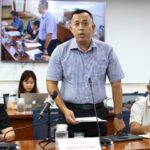
At a press conference on Ho Chi Minh City’s socio-economic development held on the afternoon of December 11th, Mr. Huỳnh Lê Công Trường, Deputy Head of the Specialized Inspection Department at the Department of Construction, announced that in 2025, the department has issued approximately 120 construction permits to units implementing transportation projects across the city.
Vietnamese National Assembly Adopts Resolution for the 10th Session of the 15th Legislature

On the afternoon of December 11th, during the closing session of the 10th Meeting of the 15th National Assembly, the Resolution of the session was adopted with a 99.3% approval rate from the attending delegates. At this meeting, the National Assembly passed 51 laws and 38 resolutions, establishing a crucial legal framework for the management of socio-economic affairs in the upcoming period.
Revised Title:
“Ho Chi Minh City’s Additional Income Ceiling to Shift Pending New Salary Scale Implementation”
The ceiling for additional income in Ho Chi Minh City, applicable during the period before the implementation of the new salary scale as per Resolution No. 27-NQ/TW, will be reviewed and incorporated into the joint Resolution of the 10th Session.
“Ho Chi Minh City Council Delegate: Residents Easily Access Social Housing Through Land Brokers”

“Ho Chi Minh City People’s Council delegate Nguyen Thi Viet Tu highlights a concerning trend: residents are increasingly turning to social media platforms for information on social housing, only to encounter data sourced not from official channels, but from land speculators.”
In Just 10 Days, Vietnam’s Largest 2,870-Hectare Reclaimed Mega-City by Billionaire Pham Nhat Vuong Will Witness a Landmark Event
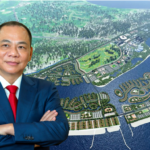
On December 19th, construction will commence on the first high-speed railway line connecting downtown Ho Chi Minh City to the former Can Gio district. The groundbreaking ceremony will take place at Vinhomes Green Paradise, a project developed by Vingroup.