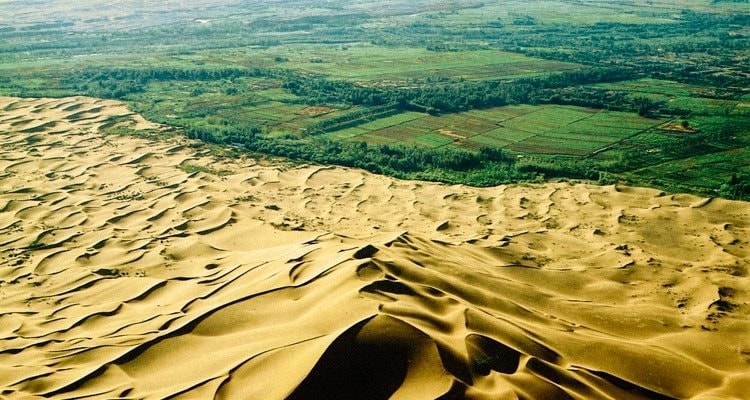
Since 1978, China has planted over 66 billion trees along its borders with Mongolia, Kazakhstan, and Kyrgyzstan—and the Chinese government plans to plant an additional 34 billion trees over the next 25 years. If successful, the Great Green Wall will increase the Earth’s forest cover by 10% compared to the late 1970s.
The Great Green Wall, officially known as the Three-North Shelter Forest Program, is designed to slow soil erosion and sand accumulation, which have intensified since the 1950s due to rapid urbanization and agricultural expansion. These changes have exacerbated the region’s inherent aridity, leading to more frequent sandstorms. Sandstorms strip away topsoil, degrade land, and increase fine particulate pollution in cities.
Northern China was arid even before the urbanization boom of the 1950s, as the Himalayas create a rain shadow along the border with Mongolia, limiting rainfall in the region. This is why the Gobi and Taklamakan deserts are so vast; their combined area is 618,000 square miles (1.6 million square kilometers), slightly smaller than Alaska, according to the Royal Geographical Society.
Before China’s efforts over the past five decades, the Gobi and Taklamakan deserts were still expanding. For instance, the Gobi Desert consumes approximately 1,400 square miles (3,600 square kilometers) of China’s grasslands annually. According to the Royal Geographical Society, desertification is devastating ecosystems and agricultural land while worsening pollution in cities like Beijing.
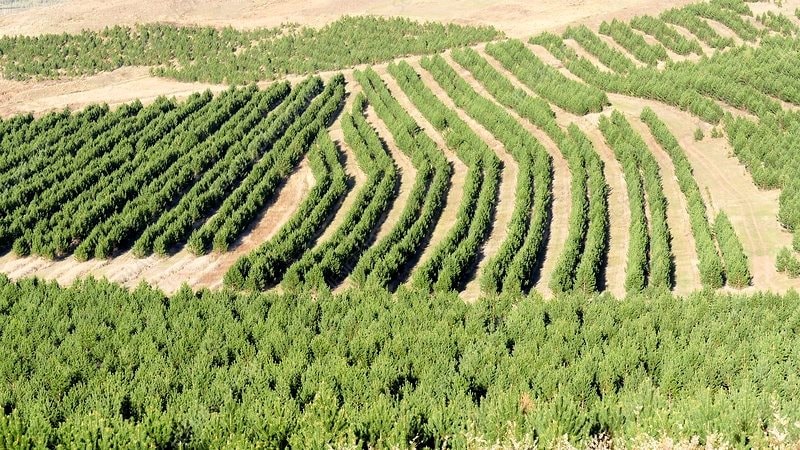
Last year, government representatives announced that China had completed tree planting around the Taklamakan Desert, stabilizing sand dunes and increasing forest cover from approximately 10% of China’s area in 1949 to over 25% today. Planting will continue around the Taklamakan to maintain and expand the forest, officials stated.
If all goes according to plan, the Great Green Wall will stretch 4,500 kilometers by 2050. This “wall” is the world’s largest planted forest—but its effectiveness in slowing desertification remains uncertain.
While some studies suggest the Great Green Wall has reduced sandstorm frequency, others attribute this decline primarily to climatic factors.
Critics argue that the survival rate of planted trees and shrubs is too low to demonstrate reliable results, possibly due to vast sections of the wall consisting of only one or two tree species—primarily poplars and willows, according to the Royal Geographical Society—making the wall vulnerable. For example, in 2000, a single pathogen killed 1 billion poplar trees in Ningxia Province. High mortality rates also result from planting trees in areas lacking sufficient water for growth. Without continuous human intervention, many trees would not survive.
“People rushed into natural sand dunes and the Gobi Desert to plant trees, which has caused a rapid decline in soil moisture and groundwater levels,” Xian Xue, a leading expert on erosion-driven desertification at the Chinese Academy of Sciences, told National Geographic in 2017. “In fact, this will cause desertification in some areas.”
Asia’s Rare Earth Refining Powerhouse: Why a Leading Nation Struggles Despite US Partnership
Malaysia plays a pivotal role in the global rare earth ecosystem, standing as one of the few nations outside China with large-scale refining capabilities.
Bottled Water Isn’t as ‘Pure’ as You Think – Tap Water is Far Cleaner, Science Confirms

Marketers have long positioned bottled water as purer, healthier, and more convenient, yet scientific evidence reveals a starkly different reality.
Volkswagen’s Affordable Electric Vehicle Set to Launch Globally

Volkswagen is making a significant investment in China, aiming to develop new electric vehicles that will reduce costs by 50% compared to other regions.
BRICS Nation Invests $1 Billion in Rare Earth Development, Aiming to Reduce China Dependence and Attract U.S. Interest with World’s 5th Largest Reserves
The vast majority of viable rare earth mineral deposits are concentrated in the southern regions of this nation.
Russia Faces New Asian Competitor Amid Customer Loss: Covertly Shipping Over 200,000 Barrels of Oil Daily to China via Third Parties
This nation is currently under sanctions imposed by the United States.