On December 12, after several days of public hearings, the Ho Chi Minh City People’s Court handed down verdicts to 16 defendants involved in a bid-rigging and public procurement fraud case within the city’s education and healthcare sectors. Among them, AIC International Joint Stock Company (AIC) was found to have orchestrated a sophisticated network of collusive bidding practices.
Unraveling AIC’s Bid-Rigging Network
The court determined that the case involving AIC was part of a long-standing and intricate bid-rigging scheme. Originating from other provinces, AIC’s modus operandi infiltrated Ho Chi Minh City’s public procurement system in education and healthcare. The mastermind behind this operation was Ms. Nguyễn Thị Thanh Nhàn, AIC’s former Chairwoman and CEO, who remains at large. Ms. Nhàn established several “dummy companies” to manipulate bidding processes, directly interfering with documents and controlling every stage of the tendering process.
To legitimize bids and create the illusion of competition, AIC founded multiple companies within its ecosystem. These entities participated in tenders solely to ensure AIC’s success. The “dummy companies” submitted intentionally flawed bids, lacking criteria, misaligned with requirements, or priced excessively to ensure disqualification. Simultaneously, AIC falsified financial reports and inflated capabilities to meet tender eligibility standards.
In Ho Chi Minh City, this scheme was managed by Hoàng Thị Thúy Nga in education and Trần Đăng Tấn in healthcare. Both defendants not only prepared bids for AIC and its dummy companies but also acted as consultants, participated in drafting tender invitations, evaluated bids, and created a closed bidding loop controlled entirely by AIC. Through this collusion, AIC secured 171 contracts—131 in education and 40 in healthcare—causing over VND 145 billion in state losses.
However, the court noted that violations in healthcare primarily stemmed from compliance with upper-level directives, not collusion or personal gain. Specifically, officials acted on instructions from the late Mr. Hứa Ngọc Thuận, former Vice Chairman of Ho Chi Minh City People’s Committee, to reduce untreated medical wastewater in line with City Council Resolution 22. During implementation, leaders issued guidelines, mandated AAO technology, and allowed contractors to advance funds to expedite progress. While these actions violated transparency principles and indirectly favored AIC, investigations found no evidence of officials benefiting, colluding, or intentionally aiding AIC. All involved admitted their actions and proactively rectified consequences. Thus, their violations were deemed non-criminal, and the court recommended administrative penalties.
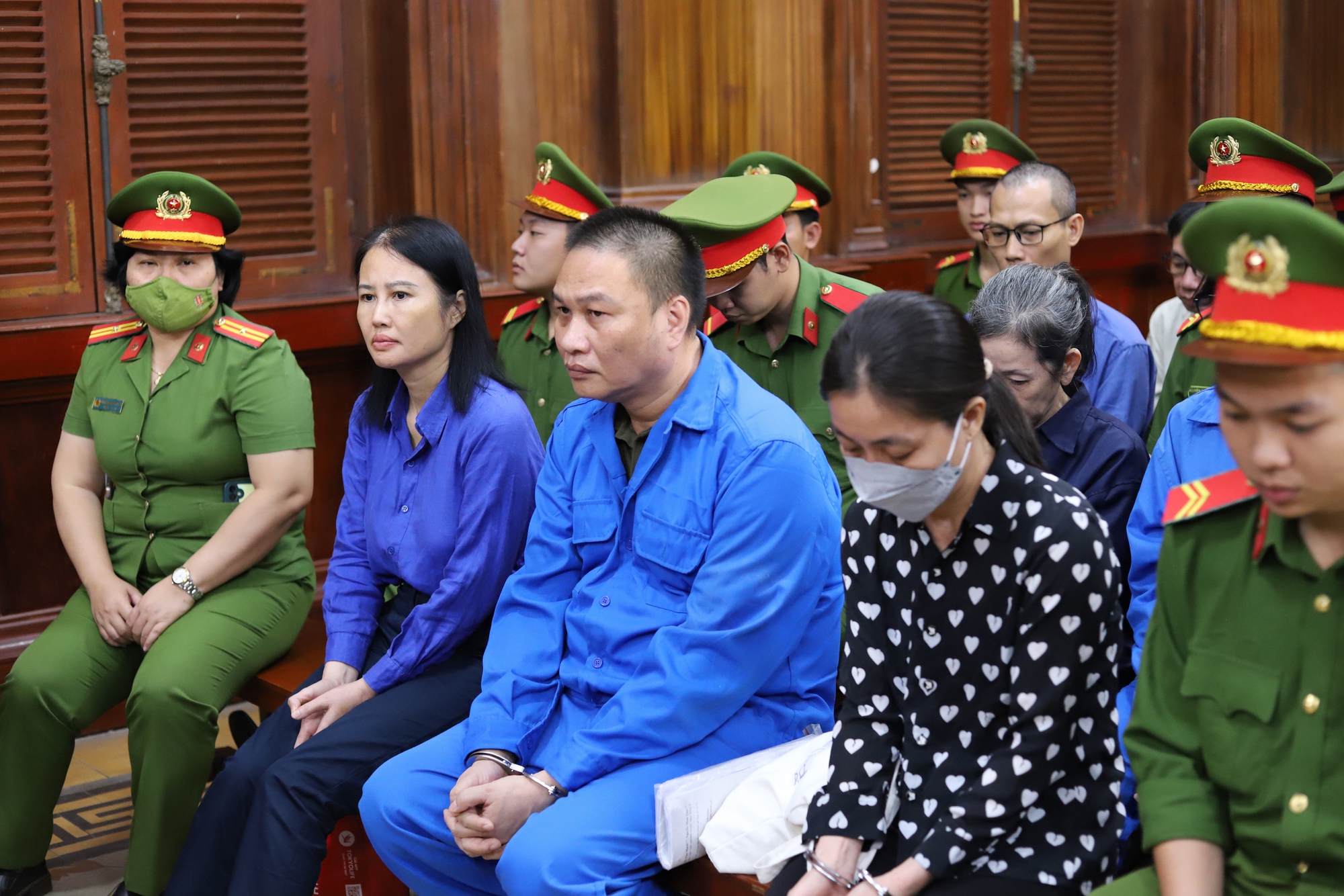
Defendants in court. Photo: Ý LINH
Businesses Manipulating Government Officials
Regarding education sector violations, the court emphasized no evidence of material gain for defendants such as Lê Hồng Sơn (former Director of Ho Chi Minh City Department of Education and Training), Lê Vương Nga, Võ Ngọc Thu, and others. Absence of personal benefit was considered a mitigating factor but did not alter the nature of the violations. Most defendants erred due to favoritism, misplaced trust in subordinates or companies, and inadequate independent verification before signing or approving documents. A notable example is a directive signed by Lê Hoài Nam, former Deputy Director of Education and Training, sent to 89 high schools and district education offices, which misaligned with city guidelines. This directive triggered a cascade of misaligned procurements, resulting in significant budget losses.
Additionally, officials relied heavily on information provided by companies. Many defendants admitted trusting AIC’s pricing, technical specifications, and “turnkey solutions,” leading to bundled purchases that inflated equipment costs and included unnecessary features. Some documents revealed companies proactively approached department leaders to introduce products, build trust, and steer processes in their favor.
Furthermore, during Ho Chi Minh City’s rapid digital transformation, leaders prioritized swift implementation to meet innovation demands. Failure to phase projects, consult diverse pricing sources, and conduct independent assessments allowed companies to gain an unfair advantage.
The court determined that AIC and Ms. Nguyễn Thị Thanh Nhàn were primarily responsible for the damages and ordered them to jointly compensate for losses equally. The court acknowledged that several defendants voluntarily rectified VND 68.4 billion in damages (including VND 66 billion from Ms. Nhàn’s family). The remaining VND 76 billion must be compensated by Ms. Nhàn and AIC.
Court Sentencing
For “Violating Bidding Regulations with Serious Consequences,” the Ho Chi Minh City People’s Court sentenced Ms. Nguyễn Thị Thanh Nhàn to 8 years in prison, cumulative with prior sentences totaling 30 years; Ms. Hoàng Thị Thúy Nga to 7 years, cumulative with prior sentences totaling 30 years; Mr. Lê Hồng Sơn to 3 years of probation; and Mr. Lê Hoài Nam to 2 years and 6 months in prison. Other defendants received sentences ranging from 2 years of probation to 5 years in prison, based on their roles and severity of violations.
Brother Reveals Family Raised $3 Million in Desperate Bid to “Save” Nguyen Thi Thanh Nhan

Mrs. Nguyen Thi Thanh Nhan’s brother revealed that the family has “borrowed and pooled resources” in an effort to mitigate the consequences for their sister, who is currently on an international wanted list.
Former Executive Sentenced to 8 Years for Illegal Land Transfer in Bến Vân Đồn

The Ho Chi Minh City People’s Court has sentenced defendant Nguyễn Công Khế to 8 years in prison for violations in the transfer of the land plot at 151-155 Bến Vân Đồn, resulting in losses exceeding 215 billion VND.
Former SJC CEO Files Handwritten 4-Page Appeal, Seeking Reconsideration of 10,800 Taels of Gold Repayment

From pre-trial detention, former SJC CEO Le Thuy Hang has filed an appeal against the first-instance judgment, which has been forwarded to the Ho Chi Minh City People’s Court.
Court Dismisses Request to Cancel Separate Pink Books; Saigon Gateway Residents File Appeal
The second first-instance verdict by the Ho Chi Minh City People’s Court partially upheld the plaintiff’s claims.
Former Asanzo Chairman’s Siblings Plead for Lenient Sentencing
Previously, the sentences handed down by the Ho Chi Minh City People’s Court were deemed significantly lighter than the penalties proposed by the Ho Chi Minh City People’s Procuracy.