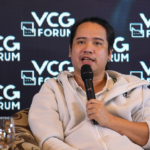
Mr. Phan Đức Trung – Chairman of the Vietnam Blockchain and Digital Asset Association, Chairman of 1Matrix Company
On the afternoon of December 12th, the Vietnam Financial Consulting Association (VFCA) and Vietnam Finance Magazine hosted the Vietnam Capital Market Outlook Forum 2026, themed “Breakthrough on a New Foundation.”
Speaking at the forum, Mr. Phan Đức Trung – Chairman of the Vietnam Blockchain and Digital Asset Association and Chairman of 1Matrix Company – noted that while the legal framework for blockchain technology and digital assets has been established, Vietnam still faces numerous infrastructure and operational challenges to fully unlock its potential as a capital channel for the economy.
Delving deeper, the representative from 1Matrix emphasized that the divide between digital assets and traditional finance extends beyond concepts, rooted in core technological foundations. He likened the stock market’s order-matching system to a central processing unit (GPU), while blockchain serves as a recording and verification mechanism, akin to a CPU. In modern models, these layers must be distinct: order matching operates independently, while settlement is recorded on the blockchain.
Another significant difference lies in market operating rhythms. Traditional banking systems operate on fixed schedules, with interest rates typically calculated monthly or annually. In contrast, the digital asset market runs 24/7, enabling real-time yield calculations, even by the minute. This shift significantly impacts liquidity and capital flow velocity.
Regarding tokenization trends, Mr. Trung cited forecasts indicating that by 2030, tokenized assets could account for approximately 10% of global GDP, equivalent to $16 trillion. Major financial institutions like JPMorgan, HSBC, and the Industrial and Commercial Bank of China (ICBC) have already integrated blockchain deeply into their core banking systems, boosting transaction processing capabilities to hundreds of thousands per second.
Furthermore, Mr. Trung noted that the digital asset market has moved beyond its nascent phase – marked by the downfall of young “prodigies” like FTX – toward the involvement of professional financial institutions.
“In 2023, the collapse of many ‘prodigies’ was primarily due to financial investors rushing in too quickly, focusing heavily on legal aspects while neglecting technology, leading to significant consequences. However, the market is now maturing, driving a different process: previously, orders were matched once daily; with ETFs, matching occurs by session; and with tokens, there are no opening hours, operating continuously,” he explained.

Another prominent trend is the increasingly dominant role of stablecoins in payments, swaps, and value storage. These assets are even more widely used than central bank digital currencies (CBDCs), as many users are concerned about privacy issues.
In Vietnam, according to Mr. Trung, capital flows linked to digital assets are substantial but not fully reflected in official statistics on economic growth drivers. Vietnam consistently ranks among the top 10 countries globally in cryptocurrency adoption, with a large contingent of freelancers willing to receive income through these channels.
While legal frameworks are progressing, technology and human resources remain significant gaps. Mr. Trung cited examples of exchange hacks (such as in South Korea) resulting not only from software flaws but also from mathematical model vulnerabilities, allowing hackers to decode behavior without needing security keys. Additionally, digital asset custody differs entirely from traditional securities custody, encompassing both “off-chain” and “on-chain” custody.
“Currently, no exchange in Vietnam possesses the necessary workforce and technology to ensure the safety of these complex custody operations,” he stressed, emphasizing the need for Vietnam to address the shortage of high-quality human resources and invest seriously in secure technological infrastructure, particularly custody technology.
“Digital assets represent a vast potential resource, but to harness them for development goals, we must simultaneously address numerous issues. The greatest challenge is synchronizing human resources, technology, legal frameworks, and compliance. Synchronization here means solving the problem holistically and concurrently. I often use an analogy: with a shoe production line, you can’t have ‘each side running differently,’ with the left side going one way and the right side another, then waiting to see which succeeds. That would be a tremendous waste of resources,” he illustrated.
Dr. Trần Quý: The Essence of Digital Assets Lies in ‘Asset’, Not Technology

When it comes to digital assets, the focus isn’t on the word “digital” but on the word “asset,” as it must be a true asset with clear ownership rights and managed as a legitimate asset, according to Dr. Trần Quý, Director of the Vietnam Institute of Digital Economic Development.
Blockchain Accelerates Real Estate Firms’ Path to IPO, Experts Say
By tokenizing real-world assets on the blockchain, real estate businesses can access capital far earlier than traditional IPO timelines.
Unlocking Vietnam’s Capital Market: Three Key Drivers Poised to Trigger a Major Influx of Investment

The year 2026 marks a pivotal moment for Vietnam’s financial market, serving as a catalyst for rapid, sustainable growth and elevating its global standing on the international stage.
Unlocking Vietnam’s Vast Capital Market Potential in the New Era

With new equity capital reaching 10% of GDP and KRX infrastructure significantly boosting liquidity, experts believe the capital market is poised for a breakthrough, supported by an increasingly robust policy framework.
Unlocking Digital Assets: A New Growth Catalyst

In the wake of the government’s issuance of Resolution 05, which pilots the cryptocurrency market, a pivotal moment has emerged for the digital economy and corporate governance reform. Representatives from businesses, experts, and policymakers engaged in discussions on the digital economy, exploring how these components can collectively forge a new foundation for growth.