


















In the rapidly evolving digital economy, cashless payments have transcended being a trend to become an essential need. The latest and most significant advancement in this journey is the establishment of cross-border QR code payments between Vietnam and its neighboring countries, particularly the vast market of China.
A Boost from the Billion-Strong Market
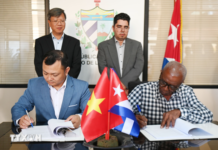
The announcement that China has officially become the next country to implement cross-border retail QR code payments with Vietnam has sparked a wave of excitement in the tourism and retail sectors. This achievement is the result of a strategic partnership between the National Payment Corporation of Vietnam (NAPAS) and UnionPay International (UPI), with the participation of major banks such as the Industrial and Commercial Bank of China (ICBC) and the Bank for Foreign Trade of Vietnam (Vietcombank).
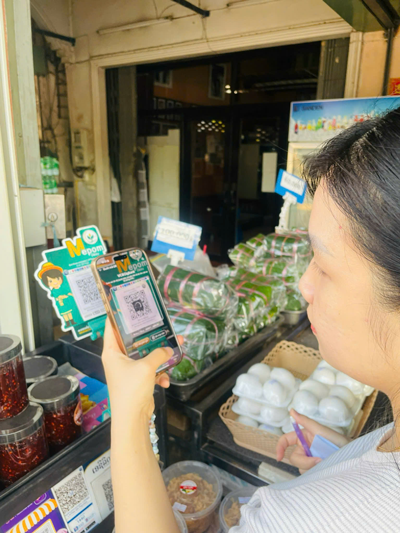
Vietnamese tourists scanning QR codes for payment in Laos. Photo: HOÀNG QUỲNH
As a result, Chinese tourists visiting Vietnam for leisure or business can now use their familiar banking apps or digital wallets to scan VIETQRGlobal codes. The acceptance network is extensive, covering most essential needs of travelers: from bustling shopping centers and tourist attractions to restaurants and retail stores.
Currently, leading retail, food and beverage (F&B), and tourism brands in Vietnam, such as GO! and Big C supermarkets (under Central Retail Vietnam), Highlands Coffee chain, and Sun World entertainment complexes, have already prepared their infrastructure to serve customers using QR codes.
This development holds special significance when considering the broader tourism landscape. According to the Vietnam National Administration of Tourism, in the first 11 months of 2025, Vietnam welcomed over 19.1 million international visitors, marking an impressive 20.9% growth compared to the same period last year. Among these, tourists from China accounted for a significant share, with nearly 4.8 million visitors, a 43% increase.
Mr. Phạm Anh Tuấn, Director of the Payment Department at the State Bank of Vietnam, noted that China is currently the largest source of tourists to Vietnam. Therefore, streamlining QR code payments not only provides immense convenience for millions of tourists but also serves as a catalyst for revenue growth for Vietnamese businesses.
Before connecting with China, the VIETQRGlobal system had already been successfully implemented in Thailand, Laos, and Cambodia. This network expansion positions Vietnam as a fintech-friendly destination in the eyes of international visitors.
Vietnam Bank for Agriculture and Rural Development (BVBank), one of the pioneers in deploying this service, reported that tourists from these countries can easily make payments at stores using BVBank’s VIETQRGlobal codes. “Tourists simply scan the code on the screen and complete the transaction in seconds. This convenience frees tourists from the worry of carrying cash, the risk of loss, or the burden of high foreign exchange fees when using international cards. All expenses are transparently managed within the app,” said Mr. Nguyễn Thiện Tâm, Director of the Digital Banking Center at BVBank, highlighting the superior convenience of this solution.
Lower Fees Compared to Currency Exchange
Cross-border QR code payments not only benefit inbound tourists but also offer significant advantages to Vietnamese travelers abroad. In Thailand and Laos, the Industrial and Commercial Bank of Vietnam (VietinBank) has implemented cross-border payment services, facilitating smooth transactions. Mr. Trần Công Quỳnh Lân, Deputy General Director of VietinBank, mentioned that Vietnamese tourists no longer need to exchange currency in advance or use high-fee credit cards; they can simply scan QR codes for seamless payments, just like in Vietnam.
Particularly in China, known for its cashless society, Zalopay has introduced an international QR code scanning feature, enabling Vietnamese users to pay directly in VND at numerous acceptance points, from upscale shopping centers to small retail stores. The system displays the converted amount along with transparent fees, allowing users to proactively manage their spending.
Research indicates that the current service fees charged by banks and e-wallets in China are approximately 1.5%, significantly lower than the 2.5%-3% currency conversion fees associated with credit card payments.
Recently, Zalopay expanded this service to Singapore. Users can scan QR codes at transaction points displaying NETS, Alipay+, and notably, pay for Grab services in the Lion City.
According to the roadmap, starting from 2026, NAPAS and UPI will complete the reverse payment connection. At that time, Vietnamese users will also be able to use apps from NAPAS member banks to scan QR codes within UnionPay’s vast network across China.
Mr. Larry Wang, Vice Chairman and CEO of UnionPay International (UPI), emphasized that this project leverages the mechanism of payment in local currencies, thereby facilitating economic, trade, and people-to-people exchanges.
Promoting Regional Financial Connectivity
Mr. Nguyễn Quang Minh, CEO of NAPAS, believes that this service not only provides seamless and convenient payment experiences for citizens of both countries but also enhances financial connectivity, promoting the use of local currencies in cross-border transactions. This, in turn, fosters trade, tourism, and broader economic cooperation between the two nations.
In an interview with the Labor Newspaper, Mr. Phạm Đức Duy, Deputy Director of the Individual Customer Division at Saigon Thuong Tin Commercial Joint Stock Bank (Sacombank), stated that the implementation of cross-border QR payments in Laos, Cambodia, Thailand, and Singapore has demonstrated the core value of this model in enhancing user experience and convenience. As a result, small businesses and households, which heavily rely on cash transactions, have greater opportunities to engage with international customers, expand their customer base, and improve revenue.
According to Mr. Duy, the mechanism of payment in local currencies reduces foreign exchange costs, shortens transaction processing times, and enhances liquidity efficiency, thereby promoting regional financial connectivity. For users, this method offers convenience, speed, and security by eliminating the need for currency exchange, avoiding conversion fees, reducing the risk of carrying cash, and fostering digital payment habits in cross-border transactions.
Vietnam Welcomes Its 20 Millionth International Tourist in 2025
On the afternoon of December 15, at Phu Quoc International Airport, the Ministry of Culture, Sports and Tourism, in collaboration with the People’s Committee of An Giang Province and various businesses, held a ceremony to welcome the 20 millionth international tourist to Vietnam in 2025. This milestone marks a significant achievement in the 65-year history of Vietnam’s tourism industry.
The 20 millionth tourist in 2025 was identified as Ms. Karolina Agnieszka from Poland, who was warmly welcomed with solemn ceremonies and gifts totaling nearly 500 million VND, sponsored by Sun Group and Ngọc Hiền Pearl. The 19,999,999th and 20,000,001st tourists also received gifts worth over 200 million VND each. Additionally, all passengers on the fortunate flight were gifted flowers and tickets to the “Kiss of the Sea” show at “Phu Quoc Sunset Town.”
D.Nhân
Caution Regarding Data Security Risks
According to Mr. Nguyễn Thiện Tâm, cross-border QR code payments also pose significant challenges in terms of information security, as transactions must pass through multiple technical systems and legal infrastructures across different countries. In a context where security standards and data management regulations are not fully harmonized, the risk of personal data and transaction information leakage is a notable concern.
Additionally, fraudulent activities such as QR code spoofing at points of sale or exploiting small, high-frequency transactions for money laundering may increase in the absence of robust monitoring mechanisms. Reliance on foreign systems and partners also heightens operational risks in the event of technical failures or disputes.
Mr. Tâm emphasized that controlling these risks requires the implementation of comprehensive solutions, from standardizing security requirements, encrypting data, and masking sensitive information to transaction authentication based on risk levels. Real-time transaction monitoring, sharing fraud alerts, and enhancing training for payment acceptance units are also crucial.
Mr. Nguyễn Đức Huy mentioned that banks and financial institutions are adopting dynamic QR codes, generated in real-time and integrated with full transaction information, to minimize risks, ensure transparency in cash flows, and support tax compliance management.