














In an official dispatch to the People’s Committee of Quang Ninh Province, the Ministry of Construction announced that the Prime Minister has approved the adjusted Railway Network Plan for Vietnam for the period 2021–2030, with a vision towards 2050.
The Hanoi – Quang Ninh high-speed railway is planned to connect from Co Loa station (linked to Hanoi’s urban railway line 4), pass through Gia Binh station (connected to Gia Binh International Airport), and terminate at Ha Long Xanh station (linked to the Hai Phong – Ha Long – Mong Cai railway). The line is designed as a double track with a gauge of 1,435 mm and a length of approximately 124 km.
“The investment in the Hanoi – Quang Ninh Railway Project, as proposed by Vinspeed, is fundamentally consistent with the Railway Network Plan,” stated Deputy Minister of Construction Nguyen Danh Huy in the dispatch.
To ensure synchronization and efficient operation, the Ministry of Construction requested the People’s Committee of Quang Ninh Province to further study and supplement connectivity solutions. Specifically, they should clarify the connection plan between the Hanoi – Quang Ninh line and urban railway line 4 to enhance accessibility to Hanoi’s city center and provide detailed explanations regarding the connection with Gia Binh International Airport.
Additionally, they should explore solutions for interoperability with national railway lines such as Lao Cai – Hanoi – Hai Phong, Hai Phong – Ha Long – Mong Cai, as well as the railway network within the Hanoi hub and the urban railway systems of Bac Ninh, Hai Phong, and Quang Ninh.
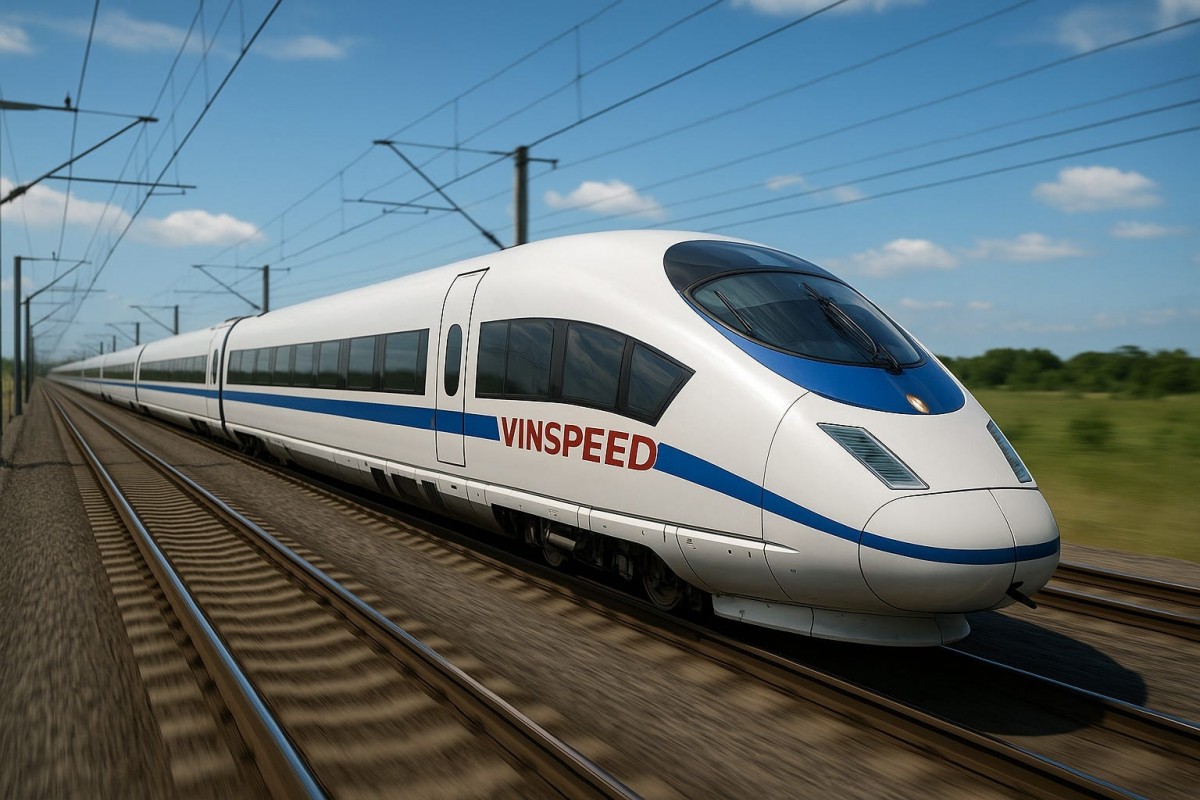
According to Vinspeed’s proposal, the Hanoi – Quang Ninh railway will start at the National Exhibition and Convention Center (Co Loa) in Dong Anh District, Hanoi, and end at the Forest Park Area in Viet Hung Ward, Quang Ninh Province, opposite the Vinhomes Ha Long Xanh urban area.
The project involves the construction of a new passenger railway with a length of approximately 120 km, double tracks with a gauge of 1,435 mm, and electrification. The main line is designed for speeds of up to 350 km/h, while the section passing through Hanoi is expected to have a design speed of 120 km/h.
In the pre-feasibility study report, Vinspeed proposed a total investment of approximately 5.54 billion USD, to be implemented under the business investment model as stipulated in the Investment Law.
According to the leadership of the Ministry of Construction, Vinspeed’s proposal to invest under the business investment model aligns with the Politburo’s Resolution No. 68. However, it is necessary to compare and evaluate the three investment models to clarify why the business investment model is the most suitable and effective choice.
Regarding technology and technical standards, the Ministry of Construction cited international experience from Germany and Spain, indicating that for lines with relatively short lengths and limited transport volumes, operating speeds of around 200–250 km/h often yield higher economic efficiency.
Under the Railway Law, high-speed railways are defined as those with design speeds of 200 km/h or higher. However, given the relatively short length of the Hanoi – Quang Ninh line and the geographical constraints at the beginning and end of the line, maintaining design speeds of 120–160 km/h in certain sections is unavoidable.
Based on this reality, the Ministry of Construction requested the People’s Committee of Quang Ninh Province and the project proposer to supplement analyses and comparisons of investment and operation costs for speed options of 200 km/h, 250 km/h, and 350 km/h, thereby selecting the most suitable speed option to ensure overall efficiency.
Regarding the timeline, the investor proposed starting the project in Q4/2025, aiming for completion in 2027 and commercial operation from 2028. The Ministry of Construction assessed this timeline as highly challenging, requiring thorough review and calculation to ensure feasibility, safety, and project quality.
The Ministry of Construction emphasized that the Hanoi – Quang Ninh high-speed railway is a large-scale project with complex technology and techniques. Therefore, to ensure the project’s feasibility and effectiveness, the investor must meticulously prepare conditions to guarantee financial capacity, project implementation and management, governance, business operations, and technical expertise, along with risk management measures for the project.
Highway Project Propels Son Hai Corporation to Claim Over 100 Billion VND Bonus, Reaching Milestone in Just 3 Days

The nearly 12,000-billion-VND expressway is slated to inaugurate on the same day as hundreds of other projects nationwide.
Technical Test Flight at Long Thanh Airport Using Boeing 787
On December 15th, the Director of Vietnam’s Civil Aviation Authority led a technical inspection flight to Long Thanh International Airport.
“Ultra-Fast Launch: Sun Group’s $2.2 Billion Casino Mega-Project in Van Don Breaks Ground in Just 9 Days”

According to the Ministry of Construction, the high-end integrated tourism service complex project in Van Don Economic Zone, invested by Sun Group, is set to break ground on December 19th.
Why Are Industry Giants Son Hai and Xuan Truong Set to Receive Hundreds of Billions in State Bonuses?

The Ministry of Construction has recently proposed to the Ministry of Finance to consider offering incentives to contractors such as Son Hai Corporation and Xuan Truong Enterprise, among others.
Ho Chi Minh City Approves High-Speed Rail Project Connecting Ben Thanh to Can Gio

Ho Chi Minh City has officially approved the investment plan for the Ben Thanh – Can Gio railway line, a project spearheaded by Vinspeed. This ambitious initiative aims to commence operations by 2028, marking a significant milestone in the city’s transportation infrastructure development.