











On the morning of December 15th, General Secretary Tô Lâm and National Assembly deputies from Constituency No. 1 of Hanoi met with voters from various wards, including Đống Đa, Kim Liên, Văn Miếu – Quốc Tử Giám, Láng, Ô Chợ Dừa, Ba Đình, Ngọc Hà, Giảng Võ, Hai Bà Trưng, Vĩnh Tuy, and Bạch Mai.
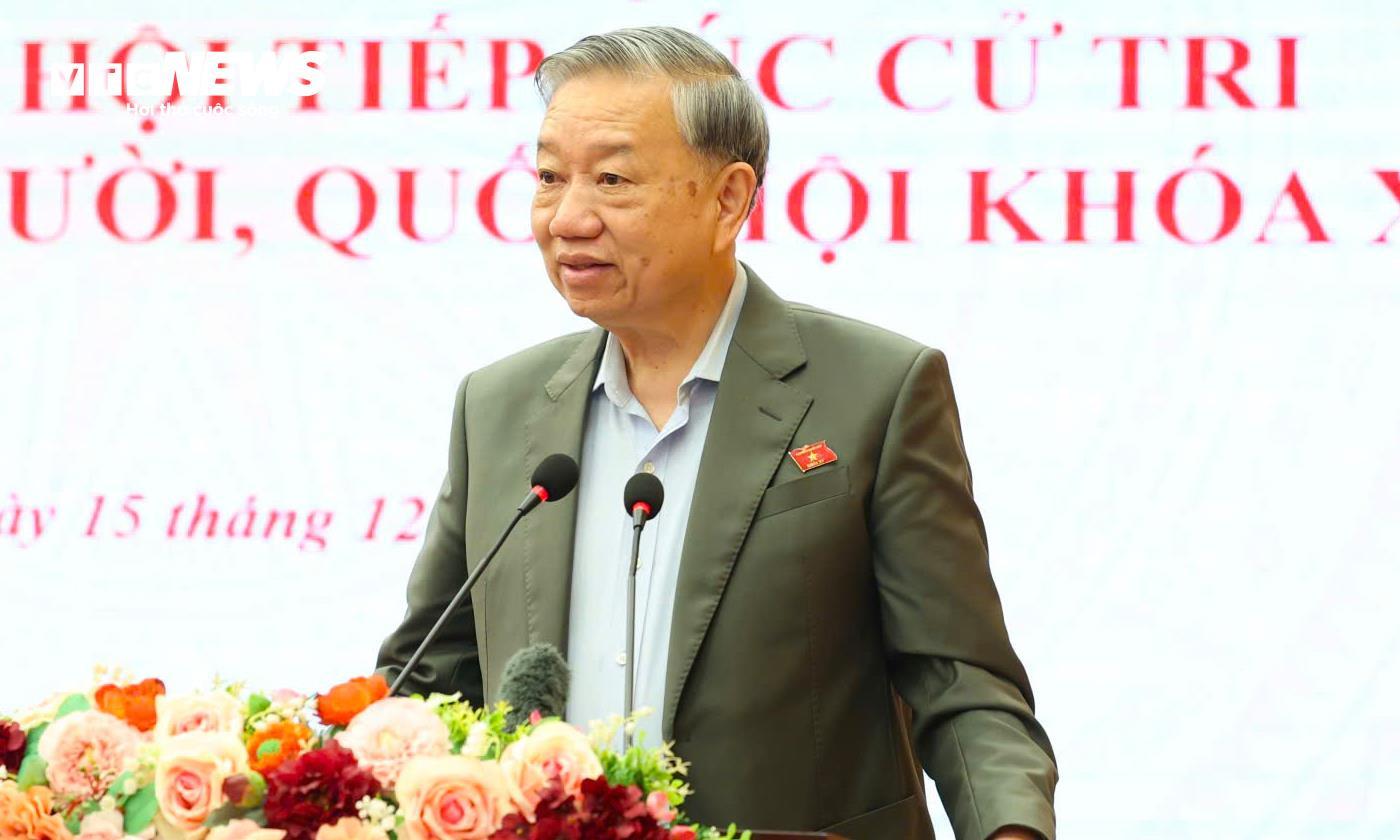
General Secretary Tô Lâm.
Addressing voter concerns about transportation infrastructure, environmental issues, and air quality, General Secretary Tô Lâm revealed that during meetings with the Hanoi Party Committee, he had urged the city to tackle four major challenges.
These challenges encompass traffic congestion, urban order for a clean, green, and civilized city, environmental pollution (particularly water and air quality), and flooding in both inner-city and suburban areas.
“If we fail to address these issues, no matter how many hospitals we build, it won’t be enough. We must focus on resolving the root causes,” stated General Secretary Tô Lâm, emphasizing these as critical bottlenecks for Hanoi, which the city is actively working to overcome.
Regarding transportation, General Secretary Tô Lâm questioned how to effectively combat traffic congestion.
“Hanoi is beautiful, elegant, and welcoming, but people hesitate to visit due to traffic jams. The chaotic traffic scenes here are unlike any other capital in the world. This ‘disease’ must be cured; we cannot allow it to persist,” he asserted.
He further noted that the current traffic situation could hinder development, investment attraction, and tourism growth.
“Tourists won’t come if they perceive traffic accidents as the greatest danger. They won’t return if, on their first visit, they can’t drive to their hotel and must walk 500 meters with their luggage,” he explained.
Therefore, General Secretary Tô Lâm suggested that Hanoi should develop ring roads, construct additional bridges, and prioritize underground metro systems.
“Underground metros offer numerous advantages. Elevated railways, however, are difficult to expand and may eventually hinder development. We must re-plan the metro system to encourage urban sprawl,” he stressed.
On environmental pollution control, General Secretary Tô Lâm criticized Hanoi’s slow progress in environmental sanitation, which remains largely incomplete. Currently, waste is merely collected from the city center and transported to outskirts for incineration, shifting pollution from urban to rural areas. Advanced technology is essential for effective waste management.
Notably, General Secretary Tô Lâm disclosed that police investigations uncovered corruption and inaccurate data reporting at air quality monitoring stations.
“Operators at these stations colluded with factories to falsify pollution levels. They’ve been bribed, otherwise, factories would have to relocate,” he revealed.
Highlighting the severity of air pollution, General Secretary Tô Lâm warned, “If our children breathe this air, cancer and lung diseases are inevitable. No amount of hospitals or doctors can suffice.”
He also addressed the issue of domestic wastewater discharge, suggesting that Hanoi should consider charging residents for wastewater treatment, in addition to clean water usage fees.
“This fee would emphasize our responsibility in water conservation and environmental protection,” he stated, pledging Central Committee, Government, and National Assembly support for Hanoi and other localities nationwide.
Additionally, General Secretary Tô Lâm mentioned Vietnam’s recent participation in international conventions on cybersecurity, demonstrating the nation’s commitment to global cyber safety.
He characterized cybercrime as a non-traditional security threat requiring global cooperation. Even powerful nations like the U.S. cannot combat it alone and must rely on international collaboration.
“Cybercriminals may operate in one country while targeting another, making the fight against them extremely complex. Moving forward, we will enhance e-commerce laws, consumer protection, and crack down on tech-enabled counterfeit and substandard goods,” he said.
General Secretary Tô Lâm acknowledged that while many cases have been severely punished, the vastness and complexity of cyberspace make it akin to “a drop in the ocean.” Fake news and misinformation persist, though significantly reduced compared to the past.
Beyond state regulation, he emphasized the need to enhance public resilience, awareness, and critical thinking in information consumption.
“Achieving this requires elevating public knowledge and understanding, a process that takes time. We must continue educating and cultivating digital citizens,” he noted.
General Secretary Tô Lâm recalled that prior to Party Congresses, online information was often chaotic, with outlets like “quan làm báo” and “dân làm báo” spreading misinformation, causing societal confusion.
“Recently, more sophisticated methods have emerged, necessitating increased warnings and enforcement. Authorities have even apprehended insiders spreading false information—a highly dangerous act. Nothing is more harmful than internal betrayal, which undermines Party and State credibility and confuses the public,” he observed.
General Secretary Tô Lâm stressed the need for unwavering efforts to create a healthy online environment, a complex task requiring systemic involvement and shared responsibility.
FPT Ventures into Railway Technology, Investing $100 Million in Quantum and AI
FPT has announced a significant investment in five strategic technologies, alongside appointing a new wave of leaders to spearhead key industries.
Prime Minister: Shaping Hanoi’s Century-Long Vision Through Strategic Planning
On the afternoon of December 15th, Prime Minister Pham Minh Chinh chaired a working session of the Government’s Standing Committee with leaders from various ministries and Hanoi city. The meeting aimed to provide feedback and input on the major planning directions for Hanoi.
Hanoi Rushes to Auction Land in Year-End Frenzy

In the final days of 2025, Hanoi’s real estate market surged with activity as hundreds of land plots—ranging from individual parcels in suburban areas to prime “golden land” designated for luxury housing and hotel projects—were put up for auction.
Abandoned Resettlement Housing Amidst Hanoi’s Social Housing Crisis
Amid soaring apartment prices, Hanoi faces a stark paradox: thousands of spacious resettlement apartments lie abandoned, deteriorating over time despite the city’s housing crunch.
Spectacular Figures Unveiled: The Mega Landscape Avenue Project Along the Red River

On the morning of December 13th, at the specialized conference of the Hanoi City Party Committee’s 18th Executive Board, on behalf of the City People’s Committee Party Committee, Mr. Duong Duc Tuan, Member of the City Party Committee’s Standing Board and Standing Vice Chairman of the Hanoi People’s Committee, presented a report on the policy for implementing the Investment Project for the Construction of the Hong River Scenic Boulevard Axis. This project holds significant importance for the development of Hanoi’s urban space.