
The construction industry, heavily reliant on traditional materials, outdated technologies, and labor-intensive operations, faces unprecedented pressure to evolve. This shift is accelerating globally, with pioneers like Singapore, Australia, Japan, South Korea, and the EU integrating emission reduction mandates into building standards. Materials without proven low lifecycle emissions are being phased out, and contractors lacking BIM adoption or material efficiency technologies face exclusion from major projects. Supply chains without transparent carbon data risk downgrading or elimination.
The world is transitioning to low-emission, tech-driven, and data-transparent construction models. While green finance once served as a market entry “passport” for Vietnamese businesses, emission standards, technology, and carbon data are now the true “credentials” for the next decade.
Leading markets like Singapore, Japan, Australia, and the EU have embedded emission reduction requirements into building codes. Materials without EPDs (Environmental Product Declarations) proving low carbon lifecycles are excluded. Contractors without BIM implementation or material data face barriers to large tenders. Non-transparent carbon supply chains are downgraded or disqualified.
The question is no longer “when to transition?” but “can Vietnam transition fast enough to seize the next 30 years of opportunities?”
The Green Materials Race: From Cost Advantage to Tech & Low Emissions
In developed nations, green materials are becoming the construction industry standard. Low-clinker cement, geopolymer concrete, recycled materials, green steel, low-carbon bricks, and bio-based materials are rapidly commercializing. All must provide verified emission data through LCA-EPDs and independent certification.
In Vietnam, most construction materials lack carbon data and energy-efficient production lines, hindering competitiveness despite low prices. The game is shifting from “low cost” to “low emissions.”
This trend is not theoretical but rigorously implemented in pioneers like Singapore. By 2025, all major projects must meet Green Mark 2021 standards, reducing operational emissions by 20-30%. Singapore mandated LCA for public projects in 2023, with nearly 49% of all buildings now green-certified—among the world’s highest rates.
Construction Technology: The New Competitive Edge
While materials form the supply chain foundation, construction technology acts as the lever for emission reduction and productivity gains. The global shift to BIM 4D/5D, AI-driven material forecasting, IoT energy monitoring, robotic construction, modular designs, and 3D printing significantly cuts waste, optimizes schedules, reduces noise, minimizes construction debris, and lowers lifecycle CO₂ emissions.
Most Vietnamese firms use BIM only for simulation, lacking emission and material lifecycle data integration, disqualifying them from international supply chains.
The era of cheap labor is over. Technological capability now defines corporate competitiveness.
Transparent Supply Chains: The New Benchmark
Construction supply chains account for 70-80% of project emissions. Green supply chains are thus critical for enterprise evaluation. Major clients in the EU, Australia, and the US demand real-time emission transparency, material traceability, low-carbon logistics, and ESG-compliant supplier management.
In Asia, this system is well-established. Singapore mandates carbon data from design stages. Australia requires LCA for infrastructure. Japan and South Korea commercialize geopolymer and green steel. The UAE builds Net Zero cities.
Compared regionally, Vietnam excels in infrastructure development and execution but lacks critical elements for international supply chain integration: green standards, carbon data, transparent supply chain tech, and low-carbon materials.
Without swift action, Vietnam risks becoming a “bottom-tier supplier,” relegated to low-profit, replaceable tasks.
Vietnam Needs a Green Overhaul: Material to Tech Transformation
To match global momentum, Vietnam must leapfrog incremental changes with a national-level restructuring program.
Materials must be green from inception: energy-efficient production, low-clinker cement, geopolymer concrete, recycled materials, EPD adoption, and transparent emission data.
Construction tech must advance: deep BIM integration with lifecycle and emission data, IoT-enabled sites, prefabrication, and modular strategies to cut emissions and timelines.
Supply chains must be data-driven. When every link—extraction, production, transport, and construction—is measured by carbon data, Vietnam can enter regional green supply chains.
This is not just a corporate challenge but an economic imperative.
Dr. Nguyễn Kinh Luân
30-Year Opportunity—But Only for Early Movers
The next three decades will see trillions invested in Net Zero infrastructure. Early green supply chain entrants will thrive; laggards will be excluded. Timely action could make Vietnam a green materials exporter, develop international contractors, attract large-scale green capital, and establish it as a regional sustainability hub.
Otherwise, Vietnam will handle low-value tasks while others capture high-value segments.
Vietnam’s construction future depends on today’s transformation speed. Green materials and technology are no longer optional but essential for a confident, high-value, sustainable Net Zero era.
Glossary
LCA (Life Cycle Assessment) – Measures emissions and environmental impact from production to disposal.
EPD (Environmental Product Declaration) – Verified emission data based on LCA.
ESG (Environmental, Social, Governance) – Sustainability and transparency standards.
BIM (Building Information Modeling) – 3D/5D models optimizing design, materials, and emissions.
AI (Artificial Intelligence) – Forecasts material use and reduces construction emissions.
IoT (Internet of Things) – Sensors tracking materials, energy, and carbon in real-time.
CO₂ – Carbon dioxide, the primary construction emission.
Net Zero – Net-zero emissions after offsets.
EU (European Union) – Enforces strict carbon standards.
Author: Dr. Nguyễn Kinh Luân, Board Member & Deputy CEO of International Market Development, Hòa Bình Construction Group.
The Comprehensive Overview of the VND 20 Trillion Tu Lien Bridge Project After 7 Months of Implementation
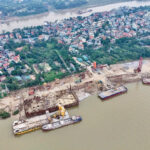
After seven months of construction, the Tu Lien Bridge project spanning the Red River, with a total investment of nearly 20 trillion VND, has begun to unveil its first components on the construction site.
TEDI Chairman Reveals the Story Behind 3,000km of Highways: Workers and Engineers Forced to Improvise for Survival

Mr. Son shared that during stressful periods like the Covid-19 pandemic, while conducting on-site surveys, workers willingly set up temporary shelters outside residential areas. This arrangement ensured both work efficiency and safety amidst the complex and evolving pandemic situation.
Coteccons: Effective Management Shaping New Competitive Advantages for Construction Enterprises

The construction industry is undergoing a profound transformation as Vietnam commits to reducing its carbon emissions by 15.8%, equivalent to 146.3 million tons of CO2 by 2030. In this evolving landscape, reducing emissions, ensuring operational transparency, and robust risk management are becoming essential credentials for businesses, particularly as ESG standards gain widespread adoption.
Bringing Green Materials to Your Home: Binh Minh Plastics Builds Trust for Modern Homeowners
As consumers increasingly prioritize health and environmental sustainability, green materials are rapidly becoming the go-to choice. With superior quality and a commitment to sustainable development, Binh Minh Plastics delivers safe, durable, and cost-effective products, empowering homeowners to build their dream homes with confidence.
Proposed Addition of Targeted Policies to Accelerate Affordable Housing Development

On December 8th, Deputy Prime Minister Tran Hong Ha chaired a meeting to review a draft Government Resolution outlining special mechanisms to address challenges and obstacles in the development of social housing.