























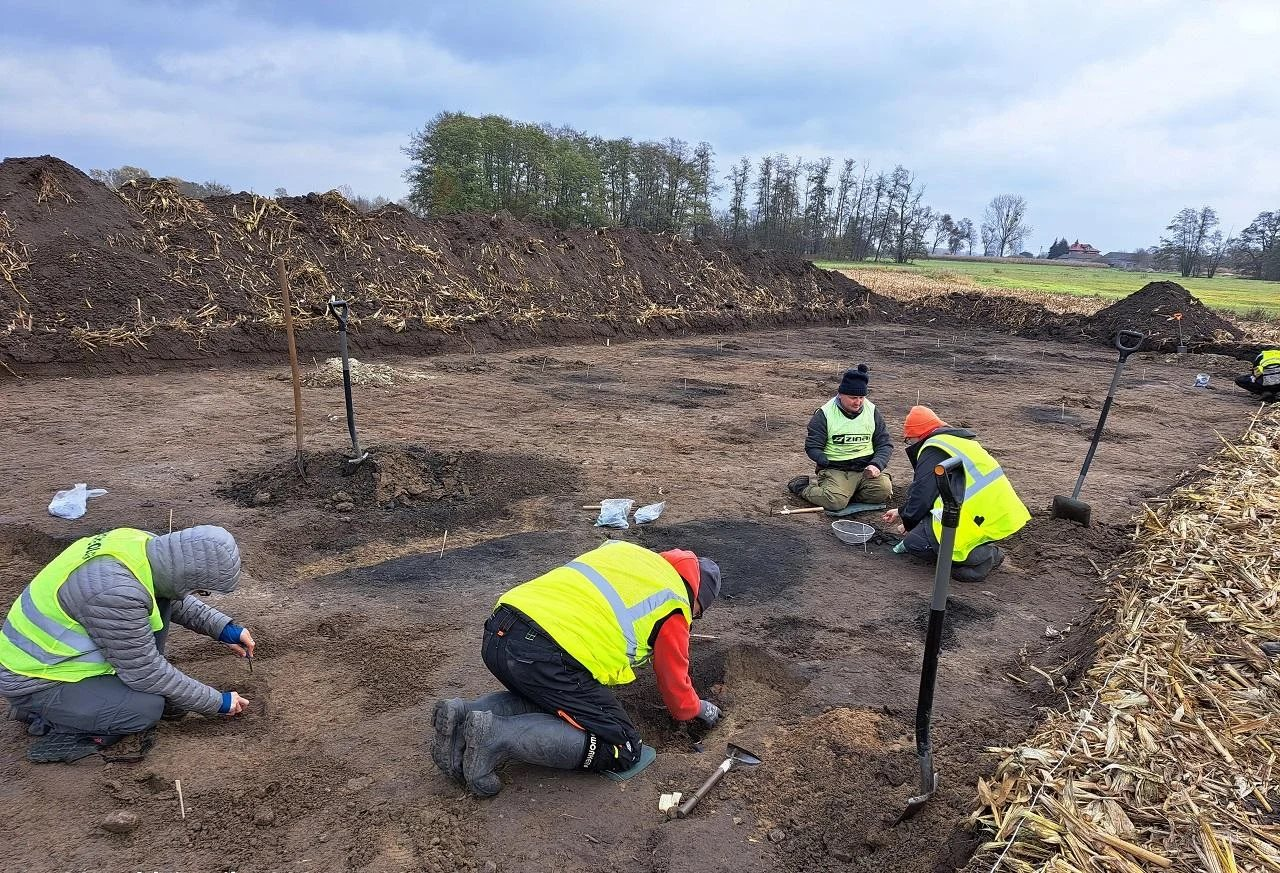
In the construction area of the new international airport west of Warsaw, Poland, archaeologists have unearthed a vast collection of artifacts spanning approximately 7,000 years of history. This discovery has captivated researchers and underscores the critical need for heritage preservation during one of Poland’s most ambitious infrastructure projects.
According to the Mazovia Provincial Heritage Conservation Office, excavations have revealed thousands of artifacts from various historical periods. The earliest findings include flint and stone tools dating back to the Neolithic era, approximately 5,200–1,900 years BCE.
Additionally, artifacts from the Bronze and Iron Ages have been discovered, including pottery, intricate metal jewelry, weapons, household items, and coins. The historical traces extend into the Middle Ages and early modern period.
Among the excavated items, pottery fragments are particularly abundant, appearing at nearly every survey site. Other notable discoveries include metal jewelry, weapon components, stone tools, coins, and ancient glass fragments.
Archaeologists have also identified remnants of ancient settlements associated with the Lusatian and Przeworsk cultures, such as semi-subterranean houses, rubbish pits, kilns, and storage pits. Medieval and early modern hearths and wells have also been documented.
All recovered artifacts undergo rigorous interdisciplinary analysis. Advanced scientific methods, including dendrochronology, X-ray imaging, radiocarbon dating (C14), anthropological studies, and specialized conservation techniques, are employed to determine their age and scientific value. Once verified, the artifacts will be transferred to designated museums under the guidance of the Mazovia Provincial Heritage Conservation Office.
The excavation began in October 2023 and is expected to continue until late 2026, preceding the large-scale land preparation for the airport project. The airport is a key component of the Centralny Port Komunikacyjny (CPK) initiative, a comprehensive overhaul of Poland’s multimodal transportation system, including 2,000 km of high-speed rail networks.
Scheduled to open in 2032, the new airport will be located approximately 50 km west of Warsaw. The CPK project aims to reduce travel time from all major Polish cities to the airport to under 2.5 hours.
Joanna Gawrońska, Senior Inspector at the Mazovia Provincial Heritage Conservation Office, emphasized the site’s exceptional archaeological value, noting that the research scope continues to expand due to the increasing number of discoveries.
Dariusz Kuś, a member of the CPK project management team, stated that the project is meticulously surveying all areas with potential historical significance, ensuring that all artifacts are treated as national heritage and protected rigorously.