


















Illustrative Image
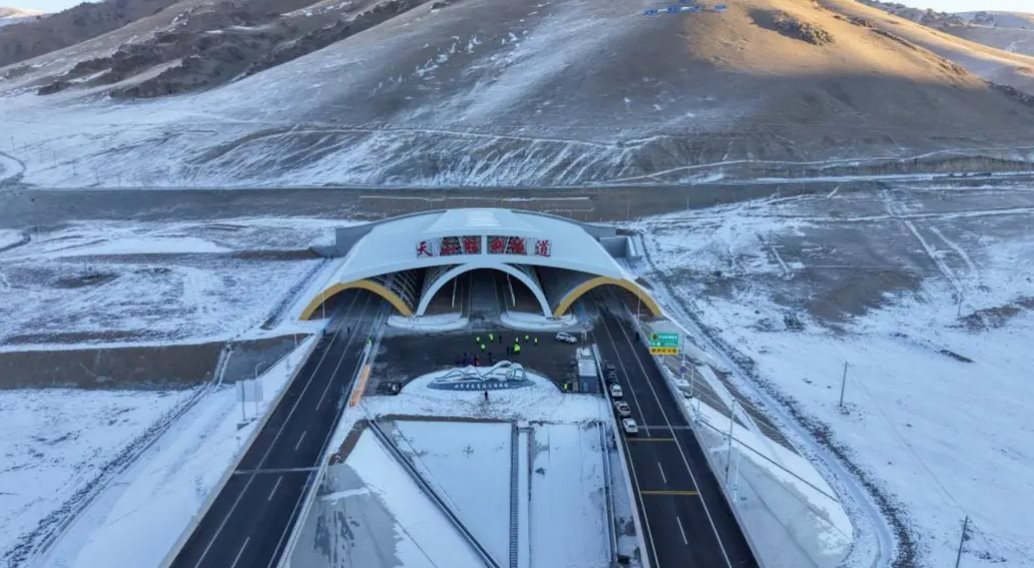
China has officially launched the Tianshan Shengli Tunnel, the world’s longest highway tunnel, spanning 22 kilometers. Located on the Urumqi-Yuli Expressway in Xinjiang Uyghur Autonomous Region, this engineering marvel significantly reduces travel time between Urumqi and Korla from nearly 7 hours to just 3.5 hours.
According to state media, the project, completed in over five years using advanced construction techniques, underscores China’s commitment to large-scale infrastructure development. This includes the Three Gorges Dam, major inland-to-sea waterways, and the Belt and Road Initiative’s (BRI) extensive rail and port networks.
While smaller in scale compared to these mega-projects, the Tianshan Shengli Tunnel is a critical technical achievement. It enhances connectivity across Xinjiang and strengthens China’s broader inter-regional transportation network.
The tunnel traverses the Tian Shan mountain range, linking northern and southern Xinjiang—a strategic region bordering eight Central and South Asian nations, including Kazakhstan, Kyrgyzstan, Tajikistan, and Pakistan. This improves China’s access to the vast Central Asian market.
Beyond transportation, the project supports China’s dual circulation strategy, fostering integration between domestic markets and international trade. Reduced transit times are expected to streamline two-way flows of goods, such as energy and industrial products northward, while accelerating the delivery of southern agricultural goods to major markets.
The South China Morning Post highlights that the new infrastructure will lower logistics costs, enhance trade efficiency, and bolster economic growth in Xinjiang, a region challenged by rugged terrain and harsh climate conditions.
Construction began in April 2020 under extreme conditions. Situated at nearly 3,000 meters above sea level, the site experiences winter temperatures as low as -42°C.
According to the chief engineer of Xinjiang’s Transportation Investment and Development Corporation, traditional methods would have required at least a decade to complete the project.
To expedite progress, Chinese engineers employed the innovative “3 tunnels + 4 shafts” strategy. Instead of a single main tunnel, three parallel tunnels were constructed: one primary and two auxiliary tunnels for geological surveys, worker access, ventilation, and emergency exits.
Four vertical shafts, each nearly 700 meters deep, enabled simultaneous construction from multiple points, drastically reducing the timeline. This approach not only made the tunnel the world’s longest but also set a record for the deepest vertical shafts in a highway tunnel.
The Tianshan Shengli Tunnel’s completion marks a significant advancement in China’s infrastructure capabilities, particularly in challenging environments. As China continues to invest in connectivity to drive economic growth, projects like this tunnel are foundational to both local development and broader regional integration strategies.
World’s First: China Constructs Longest Undersea Tunnel, Slashing Travel Time Between Two Cities from 6 Hours to Just 40 Minutes

Chinese engineers are set to construct a 122-kilometer undersea tunnel, enabling trains to reach speeds of up to 240 km/h.
The Ambitious $10 Billion ASEAN Connection: What Makes Our Neighbor’s Canal So Special?
Upon completion, this will be the longest canal in the world, offering immense benefits to this nation.