

















What Sets IFC Vietnam Apart Hinges on Clear Strategic Choices
At the International Financial Center (IFC) establishment conference in Vietnam on December 21, Prime Minister Pham Minh Chinh announced that the IFC would be developed through a collaborative effort between Ho Chi Minh City and Da Nang, focusing on complementarity rather than competition.
“The success of these two cities will drive the center forward and gradually establish its position on the global financial map,” the Prime Minister emphasized.
As Vietnam transitions from declaration to action, a critical question arises: Can we build the workforce, governance mechanisms, and professional standards necessary for the IFC to operate reliably from the outset?
In this context, the partnership between Vietnam and the United Kingdom in finance and professional services is becoming increasingly vital. Recent policy signals are fostering deeper engagement with international organizations and businesses experienced in major global financial hubs.
A prime example is the Memorandum of Understanding (MoU) signed between the Association of Chartered Certified Accountants (ACCA) and KPMG in October, witnessed by senior Vietnamese leaders in London. This agreement is not merely bilateral but a strategic move to align Vietnam’s financial ecosystem with international standards, with a skilled workforce identified as a core pillar for IFC development.
Ren Varma, ACCA’s Regional Director for Mainland Southeast Asia, notes that Vietnam is at a pivotal stage in its economic and financial development, combining robust growth momentum with clear policy directions for international integration.
“Vietnam is at a very promising juncture,” Varma stated. “Compared to other regional markets, Vietnam boasts a solid growth foundation and clear policy orientation for international integration.”
He also highlighted the workforce advantage: a young, adaptable labor force capable of embracing global standards. “With over two decades of presence in Vietnam, ACCA has witnessed the agility of the finance and accounting sectors in adapting to change,” he shared. “Coupled with Vietnam’s growing role in green finance and digital innovation, this is an attractive factor for investors seeking opportunities in ASEAN.”
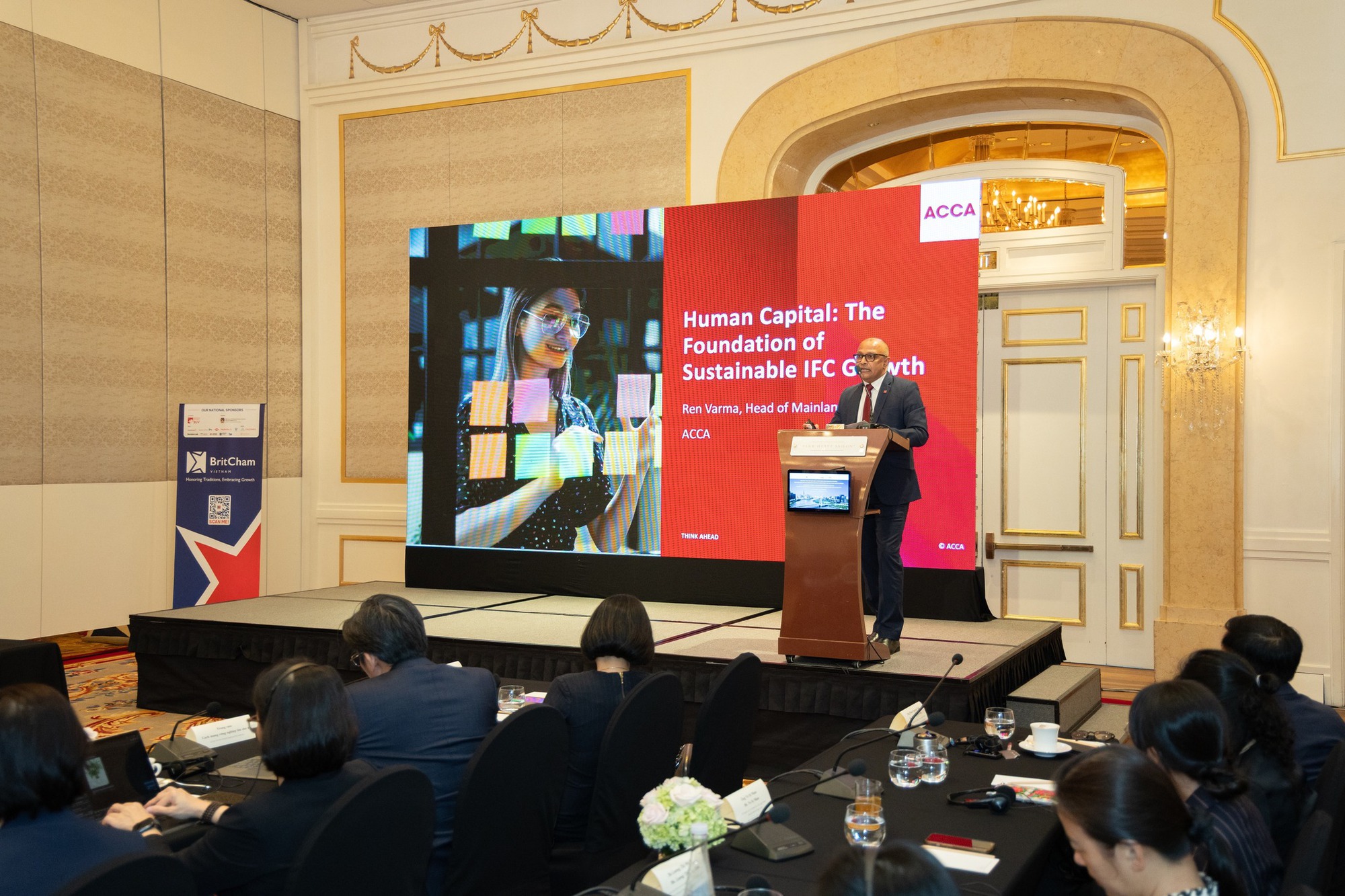
Ren Varma, ACCA Regional Director for Mainland Southeast Asia
According to Varma, what sets Vietnam apart will depend on clear strategic choices. The dual-location model is a good starting point, but a stronger focus on green finance and fintech will position Vietnam as a hub for sustainable investment and digital solutions. However, these ambitions must be built on a solid foundation, including the adoption of International Financial Reporting Standards (IFRS), ensuring audit quality, and developing a globally competitive workforce.
“Vietnam remains central to ACCA’s regional strategy,” Varma affirmed. “When Vietnam succeeds with the IFC, it will set a precedent for other emerging markets in the region.”
International audit and consulting firms also agree on the importance of standards and credibility in preparing for Vietnam’s IFC. Warrick Cleine, Chairman & CEO of KPMG Vietnam and Cambodia, emphasized that the IFC’s focus should be on workforce quality. Ensuring financial functions, risk management, and compliance operate according to international standards is crucial for building investor confidence, especially for cross-border capital reliant on consistent financial information, internal controls, and effective governance.
Progress will increasingly be measured through tangible milestones. Training and certification in finance, auditing, risk, and compliance will serve as early indicators of safe and consistent operations. The UK’s financial ecosystem offers relevant expertise as Vietnam builds internationally compliant financial infrastructure.
“Such collaborations provide Vietnam with a proven foundation that can be tailored to its growth context and ambitions,” he noted.
Additionally, UK businesses and professional associations can support Vietnamese regulators through regulatory sandboxes, joint working groups, and pilot programs, including initiatives on IFRS adoption and ESG disclosures for financial institutions and listed companies. These mechanisms allow policy testing in real-market conditions, shortening the learning curve while managing implementation risks.
Investor confidence remains key to sustaining cross-border capital flows. This confidence is bolstered by the quality and consistency of financial reporting, auditing, risk management, and a robust legal framework for taxation and business, alongside a globally trained workforce.
“For institutional investors, governance and compliance are no longer optional but fundamental requirements, accompanied by rising expectations for transparent, comparable, and consistently executed financial reporting,” Cleine stressed.
Workforce is the Key Determinant of IFC Success
From the UK business community’s perspective, the ACCA-KPMG MoU is seen more as a policy signal than a purely technical agreement. According to Matt Ryland, Executive Director of the British Chamber of Commerce in Vietnam (BritCham), the MoU’s significance lies in reflecting Vietnam’s long-term approach to financial and professional services reform.
“The important message is for international investors,” Ryland shared. “It demonstrates a clear commitment to aligning the ecosystem with global standards.”
Kenneth Atkinson, former BritCham Chairman, added that Vietnam is aiming to build a modern financial ecosystem with advanced legal frameworks, synchronized infrastructure, skilled human resources, and the ability to connect international capital. This initiative holds historical significance in the financial integration process, akin to the establishment of the stock market in 2000 but at a higher level. The UK government has supported Vietnam through TheCityUK’s advisory services on the IFC model and legal framework, drawing on its extensive financial services expertise.

Kenneth Atkinson, Former BritCham Chairman
Atkinson emphasized that workforce development is the key determinant of IFC success. BritCham and UK businesses are well-positioned to share expertise in finance, governance, and professional standards. Many UK professional associations already operate in Vietnam, providing training and certifications in IFRS, ESG, risk management, and compliance, helping the workforce align with global standards.
The development of the International Financial Center (IFC) is seen as a structural shift. Therefore, UK businesses are seeking opportunities beyond capital investment, with an interest in early participation in legal framework design, financial product development, and high-quality workforce building.
Progress is evident, but gaps remain. Vietnam’s financial workforce is young and enthusiastic, yet capabilities in advanced IFRS application, sustainability reporting, data analytics, and industry-specific English still need strengthening, while compliance practices and quality assurance remain uneven.
“This highlights the role of business associations and professional networks in bridging the gap between policy ambition and market execution,” Ryland stated. “BritCham positions itself as a connector, bringing together businesses, government agencies, academia, and professional organizations to identify gaps, share best practices, and pilot solutions that meet both reform priorities and investor needs. Our goal is to turn policy ideas into concrete actions.”
As Vietnam moves from policy conception to IFC implementation, ACCA’s long-standing role in training and certifying financial professionals—including collaborations like the ACCA-KPMG MoU—is addressing a core workforce requirement in the IFC development process.
Exclusive Investment Opportunity: December 20-26, 2025 – 6 Mega Urban Projects with Over $2.1 Billion in Capital

During the week of December 20-26, 2025, four provinces attracted investment in eight projects, totaling over 54.6 trillion VND. Notably, six of these projects are urban developments, with a combined investment of more than 47.2 trillion VND. The most significant project is a nearly 24 trillion VND urban area in Dien Bien province.
Silver Prices Surge: Long Queues Form in Hanoi as Residents Rush to Buy

Silver prices surged again today, December 27th, in the Asian spot market, surpassing $79 per ounce. Domestically, silver prices are nearing 82 million VND per kilogram.
Silver Prices Surge by 169% Annually: What’s Driving This Phenomenal Rise?

This morning (December 27th), silver prices surged by over 4 million VND per kilogram, reaching nearly 82 million VND per kilogram. Over the past month, silver has seen a remarkable 46% increase, and since the beginning of the year, its value has skyrocketed by 169%.
9 Beauty Products Recalled and Destroyed: What You Need to Know

The Drug Administration of Vietnam has issued a mandate to locate and recall nine non-compliant cosmetic products from Japan Connection, despite the company’s claim that no such products remain in their inventory for disposal.
Government Inspectorate Concludes Violations at An Khanh and Na Duong II Thermal Power Plants

Government inspectors have recommended clarifying accountability to address the issues, shortcomings, and violations identified in the An Khánh and Na Dương II thermal power projects.