



















With just a few days left until the end of 2025, the official transition to the new year 2026 is nearing. During this time, the holiday schedule for the 2026 Solar New Year has become a significant concern for many government officials, civil servants, and employees across various businesses.
Understanding the number of holiday days and arranging work schedules accordingly helps employees better plan their production, study, travel, family reunions, or rest and recuperation.
So, how many days off will employees have for the 2026 Solar New Year, and who is eligible for the swap arrangement to enjoy a continuous 4-day break?
How Many Days Off for the 2026 Solar New Year?
On December 25th, the Government Office issued Document No. 12729, announcing Deputy Prime Minister Phạm Thị Thanh Trà’s directive on the 2026 Solar New Year holiday plan. According to the document, the Deputy Prime Minister agreed with the Ministry of Home Affairs’ proposal regarding the upcoming Solar New Year holiday arrangement.
Specifically, as per the approved plan proposed by the Ministry of Home Affairs, employees in the state sector will have January 1st, 2026, off as mandated by labor laws. Additionally, Friday, January 2nd, 2026, will be swapped with the regular Saturday off-day, January 10th, 2026, as a working day.
With this arrangement, government officials, civil servants, and employees in state administrative agencies and public service units will enjoy a continuous 4-day break for the 2026 Solar New Year, starting from Thursday, January 1st, 2026, and ending on Sunday, January 4th, 2026.
This 4-day break includes 2 days resulting from the work swap and 2 regular weekend days.
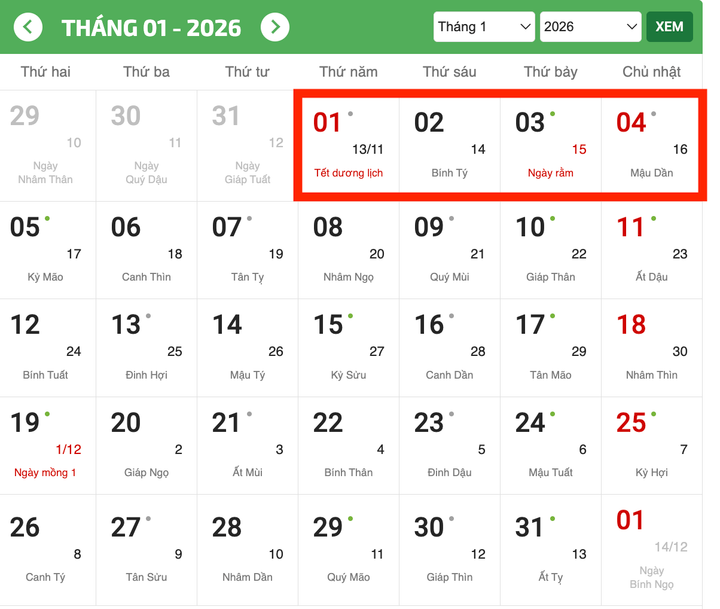
Government officials and civil servants will have a 4-day continuous break for the 2026 Solar New Year.
The Ministry of Home Affairs emphasizes that agencies and units adopting this holiday schedule must proactively arrange and assign personnel to ensure uninterrupted service delivery and avoid disruptions to organizational and public services. Special attention should be given to assigning staff to handle any unexpected situations during the holiday period.
For agencies and units without fixed Saturday and Sunday weekends, the 2026 Solar New Year holiday arrangement will be based on their specific work programs and plans while adhering to current legal regulations.
Not limited to the state sector, the Ministry of Home Affairs also encourages employers in private enterprises to consider applying a similar 2026 Solar New Year holiday schedule for their employees. However, this application must ensure full compliance with labor laws and encourage agreements that benefit employees.
In reality, the number of 2026 Solar New Year holiday days for employees in private enterprises may vary depending on each company’s work schedule. If employees only have Sundays off, according to current labor laws, their Solar New Year holiday will be just 1 day, specifically January 1st, 2026. Since this holiday falls mid-week, no additional days off will be granted.
Under the 2019 Labor Code, employees on holiday, Tet, or annual leave receive their full salary. Therefore, employees using annual leave to extend their Solar New Year break is entirely legal. This approach allows employees more rest, health recovery, family visits, or early-year travel without affecting their salary rights.
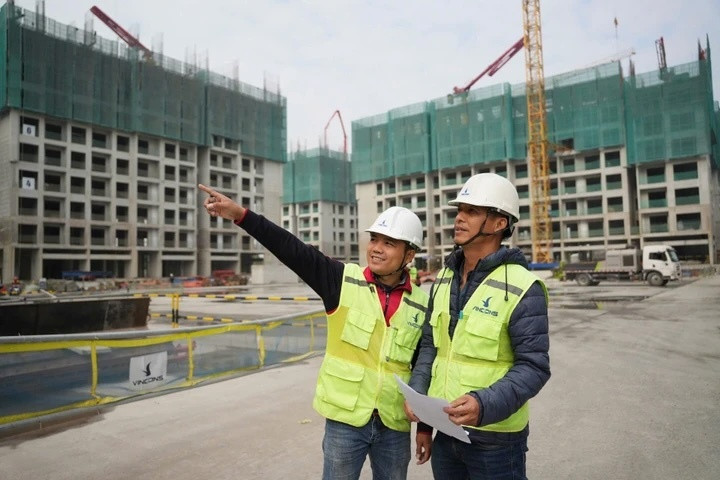
The Ministry of Home Affairs encourages businesses to grant employees a 4-day Solar New Year break. (Photo: Vingroup)
Who is Eligible for the 4-Day Solar New Year Break?
According to the approved plan, the group eligible for the work swap to enjoy a continuous 4-day Solar New Year break includes government officials, civil servants, and employees in state administrative agencies and public service units.
This group will have a continuous break from Thursday, January 1st, 2026, to Sunday, January 4th, 2026, and resume work on Monday, January 5th, 2026.
The Ministry of Home Affairs encourages private enterprises to adopt a similar holiday schedule to facilitate their employees.
However, this application is not mandatory but depends on each enterprise’s production and business conditions while ensuring full compliance with employee rights as per labor laws.
In practice, few private enterprises implement work swaps like the public sector, mainly due to increased salary costs. For enterprises with weekend breaks, swapping Friday, January 2nd, for work on Saturday, January 10th, significantly raises salary expenses.
According to the 2019 Labor Code, employees working on regular off-days must receive at least 200% of their normal workday salary.
If an enterprise only has Sundays off and applies a swap by letting employees take off Friday, January 2nd, and work on another Sunday, salary costs also increase. In this case, employees effectively only get two consecutive days off, January 1st and 2nd, and must work on Saturday, January 3rd, 2026.

The work swap for a 4-day Solar New Year break applies to government officials, civil servants, and public sector employees.
In recent years, to allow employees longer breaks during holidays, many private enterprises have flexibly permitted the use of annual leave or unpaid leave. This approach provides employees with more rest time without additional salary costs for the enterprise.
According to the Labor Code, the Solar New Year grants employees only 1 day off, so the work swap is merely encouraged. Its application depends on each enterprise’s production and business situation. For many enterprises operating on Saturdays, the swap schedule makes little difference in labor organization.
In reality, many enterprises focus resources on the Lunar New Year break, planning a full 9-day holiday. Therefore, if employees wish to extend their 2026 Solar New Year break, they typically use annual leave or agree to unpaid leave instead of applying the work swap.
Domestic Private Enterprises: The Rising Power in M&A Activities

According to the Ministry of Finance’s leadership, domestic private enterprises are increasingly becoming a pivotal force driving the growth of Vietnam’s M&A market. A growing number of foreign companies are seeking partnerships with local businesses for investment, production, and trade collaborations.
Unleashing Vietnam’s Potential: The Synergistic Power of Government, Businesses, and Citizens

To propel Vietnam’s ascent, reliance on a single force is insufficient. True power emerges from the seamless alliance of a visionary government, pioneering enterprises, and engaged citizens, united by shared vision and collective action to transform aspirations into reality.
Securing Guaranteed Paid Leave for Employees: A Comprehensive Guide

Businesses are responsible for establishing annual leave schedules after consulting with their employees.
How to Efficiently Allocate and Spend Over 400 Trillion VND in Public Investment Within Just 2 Months?

After more than 10 months, Vietnam has disbursed VND 495 trillion in public investment capital, equivalent to 54.9% of the plan. This leaves over VND 400 trillion still awaiting allocation in the final two months of the year—a critical period to boost growth and achieve this year’s targets.
TTC Honored Among Top 40 Outstanding Private Enterprises Representing 40 Years of Innovation

TTC Group has been honored among the top 40 outstanding private enterprises, embodying economic prowess, a pioneering spirit, a drive for innovation, social responsibility, and a commitment to accompany the nation into a new era of development.