











After a sluggish period from 2022 to 2023, Ho Chi Minh City’s real estate market in 2025 shows promising signs of recovery. Supply is gradually improving, transactions are picking up, and infrastructure development continues to play a pivotal role. However, beneath this positive outlook lies a persistent issue: an imbalance in product structure, particularly the severe shortage of affordable housing and social housing.
Infrastructure Development: A Key Highlight
In the broader picture, infrastructure remains the primary driver of Ho Chi Minh City’s real estate market in 2025.
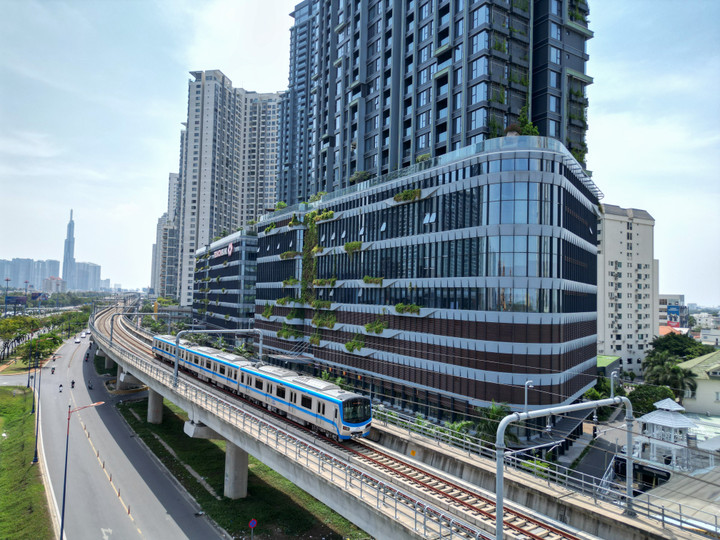
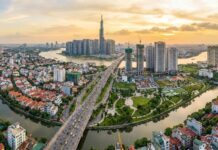
Infrastructure is a standout factor driving Ho Chi Minh City’s real estate development. (Illustrative image: Lương Ý)
The launch of Metro Line 1 (Bến Thành – Suối Tiên), the expansion of the HCMC – Long Thành – Dầu Giây Expressway, the commencement of the HCMC – Mộc Bài Expressway, the completion of Ring Road 2, and the construction of Ring Road 3, along with numerous inter-regional connectivity projects, have significantly reshaped property prices and demand in HCMC and the Southern Key Economic Region.
Areas directly benefiting from infrastructure improvements, such as Thu Duc City (formerly), the Northwest region, and the Southern part of the city, have seen notable increases in property values and liquidity. This has also accelerated the trend of population decentralization from the city center.
According to the Vietnam Real Estate Market Research Institute (VARS IRE), in 2025, apartment prices in HCMC increased by nearly 57% compared to 2019. Other housing segments, such as land plots, villas, townhouses, and single-family homes, also recorded significant price increases of around 30%. In Q4/2025, housing prices stabilized but showed no signs of decline.
CBRE Vietnam reports that in 2025, the average apartment price in HCMC ranged from 91 to 95 million VND/m², a 21-23% increase year-on-year. Nearby localities also saw property prices rise by 15-30% compared to the previous year, despite a notable improvement in housing supply.
Market research reports indicate that in 2025, the housing supply in HCMC increased by 40-50% compared to 2024, the highest level in the past three years. Many previously stalled projects have resumed after legal issues were resolved, revitalizing the primary market.
Despite the improved supply, property prices in HCMC continued to rise in 2025, primarily due to escalating land and construction costs.
Experts predict that without significant policy breakthroughs in developing low-cost housing, property prices in HCMC are unlikely to decrease in the medium term.
The Absence of Affordable Housing
A notable issue in HCMC’s real estate supply is the market’s heavy tilt toward mid- to high-end and luxury segments. Apartments priced below 40 million VND/m² were virtually absent from new launches in 2025, while luxury apartments accounted for over 60% of the new supply.
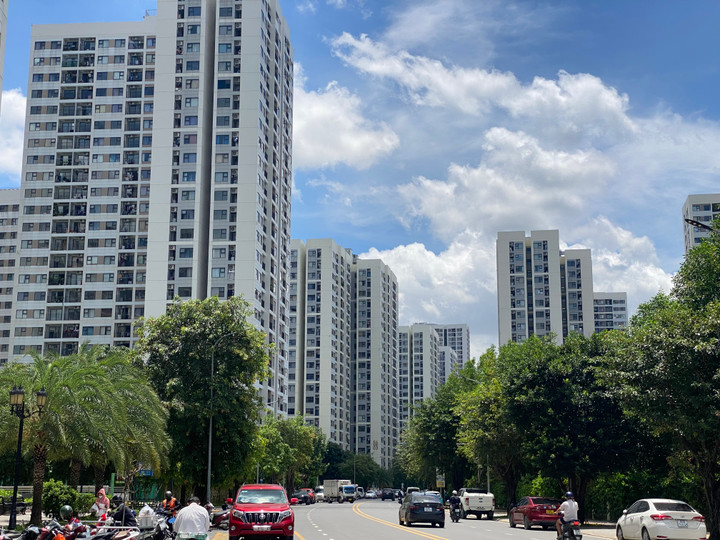
HCMC still lacks affordable housing. (Photo: Đại Việt)
Mr. Lê Hoàng Châu, Chairman of the Ho Chi Minh City Real Estate Association (HoREA), noted that for the second consecutive year, HCMC had no new commercial housing projects in the “affordable” segment (priced below 40 million VND/m²).
The market has maintained a supply-demand mismatch since 2024, leading to unsustainable development, akin to an “inverted pyramid” model.
The severe shortage of affordable and social housing has been a recurring theme in HCMC’s 2025 real estate landscape.
Studies show that the supply of housing for middle- and low-income earners meets only a fraction of the actual demand. Despite the city’s social housing programs, progress has been slow due to land fund issues, investment procedures, and financial viability for developers.
Consequently, the dream of homeownership for hundreds of thousands of workers, civil servants, and young people in HCMC is becoming increasingly distant, posing significant challenges to sustainable urban development.
The shortage of affordable housing is not unique to 2025 but has persisted for years, creating a chronic supply-demand imbalance.
Industry experts attribute the rising property prices to product structure imbalances and increasing project development costs.
Mr. Trần Thăng Long, a real estate expert in HCMC, noted that in 2025, HCMC and its satellite provinces launched nearly 30,000 housing units. However, luxury properties accounted for 90% of the supply, while in former Bình Dương and Tây Ninh, nearly 50% of the supply was in the luxury segment. Affordable housing for middle-income earners remained in short supply.
“The supply is predominantly luxury properties, while the demand is for affordable housing. This mismatch prevents property prices from decreasing,” Mr. Long explained.
According to Mr. Long, market demand remains robust, particularly for projects with clear legal status, assured construction progress, and proximity to infrastructure. Absorption rates for many projects range from 60% to 80%, indicating strong homebuying demand.
Mr. Long also noted that most transactions in HCMC in 2025 were driven by genuine housing needs and long-term asset accumulation, rather than short-term speculation. However, due to rising property prices, middle-income buyers are relocating to suburban areas like Bình Dương, Hóc Môn, Củ Chi, or neighboring provinces such as Đồng Nai and Long An (now part of Tây Ninh) to find more affordable options.
The HCMC real estate market in 2025 is clearly on a recovery path, with improved supply, transactions, and restored market confidence. However, this recovery is not yet sustainable, as challenges related to product structure, housing accessibility, and price pressures persist.
Experts emphasize that for the market to develop healthily and sustainably, HCMC must intensify policies to develop affordable and social housing, alongside infrastructure enhancements and legal procedure reforms.
Only when the housing needs of the majority are met can the real estate market truly become a driver of economic growth and sustainable urban development.
Flexible Work, Flexible Life: Redefining the Standard for Global Business Living

Ho Chi Minh City’s dynamic housing market, exemplified by innovative projects like The Privé, underscores how the rise of flexible work is redefining modern living standards.
An Phú Intersection, Ho Chi Minh City’s Eastern Gateway, Jam-Packed Ahead of New Year Holiday
As the final workday of the year drew to a close on the afternoon of December 31st, a mass exodus began from Ho Chi Minh City. Residents eagerly departed, either heading home for the holidays or embarking on New Year’s getaways. This sudden surge in traffic quickly congested the city’s gateways, particularly those leading east, as vehicles bottlenecked in a rush to escape the urban sprawl.
Europe Grapples with Severe Housing Crisis

Housing accessibility challenges are rapidly emerging as a critical economic, social, and political issue across Europe.
Transforming Ho Chi Minh City’s Eastern Gateway: A $87 Million Road Expansion Project Unveiled
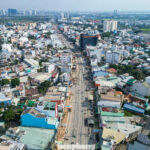
The upgrade and expansion of Nguyen Thi Dinh Road in Cat Lai Ward, Ho Chi Minh City, with an investment of over 2,000 billion VND, is poised to enhance connectivity, alleviate congestion, and create a seamless link between the existing urban area and major transportation hubs such as Cat Lai Port and Phu Huu Port.
Shocking Revelations: Ho Chi Minh City Police Inspect 11 Food Processing Facilities

The Ho Chi Minh City Police Department has launched a comprehensive inspection of 11 food processing facilities, collaborating to destroy numerous products of unknown origin.