













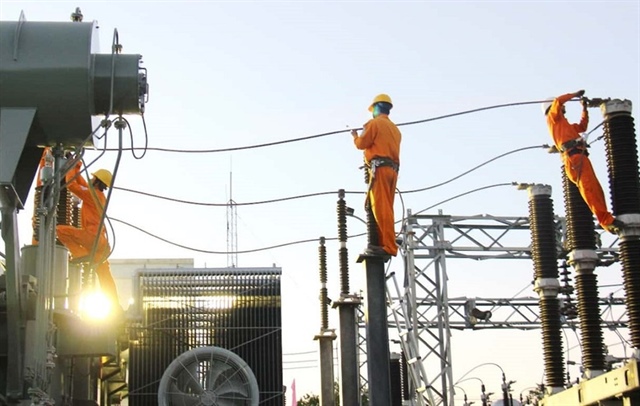
The growth of commercial electricity in 2025 being lower than GDP growth is not an anomaly but reflects a positive shift in the economic structure and energy efficiency—Illustrative image. |
Recently, data released by the electricity sector revealed a notable point: the total commercial electricity output of EVN in 2025 is estimated at 287.9 billion kWh, a mere 4.9% increase compared to 2024, while GDP growth reached 8.02%.
This disparity has raised concerns and even questions about the potential “gap” between economic growth and electricity consumption, traditionally seen as interdependent indicators.
However, according to Dr. Ngo Tri Long, former Director of the Price Research Institute (Ministry of Finance), the lower growth in commercial electricity compared to GDP in 2025 is not unusual. Instead, it reflects a positive change in the economic structure and energy efficiency of Vietnam’s economy. This trend aligns with sustainable development goals, reducing reliance on energy-intensive growth models.
Not all growth drivers lead to high electricity consumption
Comparing the two figures—4.9% growth in commercial electricity and over 8% GDP growth—the electricity/GDP elasticity ratio in 2025 is less than 1, indicating slower electricity growth than economic growth. According to Dr. Ngo Tri Long, this is a crucial indicator of growth quality, not merely a supply-demand issue.
To understand this phenomenon, a comprehensive view is needed, considering GDP growth drivers, weather conditions, and energy use trends.
Primarily, 2025’s GDP growth was driven by public investment, particularly large-scale infrastructure projects like highways, airports, and key transportation works. These projects, with investments totaling tens or even hundreds of trillions of VND, significantly contributed to GDP growth.
However, Dr. Ngo Tri Long notes that electricity consumption during infrastructure construction is low, unlike in industrial production, where electricity is essential and consumed in large quantities. Industrial electricity currently accounts for over 50% of total commercial electricity. Thus, when GDP grows strongly due to infrastructure investment, electricity demand does not necessarily rise proportionally, leading to slower electricity growth than GDP.
In essence, not all economic growth drivers result in high electricity consumption, and 2025 exemplifies this difference.
Another critical factor affecting 2025’s electricity growth was weather and natural disasters. According to Dr. Ngo Tri Long, prolonged storms, heavy rains, and flooding occurred in many areas from the North to the Central Coast. These events disrupted production and business activities, reducing electricity demand in several regions.
Notably, 2025 saw fewer prolonged heatwaves, which typically cause a sharp rise in electricity demand, especially for household use. The absence of extended heatwaves contributed to lower-than-expected commercial electricity output.
Additionally, the development of rooftop solar power for self-production and consumption significantly reduced commercial electricity growth. Many households and businesses have invested in rooftop solar systems for their own needs.
While comprehensive national data is unavailable, the electricity sector estimates self-produced and consumed electricity at around 10 billion kWh, nearly 4% of 2025’s total commercial electricity. This electricity, not traded through the grid, is unrecorded in EVN’s commercial output but still supports production, business, and household activities, contributing to economic value.
Improving electricity efficiency
From a long-term perspective, Dr. Ngo Tri Long notes that Vietnam’s electricity/GDP elasticity ratio is gradually declining, indicating improved electricity efficiency in GDP creation.
Specifically, from 2000-2010, Vietnam’s elasticity ratio was very high, around 2, showing GDP growth heavily reliant on electricity consumption. From 2011-2015, it dropped to 1.86; 2016-2020 to 1.37; and 2021-2024 to around 1.09. This continuous decline shows the economy is decoupling GDP growth from electricity consumption.
By sector, this trend is more evident. Industrial production, the largest electricity consumer, saw its elasticity ratio drop to 0.83 in 2021-2024, meaning electricity grew slower than GDP. Household consumption also showed a declining elasticity ratio. The service and trade sectors had some fluctuations but, accounting for only 8.8-10.5% of total electricity demand, had minimal impact on the overall picture.
Echoing this view, Dr. Nguyen Minh Phong, an economic expert, believes the lower electricity growth compared to GDP in 2025 may seem surprising in isolation but is consistent with the trend since 2020, where Vietnam’s electricity elasticity ratio has continuously decreased. This positive trend reflects more efficient electricity use.
According to Dr. Phong, in a context where Vietnam’s electricity consumption is high relative to GDP growth, this trend shows the economy is shifting toward less energy-dependent growth. Particularly with rising electricity prices, energy-intensive businesses with outdated technology are incentivized to adopt solar power, innovate, and conserve electricity.
However, this poses new challenges for the electricity sector, especially in dispatch and ensuring a stable power supply amid increasing renewable energy and extreme weather conditions.
|
What is the electricity/GDP elasticity ratio? The electricity/GDP elasticity ratio indicates whether electricity growth is faster or slower than economic growth. Formula: Elasticity ratio = % electricity growth / % GDP growth If ratio = 1: 1% GDP growth = 1% electricity growth – electricity and economy grow in tandem. If ratio > 1: Electricity grows faster than GDP – growth relies heavily on industry and high energy consumption. If ratio < 1: Electricity grows slower than GDP – the economy shifts toward services, technology, and efficient energy use. |
Anh Thơ
– 16:12 05/01/2026
Vietnam Poised to Become Southeast Asia’s Economic Powerhouse, Thai Media Reports

The Thai Chamber of Commerce and Industry forecasts that Vietnam will remain among Southeast Asia’s fastest-growing economies over the next five years, with its economic scale potentially nearing Thailand’s by 2029.
Convergence of Internal and External Forces Makes 2026 a Prime Year for Stock Market Investment

During the “2026 Investment Outlook – Balancing Opportunities” livestream hosted by DNSE Securities on December 29th, experts delved into the prospects of the stock market as it approaches the threshold of 2026. Despite lingering macroeconomic challenges, there was a consensus among the specialists that this year is undoubtedly “a must-invest year.”
Unlocking Success: How Vietnam Can Learn from Japan and South Korea to Escape the Middle-Income Trap

Vietnam has set an ambitious goal to become a developed, high-income country by 2045.
Vietnam 2025: Rising Spectacularly Amid Challenges

Professor Vũ Minh Khương highlights Vietnam as one of the nations surpassing growth expectations, even amidst high tariffs, demonstrating its remarkable adaptability to evolving challenges.
Stock Market 2026: Minimal Shockwaves Expected, Steady Growth Forecasted

Vietnam enters 2026 with a bold GDP growth target of 10%, a challenging yet achievable goal. In the stock market, experts predict a more stable and evenly distributed flow of capital compared to the fluctuations seen in 2025.