















Series of High-Profile Deals
DIC Corp, a leading investment and construction development company, has recently approved the transfer of four sub-zones within the Dai Phuoc Eco-Tourism Urban Area project, specifically sub-zones 1, 2, 3, and 7.1. The company has transferred sub-zones 1, 2, and 3, covering a total area of 307,428 m², to TNT Phu Hoa JSC for over VND 2.465 trillion. TNT Phu Hoa JSC, established in March 2023 with a charter capital of VND 660 billion, is primarily owned by TNT Real Estate Development JSC (99.8%), with Mr. Le Ngoc Khanh Viet and Ms. Ha Thi Nhung each holding 0.1%.
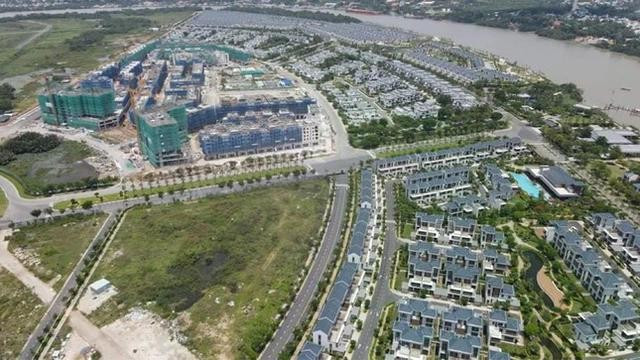
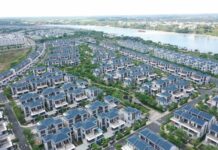
A glimpse of the Dai Phuoc Eco-Tourism Urban Area project.
Additionally, DIC Corp has transferred sub-zone 7.1, spanning 143,906 m², to Everland An Giang JSC for an estimated value of over VND 489 billion. Everland An Giang JSC, a subsidiary of EverLand Group (stock code: EVG), was established in January 2022 and is headquartered at 47-49 Truong Dinh, District 3, Ho Chi Minh City.
The Dai Phuoc Eco-Tourism Urban Area project, located in Dai Phuoc Commune, Dong Nai Province, covers over 464 hectares with a total investment of VND 7.506 trillion. As of September 30, 2025, DIC Corp’s financial report indicates that the project’s ongoing construction costs exceed VND 2.1 trillion.
Similarly, LDG Group has approved the transfer of the entire LDG Sky project to a partner to secure funding for its operations. The LDG Sky project, covering over 18,000 m², comprises five 29-story residential blocks with nearly 1,700 high-end apartments. The project has completed foundation work and obtained all necessary legal approvals.
Ngan Hiep Real Estate JSC, a 99.98% subsidiary of Novaland Group, has acquired over 30 million shares of Seaprodex (SEA), representing 24.03% of its charter capital. Meanwhile, Redwood Investment JSC has purchased over 10.5 million SEA shares, increasing its ownership to 8.44%. Redwood Investment, originally established as Nova Con Dau Eco-Tourism LLC in 2012, is a Novaland Group affiliate.
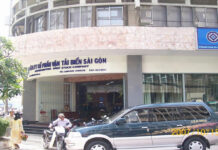
Seaprodex owns prime real estate, including its headquarters at 2-4-6 Dong Khoi, District 1, Ho Chi Minh City, and several other valuable properties.

Seaprodex owns multiple prime properties.
According to JLL, Vietnam’s real estate M&A market in 2025 has seen significant growth, marking a positive shift after a prolonged downturn. In the first 11 months of 2025, cumulative transaction volume reached approximately USD 2.4 billion. Including unofficial deals, the estimated figure is much higher.
Residential real estate led the market, accounting for over 70% of total M&A transactions. Commercial, hospitality, and industrial real estate followed with 17.7%, 5.3%, and over 3%, respectively.
Notable residential M&A deals include Vinaconex’s divestment of its 51% stake in Vinaconex ITC, the developer of the 176-hectare Cat Ba Amatina resort project in Hai Phong. Phu My Hung transferred a 49% stake in the 198-hectare Hong Hac City project in Bac Ninh to Nomura Real Estate Asia, with a total investment of USD 1.1 billion. Both parties will jointly develop the project.
Other listed companies actively engaged in M&A include DIC Corp’s transfer of the Lam Ha Center Point residential project, Vincom Retail’s transfer of Vincom Center Nguyen Chi Thanh, Becamex Group’s transfer of The Charms Binh Duong to Nam Mekong Group, and Hodeco’s divestment from Dai Duong Vung Tau Ocean Tourism, the developer of the Antares tourism project, to a Sunshine Group affiliate.
Continued Growth Momentum
Le Thi Huyen Trang, CEO of JLL Vietnam, forecasts that Vietnam’s real estate M&A market in 2026 will maintain its growth momentum but with cautious and selective movements. Investors will conduct more thorough and comprehensive project evaluations.
Capital costs, while decreasing, are unlikely to return to previous lows. Credit sources are becoming more selective, prioritizing deals with clean legal frameworks, clear profit potential, and sustainable development elements, prompting investors to calculate more carefully.
This selectivity will direct capital toward high-quality assets with strong resilience to market fluctuations, such as industrial real estate, logistics, data centers, Grade A offices, and residential projects catering to real demand with green and sustainable features.

LDG Group seeks to transfer the entire LDG Sky project to a partner.
“In 2026, the real estate M&A market will not explode but grow in depth, prioritizing quality over quantity, marking a more mature and sustainable market development,” Ms. Trang commented.
Neil MacGregor, Managing Director of Savills Vietnam, noted that M&A activity has gained momentum in the past two years as the market adapts to the new Land Law, along with amendments to the Housing Law and Real Estate Business Law, providing a clearer legal framework for investors. The supply of operational assets remains limited, so most M&A activity focuses on development projects rather than income-generating assets.
Savills highlights that M&A transactions are concentrated in residential and large-scale urban development projects, reflecting the current market context. Another notable trend is the increase in joint ventures and minority stake acquisitions, particularly favored by Japanese investors. This approach allows them to explore the market, gain experience, and build confidence before scaling up investments.
“Many investors wish to enter the Vietnamese market but are not yet ready to lead a development project or commit significant capital upfront. Holding minority stakes enables them to learn, accumulate experience, and gradually expand,” Mr. MacGregor explained.
Savills believes the market needs more time for policy changes to fully impact larger transaction volumes and improved liquidity. In the medium term, a more transparent M&A market with enhanced liquidity and diverse capital sources is expected. Long-term, Vietnam has significant potential to attract substantial institutional capital.
Riding the Wave of Apartment Investments: A New Opportunity Arises

According to experts, rental apartments are generating a substantial income stream. In the future, this segment is expected to remain highly sought-after.
DIC Corp Chairman’s Family Faces Forced Sale of Over 2.6 Million DIG Shares
During the trading sessions on December 15, 2025, and December 16, 2025, Chairman of the Board of Directors Nguyen Hung Cuong, along with his mother and sister, had a total of over 2.6 million DIG shares forcibly sold through margin call liquidation.
2026 Real Estate Market Forecast: A Surprising Shift Away from 2022’s High-Stress Scenario

In the short term, Mr. Nguyễn Quốc Anh, Deputy General Director of Batdongsan.com.vn, assesses the real estate market, stating that there are no widespread signs of a land fever. The current hotspots are primarily tied to administrative boundary consolidation stories.
Is Vietnam’s Real Estate Market Following in China’s Footsteps?
Amid the relentless surge in housing prices over recent years, investors are increasingly apprehensive as the government begins to implement more stringent tightening policies. This raises the question: Could Vietnam’s real estate market face a “black swan” event akin to China’s aftermath of the Evergrande Group crisis?
Three Decades of Vung Tau’s Real Estate Titan: The Fate of 800 Hectares of Land and Major Projects Today
From the Chí Linh urban area to DIC Phoenix, DIC Corp’s imprint has spanned Vũng Tàu for over three decades. However, following mergers and an influx of new investment, the real estate titan faces the challenge of maintaining its dominance in an increasingly vibrant and fiercely competitive market.