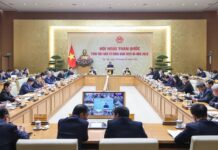










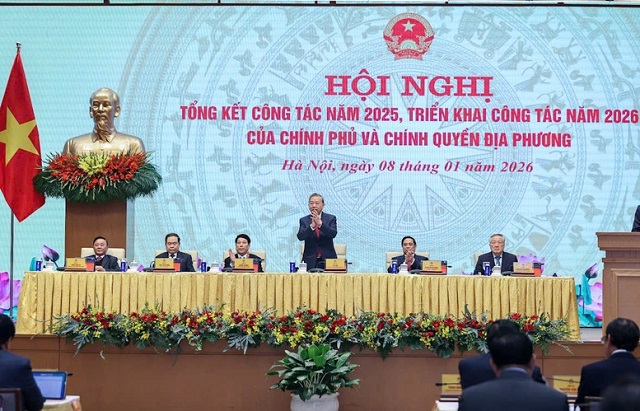
General Secretary To Lam, President Luong Cuong, Prime Minister Pham Minh Chinh, and Chairman of the National Assembly Tran Thanh Man attended the National Conference of the Government and Local Authorities – Photo: VGP/Nhat Bac
|
On January 8th, the National Conference to review the work of 2025 and implement tasks for 2026 of the Government and local authorities was solemnly held, connecting online from the Government Office to 34 provinces and centrally-run cities.
The conference served as a crucial opportunity to reflect on the challenging year of governance in 2025 and to clearly outline the direction, tasks, and solutions for 2026—a pivotal year for the nation’s development in the new phase.
Issuance of a Large Volume of Documents
At the conference, delegates comprehensively assessed the situation and achievements across various socio-economic sectors in 2025, candidly pointing out limitations, shortcomings, challenges, and analyzing causes to draw valuable lessons. Based on this, the Government proposed key tasks and solutions to successfully implement the socio-economic development plan for 2026.
According to the Ministry of Finance’s report at the Conference, under the resolute, wise, timely, and close leadership and direction of the Party—directly and regularly by the Politburo, the Secretariat, led by General Secretary To Lam—along with the supervision and accompaniment of the National Assembly and the involvement of the entire political system, the Government’s administration has achieved many positive results.
In 2025, the Government and the Prime Minister issued a large volume of directives and administrative documents, including 377 decrees, 536 resolutions, 3,134 decisions, and 280 directives and telegrams. The focus was on perfecting institutions and laws; adjusting the 2025 growth target to 8% or higher; prioritizing growth promotion while maintaining macroeconomic stability; increasing revenue, saving expenditures; and focusing on public investment with key priorities.
Additionally, the Government vigorously implemented the reorganization of the apparatus, built a two-tier local government system, promoted decentralization, and enhanced administrative procedure reform linked to digital transformation. It also improved the investment and business environment, proactively responded effectively to the United States’ countervailing tax policies, and continued to focus on cultural and social development, ensuring social security and improving people’s livelihoods. National defense and security were strengthened, and foreign affairs and international integration were expanded, creating a peaceful and stable environment for development.
Speaking Numbers
Thanks to the resolute efforts of the entire political system, the people, the military, and the business community, the socio-economic situation in 2025 is estimated to have achieved the overall goal and many important results, completing and exceeding 15 out of 15 key targets.
GDP growth in each quarter was higher than the previous one; the whole year of 2025 is estimated to reach 8.02%, among the world’s leading groups. The average growth rate for the 2021–2025 period is about 6.3%, higher than the previous period.
The manufacturing and processing industry grew by 9.97%, the highest level in the 2019–2025 period, continuing to be the main driver of growth.
The GDP scale in 2025 is estimated to reach 514 billion USD, rising 5 places to 32nd in the world; GDP per capita reached about 5,026 USD, 1.4 times higher than in 2020, placing Vietnam in the upper-middle-income group, surpassing the set target.
Notably, 20 out of 34 localities achieved a GRDP growth rate of 8% or higher; among them, 6 localities achieved double-digit growth, including Quang Ninh, Hai Phong, Ninh Binh, Phu Tho, Bac Ninh, and Quang Ngai.
Many prestigious international organizations such as the IMF, Standard Chartered, and the World Bank highly appreciated Vietnam’s governance results and growth prospects.
Budget revenue exceeded the estimate by 683 trillion VND in the context of continued implementation of exemptions, reductions, and extensions of about 251 trillion VND, and a highly volatile global economy, which is a very positive result.
In 2025, the state budget allocated the highest-ever capital for development investment, approximately 1.08 million billion VND, ensuring increased resources for public investment.
The state budget balance was ensured, with a budget deficit estimated at about 3.6% of GDP (lower than the estimated 3.8% of GDP); public debt is estimated at about 35-36% of GDP, below the ceiling of 60%.
By the end of 2025, 3,335 km of expressways had been completed (if including access roads and interchanges, it is 3,803 km, exceeding the target by 803 km), and over 1,700 km of coastal roads (meeting the set target).
2026: Determined to Create New Breakthroughs
Entering 2026, the year of the 14th Party Congress, the election of the 16th National Assembly and People’s Councils at all levels, and the first year of implementing the 5-year Socio-Economic Development Plan 2026–2030 with the goal of double-digit growth, the Government identifies that it will continue to face many intertwined difficulties and challenges alongside opportunities and advantages.
To successfully achieve the socio-economic development goals and the 2026 state budget estimate, the Ministry of Finance’s report proposes 5 key solution groups. The top priority is to promote growth while maintaining macroeconomic stability, controlling inflation, and ensuring major balances; enhancing the capacity for analysis, forecasting, and early, remote policy responses.
This is accompanied by continuing to perfect institutions and laws in a synchronized manner; renewing development thinking; creating a new growth ecosystem; increasing state budget revenue, tightly managing expenditures, and enhancing the efficiency of public resource use; controlling budget deficits and public debt within safe and sustainable limits.
– 09:18 08/01/2026
General Secretary To Lam Signs Politburo Resolution on State Economic Development
Resolution No. 79-NQ/TW, dated January 6, 2026, emphasizes that the state-owned economy is a critically important component of the socialist-oriented market economy. By 2030, Vietnam aims to have 50 state-owned enterprises among the top 500 largest companies in Southeast Asia and 1-3 state-owned enterprises in the global top 500.
2025 Socio-Economic Outlook: Record-High Metrics Across Key Indicators
Thanks to the concerted efforts of the entire political system, the people, the military, and the business community, Vietnam’s socio-economic landscape in 2025 is projected to achieve its overarching goals and numerous significant milestones, surpassing all 15 key targets.
Deputy Prime Minister: Land Issues Remain a Major Challenge for Inspection Efforts
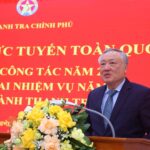
In 2026, rapid urbanization and accelerated development will demand a more robust inspection sector to prevent violations and resolve project bottlenecks.
Prime Minister: The Financial Sector Deserves to Be a Loyal “Guardian of the Treasury,” a Brilliant “Think Tank,” and a “Driving Force for Development,” Leading the Nation into an Era of Growth and Advancement
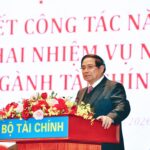
On the afternoon of January 6th, Prime Minister Pham Minh Chinh attended the 2025 financial sector year-end review conference in Hanoi. Organized by the Ministry of Finance, the event focused on summarizing achievements and outlining plans and directions for 2026.
National Economic Census: Unveiling the Comprehensive Snapshot of the Nation’s Economy
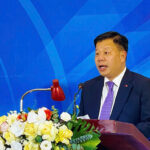
On the morning of January 7th, in Hai Phong City, the Statistics Bureau under the Ministry of Finance launched the 2026 Economic Census Campaign. This initiative aims to comprehensively, objectively, and modernly gather data on the operational status of economic establishments nationwide.