















The Vietnamese government has issued Decree 357 on the development and management of an information system and database for housing and the real estate market.
According to the decree, the information system and database for housing and the real estate market will be uniformly built and managed from the central to local levels. The Ministry of Construction is responsible for developing, managing, and utilizing the system nationwide. Provincial People’s Committees are tasked with collecting, updating, and exploiting the database.
Each real estate product will be assigned a unique electronic identification code, consisting of a combination of numbers and letters, with a maximum of 40 characters. This code is specific to each individual property, whether it’s an apartment or a standalone house, within a construction project. The allocation of unique codes for each product aims to enhance transparency, transaction management, and legal risk prevention.
The structure of the electronic identification code for real estate products will include: land plot identification code – project/construction information code – location identifier (if applicable) – type of real estate product.
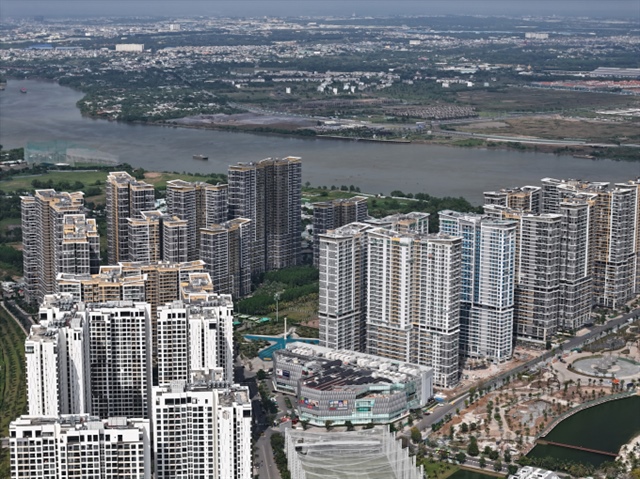
Real estate in Eastern Ho Chi Minh City, December 2025. Photo: Quỳnh Trần |
In addition to real estate products, the government has also mandated unique identification codes for condominium management units, real estate brokerage certificates, and individuals eligible for housing support policies.
The housing and real estate market database system must contain comprehensive project information, including total investment, land use scale, progress, and relevant legal documents.
The real estate database will also include statistics on buying and selling prices (in millions of VND per square meter), total transaction values, and unsold real estate inventory. Furthermore, the system will store data on notarized transactions and real estate sales contracts, which will include the identification codes of the properties and transacting parties, contract dates, and transaction types (buying, selling, leasing, transfer, etc.).
Managed by the Ministry of Construction, the system will also hold information on property ownership by organizations and individuals, such as property type, address, area, quantity, ownership duration and type, and legal status.
Other ministries and sectors are required to share, connect, and provide information to the housing and real estate market database system. The Ministry of Agriculture and Environment is responsible for sharing data on land use certificates and land plot identification codes.
The Ministry of Finance must provide information on taxes related to real estate transfers. The State Bank of Vietnam will share credit data in this sector, including outstanding loans for real estate investment and business, and balances of guarantees for future housing projects.
Anh Tú
– 5:27 PM, January 4, 2026
Urgent Completion of the North-South Expressway: Can Tho – Ca Mau Section
The Ministry of Construction has issued a directive urging specialized management departments and the My Thuan Project Management Unit to accelerate construction progress and ensure traffic safety during the operation of the main route for the Can Tho – Hau Giang and Hau Giang – Ca Mau expressway segments.
Curbing Speculation, Price Manipulation, and Digitizing Real Estate Transactions
Soaring property and real estate prices in recent times stem from a multitude of factors, including supply-demand imbalances, speculative activities by investors, price manipulation by brokers, and the creation of artificial market conditions.
Establishing the Steering Committee for the Implementation of the North-South High-Speed Railway Project

The Ministry of Construction has established a Steering Committee to finalize special mechanisms and a detailed timeline, laying the groundwork for the commencement of the North-South high-speed railway project by the end of this year.
Ministry of Construction Urges Sun Group to Finalize Con Dao Airport Planning

The Ministry of Construction has urged Sun Group to expedite the planning documentation for Con Dao Airport, with a submission deadline set for December 25th.
Exciting News for Residents of Hanoi, Ho Chi Minh City, Hai Phong, Da Nang, and Beyond

In 2025, VARS IRE reports that 19 localities, including major cities with high housing demand such as Hanoi, Ho Chi Minh City, Hai Phong, and Da Nang, successfully met their assigned targets.