












Balancing Interests
The land price table recently approved by the Ho Chi Minh City People’s Council, effective from January 1, 2026, serves as the basis for calculating land use fees, land rent, and more. However, according to regulations, by July 1, Ho Chi Minh City must issue the land price adjustment coefficient (K factor) to apply in specific cases.
Specifically, the construction of the land price adjustment coefficient is based on multiple factors, including market fluctuation adjustment, zoning adjustment, and other factors affecting land prices. It also considers the synthesis and analysis of market land price information, zoning adjustment coefficients determined by land type and land use coefficient, and land use coefficients defined by construction laws.
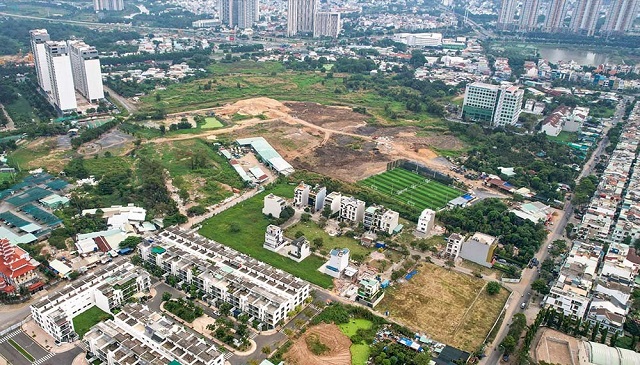
The land price adjustment coefficient, to be issued by Ho Chi Minh City before July 1, must ensure a balance of interests among all parties involved.
|
According to the Ho Chi Minh City Department of Agriculture and Environment, the land price adjustment coefficient, to be issued before July 1, must ensure a balance of interests among the State, land users, and investors. This is particularly crucial for advancing compensation and site clearance for hundreds of ongoing projects in Ho Chi Minh City.
Mr. Dao Quang Duong, Head of the Land Economy Department at the Ho Chi Minh City Department of Agriculture and Environment, stated that the Ministry of Agriculture and Environment has finalized a draft Decree detailing and guiding the implementation of National Assembly Resolution No. 254 on resolving difficulties in the Land Law’s execution.
The most significant challenge involves land allocation cases under the 2003 Land Law. After multiple appeals from the Ho Chi Minh City Department of Agriculture and Environment, this issue has been addressed in the draft. Specifically, Clause 3 of Article 63 has been amended as follows: the determination of the land price adjustment coefficient under points b and c of Clause 1 and points b and c of Clause 2 of Article 63 will follow Decree No. 71 (amended by Decree No. 226).
If there is insufficient information to determine the land price adjustment coefficient at the actual land handover time, the consulting unit will determine the specific land price using other methods outlined in Decree No. 71 (amended by Decree No. 226). This will be reported to the Land Price Appraisal Council for review and decision. If the determined specific land price is lower than the land price in the price table at the actual handover time, the price table will be applied.
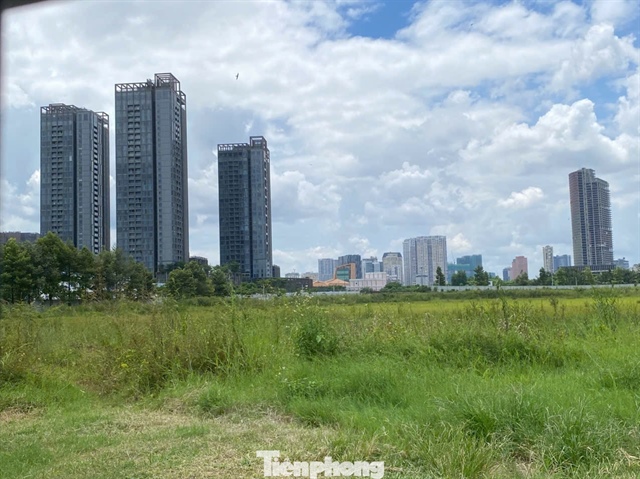
According to Mr. Duong, this regulation, once enacted, will unlock hundreds of housing projects stalled due to land use fee issues. Tens of thousands of apartments and land plots will receive certificates, boosting socio-economic development and protecting citizens’ legitimate rights.
Over 8-Fold Increase
Previously, the Ho Chi Minh City People’s Council approved a resolution establishing the land price table, effective from January 1, 2026, across Ho Chi Minh City. This table, constructed under the 2024 Land Law, adjusts to market principles and replaces older tables valid until 2025.
 |
Residential land prices have increased in most areas compared to current local tables, but the extent varies. Central areas of the former Ho Chi Minh City saw modest increases, while rapidly developing urban areas in Binh Duong and Ba Ria – Vung Tau experienced significant rises.
In the former Ho Chi Minh City area, residential land prices are adjusted by a factor of 1 to 1.65 times the 2024 price table. The highest price, approximately 687 million VND/m², is found on central streets like Dong Khoi, Nguyen Hue, and Le Loi, nearly unchanged from the current table. The lowest price, around 2.3 million VND/m², is in the Thiềng Liềng residential area.
According to the new price table, apart from a few streets with a maximum 1.65-fold increase, most areas remain stable or see minor increases (around 2%), with some production land prices decreasing to encourage investment.
The Ho Chi Minh City People’s Committee noted that the modest increases in this area are due to recent price table adjustments aligning more closely with market values. Maintaining moderate increases aims to minimize impacts on living costs, financial obligations, and business operations in the urban core.
Meanwhile, the former Binh Duong area recorded the highest land price increases among the three pre-merger localities, with residential land prices rising by a factor of 1 to over 8 times the 2024 price table.
The highest residential land price in the former Binh Duong area is 89.6 million VND/m² (on Bac Si Yersin and Bach Dang streets). The lowest is 1.3 million VND/m² (on DH.722 and Minh Tan – Long Hoa streets).
The highest increase, over 8-fold, is on DH.505 Street, from Cau Le Trang to DH.507, with the new price set at 6.3 million VND/m², up from 780,000 VND/m² in the current table. Commercial and service land on the same street increased by about 4 times, while production land rose nearly 3.8 times.
Binh Duong’s current price table, before the merger, still significantly lags market prices. Surveys show actual transaction prices can be over 13 times the old table, complicating compensation and financial obligations. In contrast, the former Ho Chi Minh City has made multiple recent adjustments, leaving limited room for further increases.
 |
In the former Ba Ria – Vung Tau area (Zone III in the new table), residential land prices also increased significantly, by a factor of 1.7 to over 4 times, though less than in the former Binh Duong area.
The highest residential land price in this area is 149.48 million VND/m², applied to central Vung Tau coastal streets, notably Thùy Vân Street. This key tourism and service hub is densely packed with hotels, resorts, and commercial businesses.
The lowest residential land price in the former Ba Ria – Vung Tau area ranges from a few million VND/m², mainly in remote rural areas or streets with incomplete technical infrastructure. These prices are significantly lower than in central Vung Tau and many urban areas of the former Binh Duong.
The Ho Chi Minh City People’s Committee noted that adjusting land prices in Vung Tau aims to narrow the gap between state prices and actual market values, especially in coastal areas where prices have risen rapidly in recent years.
However, as pre-merger land prices in this locality were already moderate to high, the adjustment range is not as dramatic as in the former Binh Duong area.
Duy Quang
– 11:29 06/01/2026
Evenings in Ho Chi Minh City Offices: VPBank Outshines Hotels with Late Lights, Viettel Bustles Past 8 PM, CJ Employees Clock Out on Time

As the city lights dim in most neighborhoods, the heart of Ho Chi Minh City awakens for its “second shift.” While some remain glued to their computer screens late into the night, others leave their offices to immerse themselves in the vibrant streets that never sleep. The evening hours offer a vivid glimpse into how professionals balance the pressures of work with the joys of leisure.
Can the $4.3 Billion Flood Control Project Meet Its 2026 Deadline Following the Deputy Prime Minister’s Directive?
Launched in 2016, the tidal defense project, with a total investment of nearly 10 trillion VND, awaits resolution of key challenges to meet its 2026 completion target.
Record-Breaking Revenue: Ho Chi Minh City and Hanoi Generate Nearly 5 Trillion VND in Just 4 Days

Unparalleled growth defines Hanoi’s trajectory, with a staggering 254% surge compared to the same period last year.
Unveiling Vietnam’s Most Modern Coastal Highway: Vingroup’s Exclusive 1-0-2 Signature Blend

This project stands as an unparalleled masterpiece, unlike anything Vietnam has ever witnessed.
Ho Chi Minh City Plans to Construct a New 26-Story Political and Administrative Center in Thu Thiem

The Ho Chi Minh City People’s Committee has proposed a multi-functional, sustainable infrastructure design for the new Political and Administrative Center, featuring a 26-story arch-shaped structure.