















Vietnam’s Ministry of Industry and Trade has submitted the third draft of a decree to the Ministry of Justice for review. This decree aims to amend and supplement several articles of Decree 57/2025 on direct electricity trading mechanisms and Decree 58/2025, which details the Electricity Law concerning renewable energy and new energy development.
Selling Excess Electricity, Capped at 50%
Notably, in the third draft, the Ministry of Industry and Trade proposed amendments and additions to several provisions of Decree 58.
Specifically, regarding self-generated and self-consumed rooftop solar power, cases eligible to sell excess electricity as per the decree include: households using single-family homes; systems connected to the national grid at low voltage levels; installations in mountainous, border, and island areas with grids not yet interconnected to the national system.
Additionally, the Ministry proposed allowing self-generated and self-consumed rooftop solar power systems installed on public assets to sell excess electricity. However, such transactions must comply with regulations and align with the seller’s functions and duties.
Previously, in the second draft, the Ministry presented two options: the first disallowed selling excess electricity, while the second permitted it under National Assembly resolutions.
Excess electricity sales are based on agreements, capped at 50% of the output from rooftop solar systems, calculated by radiation intensity. This includes both directly generated power and stored energy, if applicable.
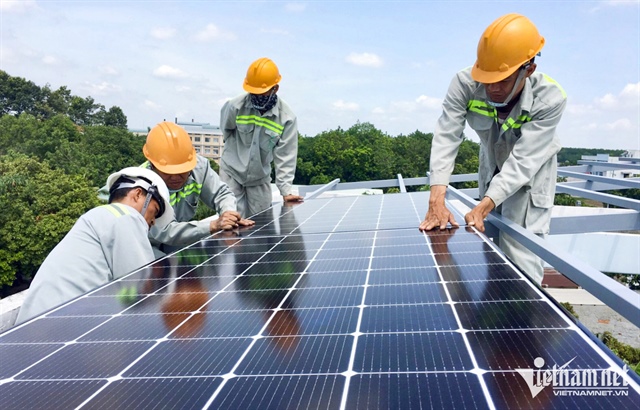
Households installing rooftop solar systems can sell excess electricity up to 50% of their output. Illustration: Bảo Kiên |
Increasing the excess electricity sale limit from 20% to 50% aims to encourage rooftop solar development until 2030, as outlined in the National Power Development Plan, the Ministry emphasized in its draft proposal.
Market-Based Pricing with a Cap
Excess electricity prices will reflect the average market rate from the previous year, as announced by the electricity market operator, but will not exceed the maximum price for ground-mounted solar power.
For mountainous, border, and island areas without access to the national grid, the Ministry proposed no limit on excess electricity purchases. Payment covers all electricity fed into the buyer’s grid, measured at the meter.
From the decree’s effective date until December 31, 2030, excess electricity sales can exceed 50% of rooftop solar system output based on radiation intensity.
Sellers must obtain an electricity operation license, unless exempt under regulations.
The draft also clarifies notification requirements for self-generated and self-consumed rooftop solar installations.
Organizations or individuals installing systems with a capacity of 100kW or more, not connected to the national grid, must notify the local commune-level People’s Committee. Notifications include: investor name, capacity, location, implementation timeline, and commissioning date.
Those installing rooftop solar systems connected to the national grid at low voltage levels must notify the local commune-level People’s Committee using the provided form.
Systems with a capacity below 1kW, based on the inverter’s capacity, are exempt from this requirement.
Organizations or individuals installing systems connected to the national grid at medium voltage or higher, without selling excess electricity, must notify the Department of Industry and Trade.
If excess electricity sales are registered, the commune-level People’s Committee must send an electronic copy of the notification to the Department of Industry and Trade within five days for management.
Upcoming Support Policies for Rooftop Solar Installations
The Ministry of Industry and Trade highlights that rooftop solar power is decentralized, requires no transmission grid investment, minimally impacts the national system, installs quickly, and meets local demand. Continued encouragement is needed to reduce grid strain and mitigate short- to medium-term power shortages.
Implementation of Decree 58 has revealed challenges in direct electricity trading for rooftop solar. Previously, in Document 5429 dated August 21, 2025, Vietnam Electricity (EVN) proposed increasing excess electricity purchases from rooftop solar during supply shortages.
The Ministry is urgently drafting a Prime Minister’s decision on support policies for households installing self-generated and self-consumed rooftop solar systems with storage for 2026-2030.
If approved, households will receive financial and technical support, driving significant growth in this sector.
Tâm An
– 20:46 07/01/2026
Vietnam’s 2026 Economic Forecast: Opportunities Are Here, Awaiting One Key Factor

Despite facing significant risks, particularly the potential for high U.S. tariffs, Vietnam’s economy sustained positive growth in 2025 and entered 2026 on a favorable footing. However, the greatest challenge lies in the capacity for effective implementation and execution.
Vietnam’s Smart Home Market Surges in 2025: Ecovacs and Tineco Dominate Sales

Ecovacs witnessed a remarkable 70% surge in sales, while Tineco’s products soared to an astonishing fourfold increase.
Prime Minister: The Financial Sector Deserves to Be a Loyal “Guardian of the Treasury,” a Sharp “Think Tank,” and a “Driver of Development,” Leading the Nation into an Era of Growth and Advancement

On the afternoon of January 6th, Prime Minister Pham Minh Chinh attended the 2025 financial sector year-end review conference in Hanoi. Organized by the Ministry of Finance, the event focused on summarizing achievements and outlining plans and directions for 2026.
Exciting News from Trung Nam

At a recent business update and 2026 strategy session, the conglomerate’s leadership announced plans for a robust relaunch of energy projects in 2026. Alongside this, they emphasized continued investment in critical infrastructure and active participation in major tenders.
Massive Offshore Oil Reserve Discovered in Vietnam: Over 430 Million Barrels Uncovered

This oil and gas field boasts an impressive daily production capacity of approximately 6,000 barrels of oil.