













In his opening remarks at the conference, Prime Minister Pham Minh Chinh noted that since the beginning of the term, Vietnam has been pursuing its 2025 socio-economic development goals and the 2021-2025 five-year plan amidst a rapidly changing and complex global landscape. Many challenges have been unprecedented and beyond forecasts, with obstacles often outweighing opportunities.
The prolonged impact of the COVID-19 pandemic, intensifying strategic competition among major powers, and escalating military conflicts worldwide have slowed global growth, investment, and trade. Inflation and public debt have surged in most countries compared to pre-pandemic levels, while many global supply chains remain disrupted. Financial and monetary risks have increased, alongside severe threats from traditional and non-traditional security issues, pandemics, natural disasters, and extreme climate change.
Domestically, Vietnam, as a developing nation with a low starting point and an economy in transition, has faced compounded external challenges. The nation has grappled with mounting routine and unexpected tasks, legacy limitations spanning multiple terms, and the need to reorganize governance at both central and local levels. Natural disasters and floods have inflicted heavy losses on production, business, and livelihoods.
Under the leadership of the Party Central Committee, directly guided by the Politburo and Secretariat, and led by General Secretary To Lam, the government has worked in tandem with the National Assembly and the entire political system. With active participation from the public, businesses, and international partners, the government has implemented decisive, synchronized, and effective measures, achieving significant milestones across all sectors.
According to the Ministry of Finance, Vietnam’s 2025 socio-economic performance is expected to meet its overarching goals and surpass 15 out of 15 key targets.
GDP growth accelerated quarter-on-quarter, reaching an estimated 8.02% for 2025, placing Vietnam among the world’s top performers. The average growth rate from 2021 to 2025 is approximately 6.3%, outpacing the previous period.
The manufacturing and processing sector grew by 9.97%, the highest rate between 2019 and 2025, remaining the primary growth driver.
Vietnam’s 2025 GDP is projected at USD 514 billion, climbing five positions to rank 32nd globally. Per capita GDP reached approximately USD 5,026, 1.4 times higher than in 2020, elevating Vietnam to the upper-middle-income group ahead of schedule.
Twenty out of 34 localities achieved GRDP growth rates of 8% or higher, with six—Quang Ninh, Hai Phong, Ninh Binh, Phu Tho, Bac Ninh, and Quang Ngai—recording double-digit growth.
Despite tax exemptions and extensions totaling VND 251 trillion, and global economic volatility, budget revenues exceeded estimates by VND 683 trillion, a highly positive outcome.
In 2025, the state budget allocated a record VND 1,080 trillion for development investment, ensuring increased public investment resources. Fiscal balances were maintained, with a deficit of approximately 3.6% of GDP (down from the planned 3.8%), and public debt at 35-36% of GDP, well below the 60% cap.
By year-end 2025, Vietnam completed 3,335 km of expressways (3,803 km including connectors and interchanges, exceeding the target by 803 km) and over 1,700 km of coastal roads (meeting the set goal).
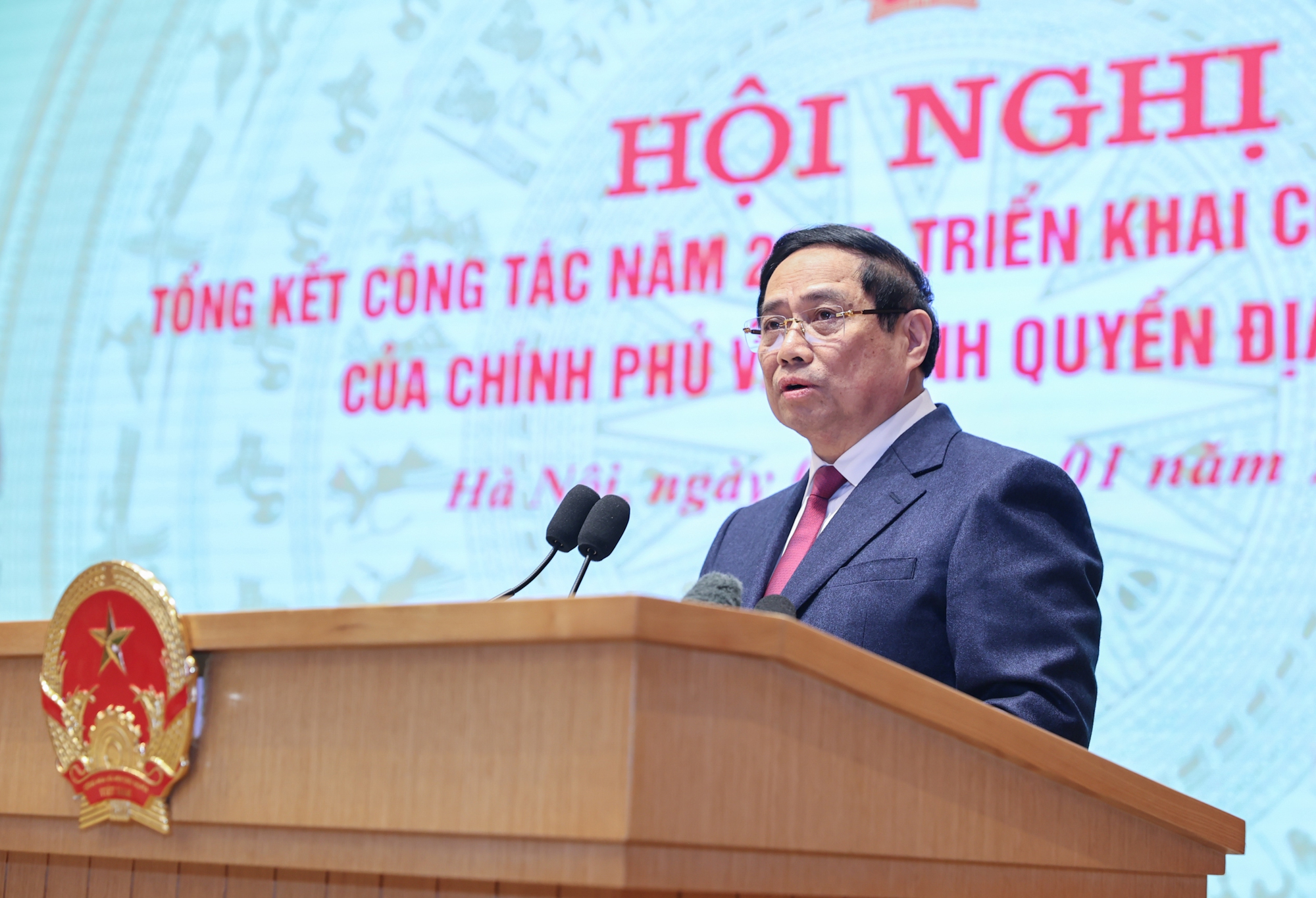
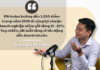
Prime Minister Pham Minh Chinh. Photo: VGP
Notably, 2025 saw an 8.02% economic growth rate, among the highest globally, while maintaining macroeconomic stability, controlling inflation, and ensuring economic balances. Budget deficits and public debt remained below mandated limits, with social welfare, national defense, and security strengthened. International integration and the nation’s global standing were enhanced.
Despite these achievements, challenges remain, including economic restructuring, growth quality improvement, technological and digital transformation, and green transition. Macroeconomic stability faces external pressures, while environmental pollution and traffic congestion persist. Cybersecurity, public order, and safety in some areas require continued attention.
5 Key Solutions for Double-Digit Growth
As Vietnam enters 2026—a year marked by the 14th Party Congress, National Assembly and People’s Council elections, and the launch of the 2026-2030 Socio-Economic Development Plan—the government anticipates intertwined challenges and opportunities in pursuing double-digit growth.
To achieve 2026 socio-economic and budget targets, the Ministry of Finance outlines five key solutions. Priorities include fostering growth while ensuring macroeconomic stability, controlling inflation, and maintaining economic balances, alongside enhancing policy forecasting and responsiveness.
Additional measures focus on institutional and legal reforms, innovative development thinking, creating new growth ecosystems, increasing state budget revenues, optimizing public resource use, and managing deficits and debt sustainably.