













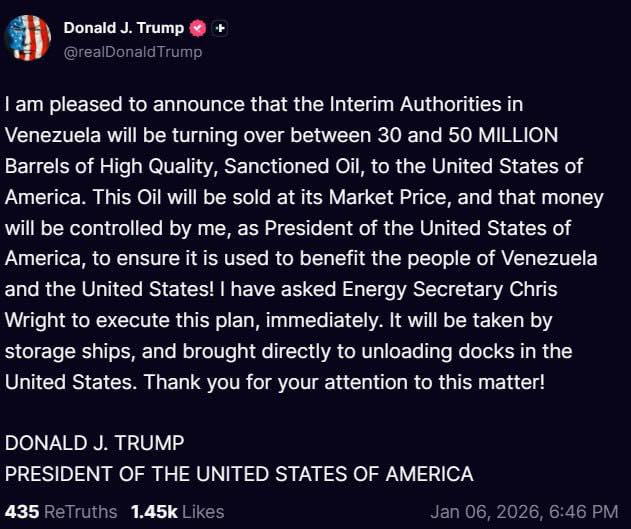
U.S. President Donald Trump unexpectedly announced a major oil deal between Washington and Venezuela’s interim government on January 6th.
“I am pleased to announce that Venezuela’s interim government will transfer 30 to 50 million barrels of high-quality, sanctioned oil to the U.S.,” President Donald Trump wrote on the social media platform Truth Social.
According to President Trump, this oil will be sold at market prices, and the proceeds will be under the direct control of the White House. “The funds will be managed by me, as the President of the United States, to ensure they benefit both the Venezuelan and American people,” he added.
The U.S. leader stated that he has instructed Energy Secretary Chris Wright to “implement this plan immediately.” President Trump confirmed that “the oil will be transported by tankers and delivered directly to ports in the U.S.”
Reuters reports that senior U.S. government officials and the Caracas administration have held private discussions about the potential export of Venezuelan crude oil to U.S. refineries. Citing five sources from government, the oil industry, and maritime sectors, Reuters suggests this agreement could significantly alter global oil flows.
Specifically, Venezuela’s oil supply is likely to be redirected from China, its major customer in recent times, while helping Venezuela’s state-owned oil company, PDVSA, avoid deeper production cuts amid tightening sanctions.
Currently, Venezuela has millions of barrels of oil stored in tankers and storage facilities, unable to be exported due to the embargo imposed by President Trump in mid-December last year.
Before the energy sanctions, U.S. refineries imported approximately 500,000 barrels of Venezuelan oil daily. Notably, many U.S. refineries are still equipped to efficiently process heavy crude oil, a characteristic of Venezuelan oil, making it particularly suitable for the U.S. refining system.
Reuters also reports that President Donald Trump is scheduled to meet with leaders of major oil companies at the White House this weekend to discuss strategies for reviving Venezuela’s oil industry, which has been severely weakened by years of underinvestment, mismanagement, and sanctions. The country holds an estimated 303 billion barrels of proven oil reserves, the largest in the world.
Previously, President Trump declared that Washington would take control of Venezuela’s vast oil reserves and attract billions in U.S. investment to rebuild the devastated oil sector.
President Trump emphasized that his administration is willing to work with the remaining Venezuelan leadership, provided that Washington’s strategic objectives are met, including opening the oil sector to U.S. investment.
U.S. Commerce Secretary Howard Lutnick also highlighted Venezuela’s resource potential, noting its significant untapped reserves of steel, aluminum, and other critical minerals. “Venezuela was once one of the world’s greatest economies and cultures, and it has been destroyed. Now, President Trump will restore it,” Lutnick stated.
Reflecting on a Year of Trade Tensions
Following the initial shock, Vietnam and other Asian export nations steadily moved toward trade agreements with the U.S. administration. Meanwhile, export activities continued to grow.
Trump Warns of Tariff Hike on Asia’s Rice Export Giant: Already Taxed at 53%, Second-Largest Supplier to the U.S.

The United States has accused this nation of dumping rice into the American market at unfairly low prices.
After India, Russia’s Second-Largest Oil Buyer Slashes Imports: Daily Output Drops by Hundreds of Thousands of Barrels, Shifting Purchases to Kazakhstan, Iraq
Once the largest buyer of Russian oil following Europe’s halt on crude oil purchases from Moscow, this entity has significantly reshaped global energy dynamics.
India Secures Another Massive Discount on Russian Oil as Moscow Pledges to Boost Supplies: What’s Behind the Deal?
India is currently purchasing Russian oil at a significant discount, approximately $5 per barrel below the Brent crude benchmark.
Global Energy Titan Launches Fleet to Secure Over 70 Million Tons of Russian Gas in 2024

Despite U.S. sanctions, Russian LNG continues to find a warm reception in the world’s most coveted market.