















Ho Chi Minh City has approved a groundbreaking plan to adjust the infrastructure blueprint for a direct road link between Can Gio and Vung Tau. This innovative project will employ a complex technical solution, incorporating both an offshore bridge and an underwater tunnel to navigate shipping lanes, promising to significantly reduce travel time between the two locations.
Specifically, on the morning of January 7th, during the 3rd Conference of the Ho Chi Minh City Party Committee, the adjusted planning for the sea-crossing road project connecting Can Gio and Vung Tau under a public-private partnership (PPP) model, using a BT contract type, was officially approved. This marks a crucial step toward realizing the vision of connecting the Southern Key Economic Region.

AI-generated illustration of the future sea-crossing road connecting Can Gio and Vung Tau
Addressing Overburdened Transportation Infrastructure
In his concluding remarks at the conference, Secretary of the Ho Chi Minh City Party Committee Tran Luu Quang highlighted the limitations of the current transportation network. Following administrative boundary adjustments, the demand for connectivity between Ho Chi Minh City’s center and the Ba Ria – Vung Tau region has surged.
However, current travel relies heavily on the Long Thanh – Dau Giay Expressway (passing through Dong Nai). This route frequently experiences severe congestion, and the considerable distance makes it challenging for residents and businesses to manage their time effectively.
Given these challenges, city leaders emphasized the urgent need for a new direct connection. While road options through the Nha Be area were considered, they were deemed unfeasible due to significant planning obstacles, high land clearance costs, and incompatibility with the city’s vision for developing Can Gio as a maritime urban space.
Technical Breakthrough: Submerged Tunnel Instead of Elevated Bridge

AI-generated illustration of the future underwater tunnel connecting Can Gio and Vung Tau
According to Secretary Tran Luu Quang, the straight-line distance from Can Gio to the Bai Truoc and Bai Sau areas in Vung Tau is only about 13-14 km. Leveraging this advantage, Ho Chi Minh City has collaborated with strategic investors and reached a high consensus on the sea-crossing road project.
The project is planned with a scale of 6 lanes, starting from the Can Gio reclaimed urban area. Its most distinctive feature lies in its technical design solution. Instead of constructing a bridge with a very high clearance for shipping (approximately 60m), which poses significant construction challenges, the project will adopt a hybrid model.
Specifically, the route will consist of two main components: conventional sea-crossing sections will use bridge structures, while critical shipping lanes will transition to an underwater tunnel.
The tunnel segment will employ a technique similar to the immersed tunnel technology successfully implemented in the Saigon River Tunnel (Thu Thiem Tunnel). To facilitate the construction of this complex tunnel, two artificial islands will be created on either side of the shipping lane.
Unlocking Maritime Economic Potential, Reducing Travel Time to 1 Hour
This road project not only addresses transportation challenges but also holds strategic significance in connecting the maritime economic space. Both Can Gio and Ba Ria – Vung Tau possess immense potential in tourism, logistics, and port industries, but the lack of direct road connectivity has hindered their mutual development.
As the city’s development space expands, the need for enhanced regional connectivity becomes more urgent than ever.
According to preliminary estimates from investors, the project’s construction is expected to take approximately 3 years. Once this “mega-project” is completed and operational, travel time by car from central Ho Chi Minh City to Vung Tau is projected to be reduced to a record-breaking one hour.
To ensure the project’s effectiveness, Ho Chi Minh City is also implementing synchronized infrastructure upgrades in the Can Gio area, including key projects such as expanding the Rung Sac Road and constructing the new Can Gio Bridge to replace the Binh Khanh Ferry.
Previously, Vingroup proposed a 14 km sea-crossing route between Can Gio and Vung Tau, comprising bridges, tunnels, and access roads, with a total investment of over 104 trillion VND. The route begins at Bien Dong 2 Road (Can Gio reclaimed urban area), connects to Mai Sao – Ben Dinh Road, and intersects with 30/4 Road in Vung Tau.
The entire route includes approximately 3.1 km of tunnel, nearly 8 km of bridge, and about 3 km of access road, heading southeast and crossing the Ghenh Rai Bay. The project requires approximately 137.5 hectares of land; the investor will provide all capital, and the government will compensate with land under the BT model.
Ho Chi Minh City Plans to Construct a New 26-Story Political and Administrative Center in Thu Thiem

The Ho Chi Minh City People’s Committee has proposed a multi-functional, sustainable infrastructure design for the new Political and Administrative Center, featuring a 26-story arch-shaped structure.
Ho Chi Minh City Targets 10% Growth
In 2026, to secure double-digit growth, Ho Chi Minh City has crafted an ambitious plan targeting growth exceeding 10%.
Unveiling Vietnam’s Top 5 Economic Powerhouses Driving Over 50% of GDP Growth in 2025
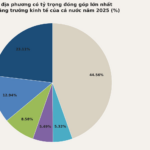
According to the General Statistics Office (Ministry of Finance), these five localities have contributed a staggering 55.4% to the nation’s overall growth.
New Momentum at Le Méridien Saigon

In October 2025, Royal Canary JSC, the developer of Le Méridien Saigon at 3C Ton Duc Thang, Saigon Ward, increased its chartered capital from approximately VND 2,654 billion to nearly VND 3,210 billion, entirely funded by domestic private capital.
Prime 1km Stretch in Ho Chi Minh City’s Core: High Demand for Rental Spaces
Nestled in the heart of Thanh My Tay, Ho Chi Minh City, Nguyen Gia Tri Street, though a mere kilometer long, stands as a vibrant hub in the rental market. Its prime location, offering seamless connectivity, coupled with competitive rental rates and a steady influx of students and young professionals, makes it a sought-after destination for businesses seeking prime storefronts.