









In July 2022, China officially granted Vietnam permission to export durian. Two months later, the first batch of Vietnamese durians was shipped to China. Since then, Vietnam’s durian industry has rapidly grown into a billion-dollar sector, competing fiercely with Thailand for the top spot in China’s durian market.
Impressive Figures
Thai durians have dominated China’s import market since 2005, but this position is increasingly under threat as China has opened its doors to durian imports from Vietnam, Malaysia, the Philippines, Cambodia, and most recently, Laos.
According to the Import-Export Department (Ministry of Industry and Trade), data from China Customs reveals that in the first 11 months of 2025, China spent nearly $7.2 billion importing over 1.79 million tons of durians from Southeast Asian countries, marking a 17.2% increase in volume and a 5% rise in value compared to the same period in 2024.
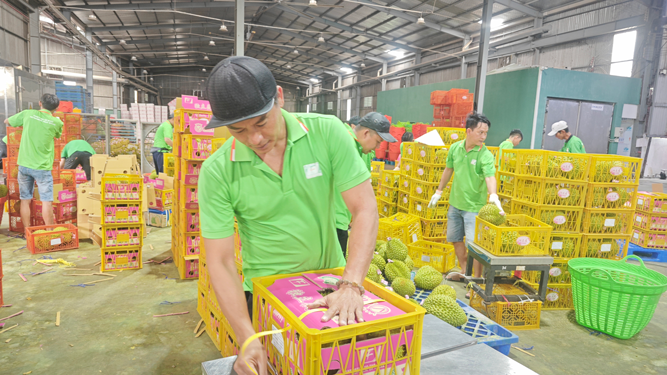
Packaging durians for export
Thailand remains the largest durian supplier to China, with over 903,000 tons valued at $3.9 billion. Vietnam follows closely as the second-largest supplier, exporting 884,600 tons worth over $3.24 billion.
In terms of market share, Vietnam holds 49% in volume and 45% in value, while Thailand accounts for 50.4% in volume and 54.4% in value.
The Import-Export Department reports that China’s durian imports from Vietnam grew more significantly than those from Thailand, with a 22.8% increase in volume and a 13.1% rise in value compared to the same period in 2024.
During this time, the proportion of Vietnamese durians in China’s total fresh durian imports also increased to 49.3%, up from 47% in the same period in 2024. “Moving forward, maintaining Vietnam’s market share will heavily depend on quality control, residue management, and supply stability,” the department noted.
Recently, Thai media predicted that Vietnamese durians could surpass Thai durians in the Chinese market within the next three years. Mr. Dang Phuoc Nguyen, Secretary-General of the Vietnam Fruit and Vegetable Association (VINAFRUIT), emphasized that the most critical factor for Vietnamese durians is strengthening internal capabilities, as external factors already favor Vietnam over its competitors.
“Vietnam’s proximity to China allows for faster transportation, ensuring fresher durians, which is a significant advantage. This year, Thailand faced additional challenges in transporting durians to China due to border tensions with Cambodia. Meanwhile, Vietnam is set to open the North-South expressway, reducing transportation time, and its cold storage systems are becoming increasingly advanced,” Mr. Nguyen explained.
Mr. Nguyen also noted that competitors are enhancing deep processing of durians to overcome logistical disadvantages when exporting to China.
Focusing on Quality
Mr. Le Anh Trung, Chairman of the Durian Association of Dak Lak Province—the largest durian-growing region in Vietnam with 45,000 hectares, accounting for 25% of the country’s total—recently conducted a survey in China and found immense market potential. “If 300 million affluent Chinese consumers each eat four durians annually, China would need to import up to 6 million tons per year, triple the current amount,” Mr. Trung estimated.
According to Mr. Trung, Vietnam’s durian industry has experienced rapid growth over the past four years, primarily driven by Chinese businesses’ confidence in the quality of Vietnamese durians, which has spurred industry-wide demand.
“From our survey, we observed that while Thai durians may not match Vietnamese durians in appearance, they excel in quality, particularly in sweetness and flesh color. It’s time for Vietnam’s durian industry to shift from competing on quantity and price to competing on quality,” Mr. Trung stated.
The Chairman of the Durian Association of Dak Lak Province proposed standardizing and managing the entire supply chain as the essential path to sustainable industry development.
Mr. Trung mentioned that in Krong Pak, a renowned durian-growing area in Dak Lak, a model for controlling durian quality throughout the supply chain has been implemented under local government supervision, covering pre-harvest, harvest, and post-harvest stages.
This approach not only meets current market requirements but also prepares for future demands, especially regarding pesticide residue limits. The model will soon be expanded to other key durian-growing areas in Dak Lak.
From a farmer’s perspective, Ms. Nguyen Thi Thinh, Director of Tan Phu Agricultural Cooperative (Vinh Long), noted that durians remain the most economically efficient crop in the region, despite reduced profits compared to previous years.
According to Ms. Thinh, last year, the farmgate price of Ri6 durians was around VND 130,000 per kg, but it has now dropped to approximately VND 50,000 per kg. “The durian market’s price volatility is difficult to predict, causing farmers anxiety. Farmers are striving to apply science and technology to reduce costs and maintain profits amid falling durian prices,” Ms. Thinh said.
Ms. Thinh also emphasized the importance of regulatory bodies ensuring the quality of agricultural inputs, allowing farmers to use them confidently without worrying about chemical residues and ensuring their health.
China Accounts for Nearly 95% of the Market
According to the Import-Export Department’s report, durian exports in the first 11 months of 2025 reached $3.65 billion, a 16.8% increase compared to the same period in 2024. China remains the primary market, accounting for 94.54% of total durian export revenue, with $3.45 billion, up 21.4% from the same period in 2025.
The Chairman of the Durian Association of Dak Lak Province noted that while efforts have been made to develop additional markets beyond China, the results have been limited, prompting businesses to focus on this key market.
Durian exports to markets like Europe and the Americas primarily serve the overseas Chinese community and other Asian populations. Western consumers are still unfamiliar with the unique flavor and aroma of durians, resulting in limited consumption. “We have also promoted durians in India, but the potential is modest, with annual import turnover not exceeding $1 million,” Mr. Trung added.
Vietnamese Durian Exports Plummeted 69.4% Due to Cadmium Barriers, But Bầu Đức Reveals Ace: 1,600 Ha in Laos and 20,000 m² Cold Storage for Frozen Durian, Aiming for 50% Higher Off-Season Prices
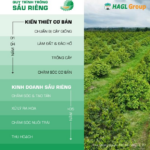
HAGL is strategically expanding its durian segment into a new core business pillar, focusing on a freezing strategy to command premium pricing and leveraging advanced Thai technology.
Exposing the Counterfeit Durian Ring: The Industry’s Plea to Untangle Quality Testing Bottlenecks
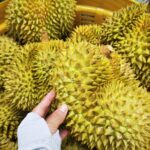
To ensure sustainable durian exports, it is crucial to enhance testing capabilities, prioritize transparency, and reduce costs.
China Spends Nearly $1 Billion on Vietnamese Durian in a Single Month
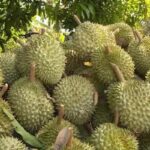
In September, China spent nearly $1 billion importing Vietnamese durians, marking a 67.7% surge compared to the previous month and accounting for a staggering 93.6% of the total export value for this product.
The Homeland of Musang King: Vietnam Imports Durian for Domestic Consumption
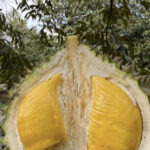
Malaysia, renowned for its prized “King of Durian” Musang King, also imports durians from Vietnam to meet domestic demand.
Southeast Asia’s Durian Powerhouse Reveals Only 10% Profit Due to Thai Middlemen, Plans Direct Exports to China
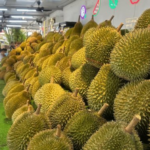
In 2024, the country successfully exported approximately 600 tons of durian to the Chinese market.