

















Vietnam’s Electric Vehicle Revolution: A Regional Phenomenon
According to the latest report from PwC Vietnam, released on January 9, 2026, Vietnam is emerging as a standout player in the ASEAN region, boasting an unprecedented rate of automotive electrification that outpaces many of its neighbors.
While Singapore maintains its lead as the most mature electric vehicle (EV) market in the region, Vietnam is experiencing an electrifying surge at an unparalleled pace.
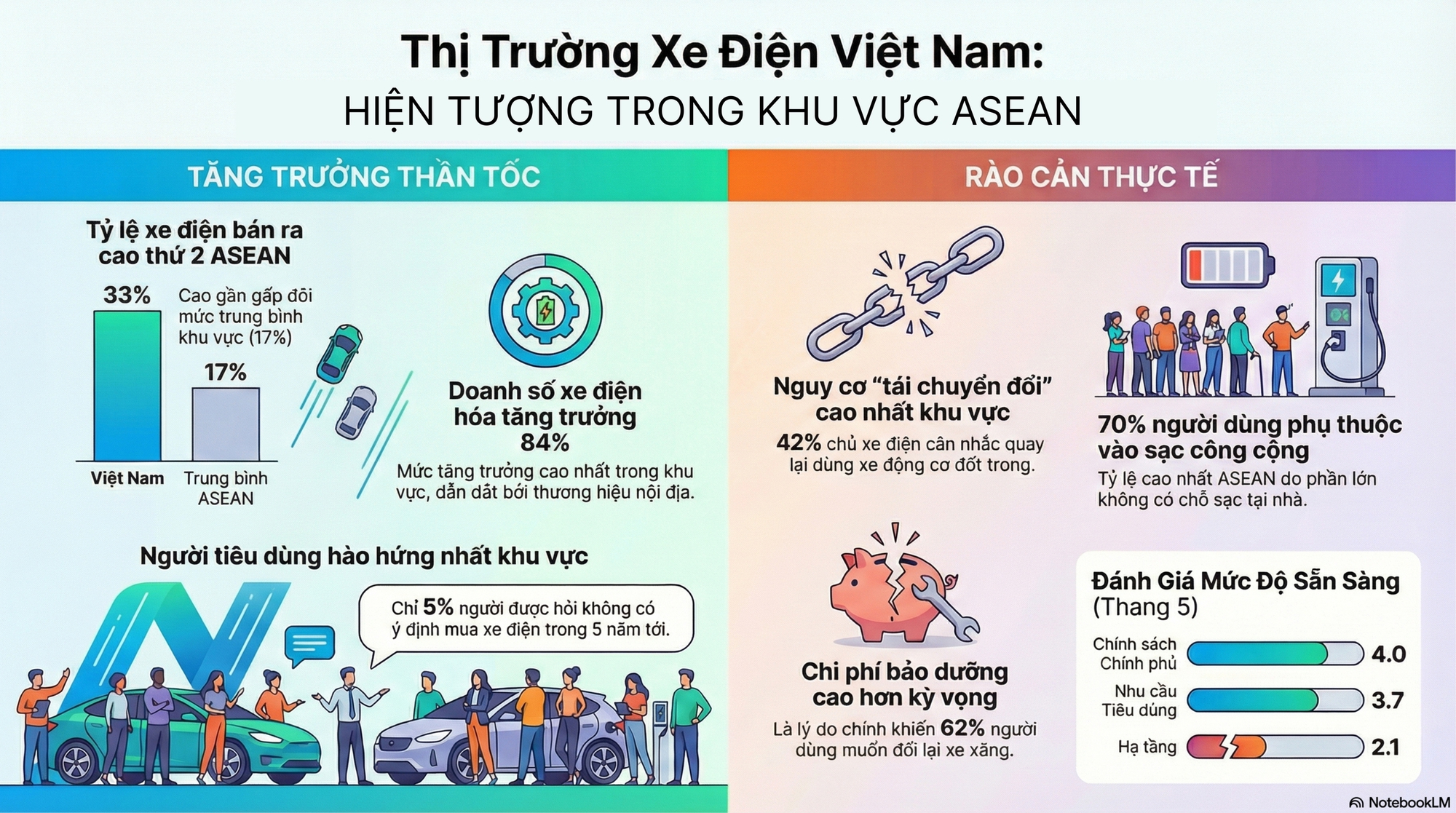
By Q3 2025, EV sales in Vietnam soared by an impressive 84%, contributing to EVs accounting for 33% of total vehicle sales in the domestic market. This figure is not only double the average of 17% across the six surveyed ASEAN countries but also positions Vietnam as the second-highest EV adopter in the bloc, trailing only Singapore and surpassing major markets like Thailand, Indonesia, and the Philippines.
This remarkable growth is fueled by a combination of government incentives and the strength of domestic brands. Vietnam scores high on the policy support index (4.0/5.0), thanks to aggressive measures such as a 100% exemption on registration fees for EVs until 2027.
Simultaneously, VinFast has risen to become the leading EV brand in ASEAN, with sales surging from 56,000 units in Q3 2024 to over 100,000 units in Q3 2025, primarily driven by robust domestic demand. Vietnamese consumers are also the most positive about EVs in the region, with 15% already owning an EV—the highest rate in ASEAN—and only 5% indicating no intention to purchase one in the next five years.
Challenges Ahead: Infrastructure and Post-Purchase Experience
However, Vietnam’s EV market faces a critical juncture as post-purchase experiences and infrastructure lag behind its ambitious goals. The country’s infrastructure score remains low at 2.1/5.0, below both Thailand and Singapore. With most EV owners lacking home charging options, 70% rely on public charging networks at offices or shopping centers—the highest dependency rate in the region. Concerns over range, battery life, and long charging times remain significant barriers to long-term growth.
To sustain momentum, enhancing ownership experiences and developing charging stations that meet expectations for charging speed (around 35.7 minutes) and range (over 387.5 km) are imperative.
According to Patrick Ziechmann, Leader of the ASEAN Automotive Center of Competence at PwC, Vietnam’s EV market is accelerating at a breathtaking pace. “No other ASEAN market is witnessing such rapid growth, driven by strong domestic manufacturing. However, Vietnam is at a crossroads: consumer enthusiasm is high, but infrastructure and ownership experiences need improvement to sustain this momentum. The next phase of growth will depend on how quickly stakeholders bridge the gap between ambition and reality,” Ziechmann noted.
Urgent Development: Cat Lai and Long Hung Bridges; CC1 CEO Announces 100 Million Shares Issued at VND 11,100 per Share

At an extraordinary shareholders’ meeting on the morning of January 9th, the leadership of Construction Corporation No. 1 (UPCoM: CC1) focused on plans to develop two bridges connecting Ho Chi Minh City with Dong Nai Province. Additionally, they outlined a private placement proposal to issue 100 million shares at a price of 11,100 VND per share.
Secretary-General Tô Lâm Signs Politburo Resolution on State Economic Development

Resolution No. 79-NQ/TW, dated January 6, 2026, emphasizes that the state-owned economy is a critically important component of the socialist-oriented market economy. By 2030, Vietnam aims to have 50 state-owned enterprises among the 500 largest companies in Southeast Asia and 1-3 state-owned enterprises among the 500 largest companies globally.
“Real Estate to Receive Unique Identification Codes: A ‘Steel Shield’ to Curb Speculation and Enhance Market Transparency”

Assigning unique identifiers to real estate properties is a pivotal step in the digital transformation of the housing sector and the real estate market, aligning seamlessly with modern management requirements.
Prime Real Estate with Complete Legal Framework Attracts Year-End Remittances

By the end of 2025, Vietnam solidifies its reputation as a secure haven for remittance flows, driven by its stable economic growth, increasingly transparent legal frameworks, and the sustained recovery of its real estate market.
Cà Ná: The Urban Development Equation Linked to Economic Infrastructure and Logistics Operations

As numerous transportation infrastructure, seaport, and industrial projects in the South Central Coast region enter their operational phase by 2025, the coastal real estate market is poised for a distinct polarization.