









As 2025 drew to a close, the global economy faced sluggish growth, persistent inflation, and prolonged geopolitical instability, placing significant pressure on domestic governance. This year marked the final term of the administration and the inaugural year of the fully established Government Party Committee.
The emergence of the Government Party Committee signifies a fundamental shift in leadership methodology. Departing from the previous decentralized model, the Party’s direct and comprehensive leadership over the Government is now more clearly defined, with heightened expectations for discipline, accountability, and efficiency.
In this context, the imperative for a “state transition” became a recurring theme.
The old state was characterized by a cumbersome bureaucracy, institutional bottlenecks, prolonged project backlogs, slow infrastructure progress, and limited policy flexibility due to an unfavorable international environment.
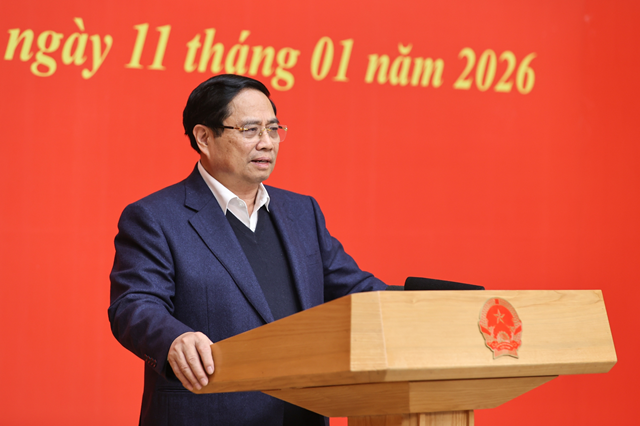
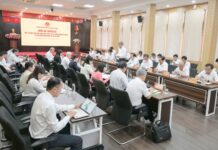
Prime Minister Pham Minh Chinh addresses the 2025 Year-End Review Conference, outlining directions and tasks for 2026 – Photo: VGP/Nhat Bac
|
The new state is defined by organizational restructuring, expedited policy decisions, and localized action implementation.
In its first year of operation, the Government Party Committee prepared and submitted 154 out of 160 proposals to the Politburo and Secretariat, the highest number in a single term. These included major resolutions and initiatives on institutional frameworks, legislation, and the resolution of long-standing issues.
Concurrently, a reorganization of the administrative apparatus was undertaken. The review of Resolution 18-NQ/TW, amendments to the Law on Government Organization and the Law on Local Government Organization, and the accelerated implementation of the two-tier local government model have brought about significant operational changes.
This “turnaround” is evident in socio-economic management.
In 2025, GDP growth reached 8.02%, among the highest in the region and globally despite widespread challenges. The economy’s scale hit approximately 514 billion USD, with per capita GDP surpassing 5,000 USD. Trade maintained its upward trajectory, marking the 10th consecutive year of surplus. Budget revenues exceeded projections, while deficits and public debt remained under control.
Infrastructure investment emerged as a key highlight of the new governance state. Nationwide, 564 major projects with a total capital of over 5 million billion VND were launched and inaugurated. The North-South Expressway was substantially completed, Phase 1 of Long Thanh International Airport’s construction was finalized, and several energy and power transmission projects were completed ahead of schedule.
These figures not only reflect investment scale but also demonstrate accelerated execution and improved implementation strategies.
Alongside physical infrastructure, institutional and technological frameworks were elevated. In 2025, groundbreaking resolutions on science and technology, innovation, private sector development, and international integration were enacted. The semiconductor strategy, strategic technology lists, and high-quality workforce training programs for emerging industries were rolled out simultaneously.
As a result, Vietnam’s rankings in innovation, AI, and startup ecosystems continued to improve, expanding opportunities for future development.
Concluding the conference, Prime Minister Pham Minh Chinh emphasized that the state transition involves not just procedural changes but a shift in governance mindset. Amid more challenges than opportunities, maintaining macroeconomic stability and achieving high growth have bolstered confidence among citizens, businesses, and domestic and foreign investors.
This confidence is considered the most significant outcome of the turnaround.
As 2026 begins, the demand for state transition intensifies. This marks the start of a new term, aligned with the implementation of the 14th Party Congress resolutions and long-term strategic goals.
The Government aims for GDP growth of 10% or higher and per capita GDP of 5,400-5,500 USD, while establishing a new growth model centered on science, technology, innovation, and digital transformation.
According to the Prime Minister, the upcoming phase’s core focus is the continued realization of strategic vision and autonomy, guided by five key pillars: institutional refinement, resource mobilization, infrastructure investment, technological advancement, and strategic balance.
Immediately following the conference, party committees and organizations at all levels were urged to swiftly translate tasks into action, minimize policy delays, and maintain momentum from the start of the term.
The state transition, therefore, extends beyond 2025, serving as the foundation for the Government to enter a phase of higher expectations, faster pace, and greater pressure in the years ahead.
– 16:00 11/01/2026
Sustainable Business Quality: The Cornerstone of a Robust Stock Market

This is the insight shared by Mr. Nguyễn Hoàng Tùng, Director of the Southern Branch of Agribank Securities Company (Agriseco), as he forecasts the outlook for the stock market in 2026.
“Stocks ‘Cheap by the Crowd, Expensive by the Index’: Brokerages Highlight Key Investment Opportunities for 2026”
Leveraging the synergy between anticipated foreign capital inflows and supportive domestic fiscal policies, VDSC identifies three pivotal investment themes for 2026.
Vietnam’s GDP Projected to Hit $514 Billion by 2025, Poised to Surpass Singapore and Thailand, Experts Forecast

The latest report from the Statistics Bureau on the socio-economic landscape reveals that Vietnam’s GDP at current prices is projected to reach 12,847.6 trillion VND in 2025, equivalent to $514 billion. This marks a significant $38 billion increase from 2024, when the GDP stood at $476 billion.
Currency Exchange Outlets in Ho Chi Minh City Remain Inactive Ahead of Deadline

In recent days, numerous gold shops and currency exchange outlets in Ho Chi Minh City, as well as online marketplaces, have predominantly focused on buying rather than selling.
Real Estate 2026: Surging Supply, Cooling Prices

With over 1,000 projects unlocked, nearly 580,000 successful transactions in 2025, record-breaking credit, and accelerated public investment, the real estate market is entering a pivotal phase on the cusp of a new growth cycle.